
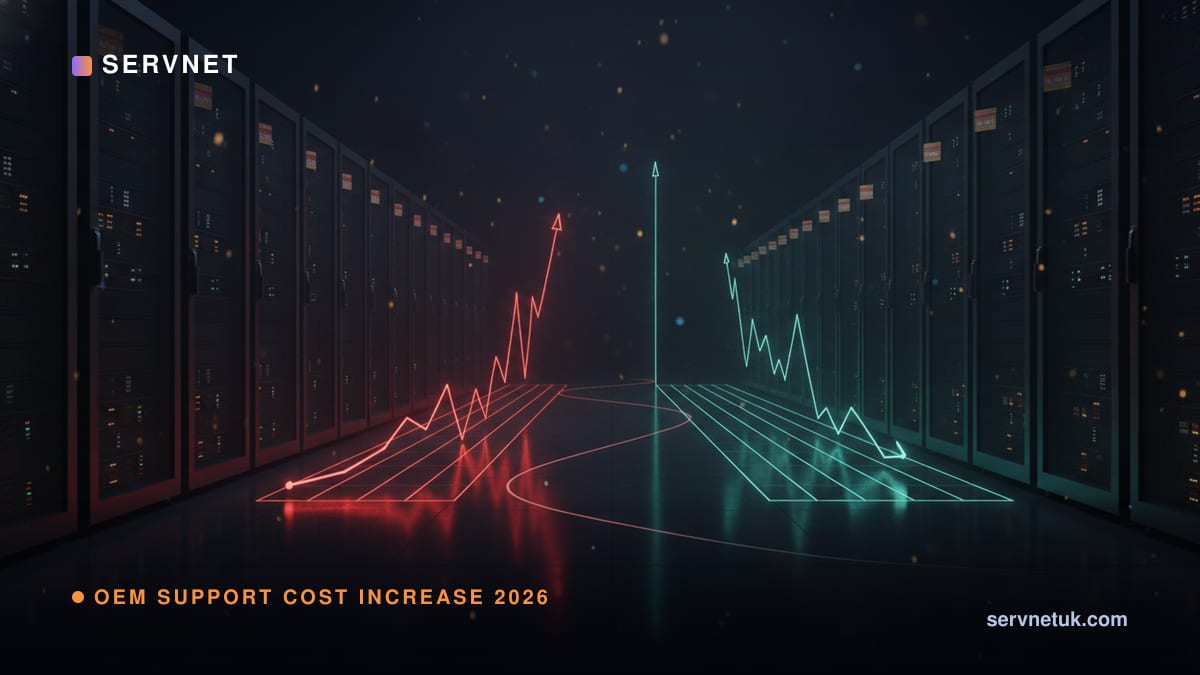
A January 2026 market note recorded roughly 15% system-wide OEM price increases on enterprise servers from Dell, HP, Lenovo and HPE in Q1 alone — while typical vendor support contracts still assume a 'standard' 3% to 6% annual escalation. That gap is where UK renewal-shock lives. This tracker pulls together the verified 2026 figures on OEM hardware pricing, support-contract escalation, and third-party maintenance costs, sets them against each other with their exact scopes intact, and works through a UK renewal-versus-switch comparison so IT leaders can benchmark before, not after, the invoice lands.
View the data behind this chart
| Mac mini | iPad / iPad mini | Mac Pro | 13-inch iPad Pro | |
|---|---|---|---|---|
| Monthly price | $/month4.49 | $/month5.99 | $/month18.49 | $/month11.99 |
The 2026 Reality: A Patchwork of Increases, Not One Number
There is no single, universal 'OEM support price rise' for 2026. Instead there is a patchwork of confirmed increases sitting across different layers of the stack, and UK buyers are the ones left reconciling them at renewal time.
On the enterprise hardware side, a January 2026 market note on the server-hardware sector recorded that Dell, HP, Lenovo and HPE had implemented system-wide price increases of approximately 15% for enterprise servers in Q1 2026 alone. A separate January 2026 analysis of IT hardware pricing put the broader picture at 15% to 20% across the board, with lead times stretching from weeks to months as supply tightened.
Layered on top of these hardware increases sits the contract itself. According to 2026 guidance on OEM IT maintenance contracts, vendor agreements commonly build in annual price-escalation clauses of 3% to 6% per year — a baseline uplift that applies regardless of what is happening to component costs. When hardware list prices are climbing by double digits, as they did in Q1 2026, that 'standard' 3–6% escalation figure looks conservative rather than protective.
Meanwhile, in the third-party maintenance (TPM) market — the alternative many buyers turn to when OEM renewals spike — a March 2026 industry note reported that prices had themselves climbed 30% to 50% over the previous year, with further rises expected into early 2026. That is a critical, easily-missed distinction: TPM is not a static escape hatch from OEM inflation; it has its own cost trajectory, and buyers need current quotes, not assumptions.
Beyond Hardware: What's Really Driving OEM Support Cost Increases
OEM support renewal quotes are not decided by a single input. They are built from three moving parts: the underlying component costs the vendor must plan spares around, the labour and logistics cost of honouring the contract, and the escalation formula written into the original agreement.
Component costs have moved sharply. The same January 2026 server-hardware note recorded DRAM price increases of 50% to 60% or more — a direct input into the spares pool that keeps out-of-warranty and post-warranty support contracts serviceable. When memory alone costs that much more to source or hold in stock, the support desk's cost base shifts before a renewal quote is even drafted.
Vendor list pricing tells a similar story, though the exact figures vary by source. The January 2026 IT hardware pricing analysis put Dell's list-price increase at around 17%, with Lenovo and HPE both in the 10% to 15% range. A separate January 2026 server-hardware market note put Dell higher, at 15% to 20%, with Lenovo and HP/HPE both around 15%. These are two independently reported estimates rather than one confirmed figure, but both point the same direction.
Supply constraints compound the effect. The hardware-pricing analysis found lead times had stretched materially in 2026: Dell moved from 2–3 weeks to 4–6 weeks, Lenovo from 2–3 weeks to 6–8 weeks, and HP/HPE from 2–4 weeks to 5–7 weeks. Longer lead times mean OEMs must hold more spares for longer to guarantee contracted response times, and that carrying cost typically finds its way into the renewal quote.
Worked Example: OEM Renewal vs Third-Party Maintenance
The clearest way to see how these figures interact is a worked example — using illustrative numbers to show the mechanics, not a quoted market average. Assume a UK organisation is due to renew support on a small server estate, and its current annual OEM support quote (a stand-in baseline for illustration only) is due for renewal.
Applying the 'standard' 3% to 6% contract escalation reported for typical vendor agreements would nudge that baseline up modestly — the outcome most buyers expect and budget for.
But 2026 has not delivered a standard year. If the roughly 15% system-wide OEM hardware price increase reported for Q1 2026 has flowed through into the support side — because spares, labour and logistics costs behind the contract have also risen — the renewal quote could land far above the 3–6% escalation buyers were expecting, turning a modest budget line into a significant unplanned cost.
The natural next step is a competing quote from a third-party maintenance provider. Here the picture is more nuanced than 'TPM is always cheaper': the same period's reporting found TPM pricing itself had risen 30% to 50% over the prior year. That doesn't mean TPM has lost its value proposition — it typically still sits well below OEM list renewal pricing in most published comparisons — but it means the gap can't be assumed; it has to be quoted and checked, ideally at the same time the OEM renewal notice arrives rather than after the deadline has passed. Buyers can get a hardware maintenance quote to see where their own estate actually lands before signing an OEM renewal by default.
To make the UK angle concrete: a typical UK IT team renewing OEM server support often receives a quote that is dollar-denominated or indexed to global component costs, so the same underlying price rise arrives twice — once in the OEM's own cost base, and again through sterling/USD exchange-rate exposure that has nothing to do with the vendor's service quality. VAT then applies on top of whatever total is agreed. Because OEM support typically renews annually rather than being fixed for the life of the asset, a 10% to 20% underlying increase can turn into a materially larger year-on-year swing in a UK budget once currency movement and VAT are added, and it can arrive with little advance warning if the renewal notice lands close to the expiry date. This is why procurement teams are advised to compare OEM and third-party quotes on a like-for-like basis before committing, factoring in VAT and currency exposure explicitly rather than assuming the headline percentage is the full cost movement.
The Hidden Costs of Staying on OEM Support
Sticker price is only one part of the OEM support equation. Renewal quotes rarely capture the full cost of staying on OEM support as hardware ages, and the pattern isn't unique to IT.
A 2026 analysis of vehicle warranty economics found that out-of-warranty repair bills for vehicles aged 6 to 10 years typically rise to $1,200 to $2,000 or more annually, and that labour and parts costs generally were up 20% to 40% versus pre-2020 levels. It's a different industry, but the mechanism — ageing assets, rising labour and parts costs, and providers repricing accordingly — mirrors what UK IT buyers face with post-warranty server and storage support. Separately, warranty-cost reporting for the automotive sector showed General Motors setting aside $5.1 billion in warranty accruals for vehicles sold in 2025, plus a further $3.25 billion in changes of estimate for older vehicles already in service — illustrating how large post-sale support liabilities can grow once equipment is out of its original warranty window.
In IT support specifically, the less visible costs tend to show up as:
- •Renewal terms that include or encourage a hardware refresh, which should be compared with like-for-like support continuation
- •Reduced flexibility to mix support tiers across a mixed estate, with OEMs preferring uniform, vendor-wide contracts
- •Administrative overhead tracking multiple renewal dates, escalation clauses, and currency or VAT terms across a multi-vendor estate
- •What the renewal covers on end-of-life hardware (parts availability and response times), which should be checked against the contract
Vendor-by-Vendor: Where the Pressure Is Building
Different OEM vendors are moving at different speeds, and buyers negotiating renewals in 2026 should treat vendor-specific figures separately rather than averaging them into one number.
Two independent January 2026 estimates give a useful, if not identical, picture of enterprise server list pricing. Dell shows the widest reported range — 15% to 20% in one estimate, around 17% in another — while Lenovo and HPE cluster more tightly, around 10% to 15% or 15% flat depending on the source. Support renewal pricing isn't the same figure as hardware list pricing, but the two are structurally linked: OEM support economics assume spares and replacement units can be sourced at a broadly predictable cost, and 2026 has disrupted that assumption across the board.
It isn't only enterprise server vendors repricing support in 2026. In July 2026, Apple raised AppleCare+ pricing for new Mac and iPad sign-ups by 50 cents per month or $5 per year — a small increase in cash terms, but notable because it confirms support-plan repricing in 2026 is a cross-category pattern, not an enterprise-server-specific anomaly. Existing AppleCare+ customers kept their prior pricing at the time of the change, a reminder that renewal timing, not just vendor choice, determines what a buyer actually pays.
Of the categories tracked here, software and consumer-device support pricing carries the clearest evidence trail. Apple's AppleCare+ change is a dated, itemised list-price move — 50 cents a month or $5 a year for new Mac and iPad sign-ups — rather than a market-wide estimate, and the same pattern of small, compounding annual uplifts is what the generic 3% to 6% escalation clause common to vendor IT contracts is designed to produce. For UK IT leaders reviewing software or device-support renewals specifically, that combination — a published per-plan increase plus a standard escalation clause — is a more concrete planning input than the market-wide hardware percentages reported elsewhere, precisely because it is anchored to actual list prices rather than analyst estimates.
View the data behind this chart
| Phase | Starts (week) | Duration (weeks) |
|---|---|---|
| Hardware Hikes | 1 | 12 |
| TPM Price Surge | 9 | 8 |
| AppleCare+ Rise | 27 | 4 |
Actionable Strategies for UK IT Leaders
UK IT leaders don't need to wait for a renewal notice to start managing this risk. Several actions are available right now.
- •Request renewal quotes early, ideally well ahead of expiry, so there is time to benchmark against third-party maintenance rather than accepting the first OEM figure under time pressure
- •Separate the escalation clause from the underlying quote when reviewing a multi-year OEM contract — a 3% to 6% annual escalation looks very different once you know the vendor's own hardware and spares costs have already moved by double digits
- •Compare Third-Party Maintenance against OEM support on a like-for-like basis: same response times, same coverage scope, same currency basis — not just headline annual cost
- •Check when OEM support typically ends for each hardware line in your estate, since renewal terms and eligibility can change as a platform nears its OEM end-of-service date
- •Factor in VAT and any sterling/USD exposure explicitly — vendor quotes that are dollar-denominated or indexed to global component costs can move independently of the exchange-rate assumptions used at initial purchase
- •Ask whether the renewal quote bundles mandatory services you don't need — unbundling can reveal genuine negotiating room, since OEMs don't always require every bundled element for continued support eligibility
- •Push for explicit commitments on spares availability and response times in writing, rather than accepting a headline price rise without corresponding service-level detail — cheaper support is not automatically lower-risk if spares or response times are left undefined
- •Where compliance obligations apply (cyber risk, data-handling controls, or public-sector procurement scrutiny), build those requirements into the negotiation upfront so cost isn't compared in isolation from risk
- •Where renewal costs are hard to justify, discover strategies to cut OEM support renewal costs specific to the UK market
The Verdict: When to Renew, When to Switch
There is no universal answer, but the decision generally comes down to three variables: hardware age, workload criticality, and budget flexibility.
For hardware still within its first support term and running mission-critical workloads, an OEM renewal — even at a higher 2026 price — is often still the safer choice, because OEM contracts typically carry the tightest coupling to original firmware, spares, and vendor-certified engineers.
For hardware several years past its original warranty, running workloads that can tolerate a slightly longer response window, or sitting in an estate where budget headroom has shrunk, a third-party maintenance quote is worth obtaining before any OEM renewal is signed — not as an automatic switch, but as a genuine comparison point, given that TPM pricing itself moved 30% to 50% in the twelve months to early 2026.
Beyond 2026, the direction of travel looks unlikely to reverse quickly: component costs, contract escalation clauses, and extended lead times are all structural rather than one-off pressures. Locking in multi-year terms — OEM or TPM — before the next reported wave of increases can be a reasonable hedge, provided the escalation clause is understood upfront rather than discovered at the next renewal.
Methodology
This tracker draws on vendor pricing announcements, industry analyst commentary, and contract-management guidance published between January and July 2026, covering OEM hardware list pricing, support-contract escalation norms, and third-party maintenance market movements. Sources include direct reporting on Apple's AppleCare+ pricing change (9to5Mac, July 2026), server-hardware market analysis (ReluTech and Infonaligy, both January 2026), and third-party maintenance market commentary (Trifecta Networks, March 2026), alongside contract-escalation guidance from Extended Tech Solutions.
Two adjacent automotive warranty-cost sources (CarOracle and Warranty Week) are used only as illustrative analogies for how post-warranty support costs can surge as assets age — not as IT-sector data points — and are flagged as such throughout.
Each figure is presented with its original scope intact: consumer support-subscription pricing is kept separate from enterprise hardware list-price data, and generic contract-escalation assumptions are kept separate from measured or reported percentage changes. Where two sources reported overlapping but non-identical figures for the same vendor, both are shown side by side rather than merged or averaged, so readers can see the range rather than a single, potentially misleading blended number.
Sources
Every figure in this article traces to the sources below.
- •9to5Mac — AppleCare+ July 2026 pricing change for new Mac and iPad sign-ups
- •Extended Tech Solutions — typical annual escalation clauses in OEM IT maintenance contracts
- •Trifecta Networks — third-party maintenance price rises in the 2026 hardware cost surge
- •ReluTech — 2026 server hardware crisis: OEM price increases and DRAM costs
- •Infonaligy — 2026 IT hardware price surge and vendor lead times
- •CarOracle — out-of-warranty repair cost shock as an illustrative analogy
- •Warranty Week — GM warranty accrual figures as a post-sale cost-surge illustration
The 10 data points behind this study are free to download, each with its source. The figures belong to those sources: cite the named source and check its terms before reusing a figure.
Cite as: Servnet Research, “OEM Support Price-Hike Tracker 2026: UK Cost Data”, servnetuk.com, 2026.
Servnet Research publishes dated observations from public sources for information only. It is not legal, security, financial or investment advice, and data are provided without warranty. Figures from named sources belong to those sources. Spotted an error, or want something corrected or removed? See our corrections and takedown policy.