
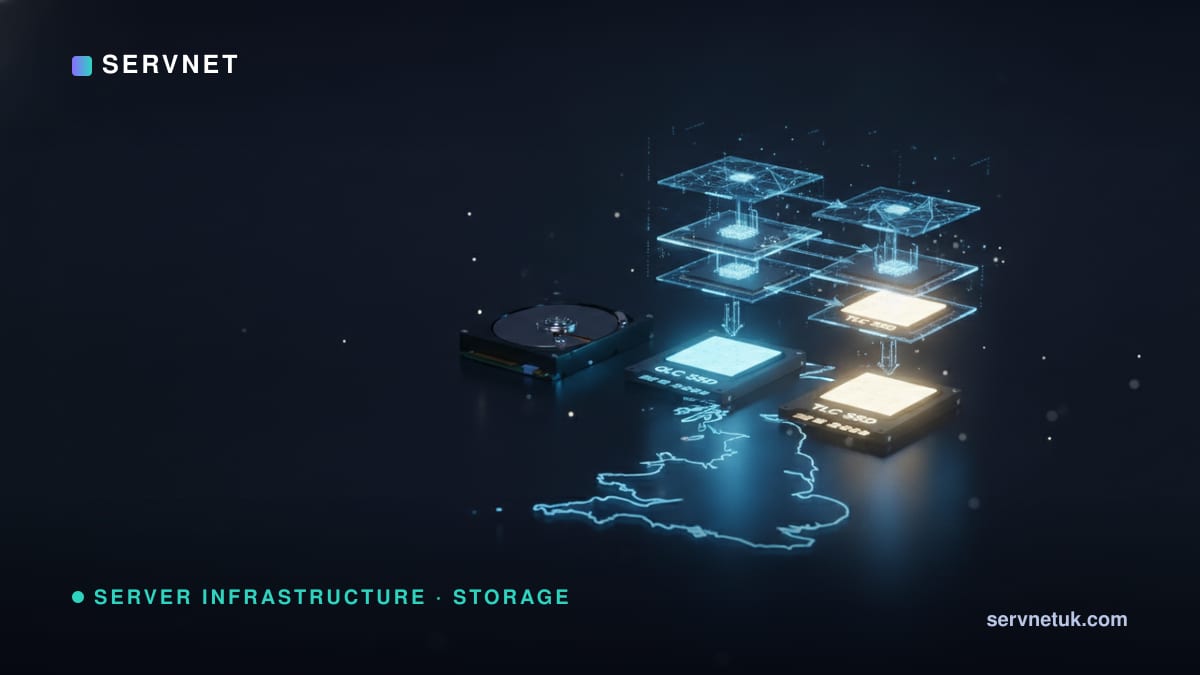
Storage media is not a single choice any more, it is a portfolio. Spinning disk, QLC flash and TLC flash each occupy a different point on the cost, speed and endurance curve, and the cheapest estate is almost never built from one of them alone. The skill is matching media to the data that lives on it, so hot data sits on flash that can take the writes and cold data sits on capacity that costs a fraction as much. Get the tiering right and you buy less, faster storage; get it wrong and you either overspend on flash or strangle a workload on disk. Here is how the three media compare and how to blend them.
View the data behind this chart
| HDD | QLC flash | TLC flash | |
|---|---|---|---|
| Cost per TB | Lowest | Near-disk | Highest |
| Latency | High | Flash reads | Lowest |
| Endurance | Workload fit | Limited writes | Highest |
| Best for | Cold capacity | Read-heavy bulk | Hot, write-heavy |
Three media, three jobs
Hard disk drives are the capacity workhorse. They are far cheaper per terabyte than any flash, they scale to very large capacities, and for sequential and cold workloads they are entirely adequate. What they cannot do is deliver low latency or high random IOPS, and their rebuild times on large drives are long, which shapes how you protect them.
TLC flash is the performance and endurance tier: fast, low-latency, and durable enough for sustained writes, which is why it carries databases, virtualisation and anything latency-sensitive. QLC flash sits in between, storing more bits per cell to approach disk on cost per terabyte while keeping flash-class read speed, at the price of lower write endurance and a write-performance cliff when its cache is exhausted. Three media, three jobs.
The economics: cost per terabyte and per write
Two numbers decide where each medium belongs: cost per terabyte and cost per unit of endurance. On capacity, disk is cheapest, QLC has closed much of the gap to disk while staying well below TLC, and TLC is the most expensive per terabyte. On endurance, the order reverses: TLC tolerates the most drive writes per day, QLC far fewer, and the comparison with disk is really about workload fit rather than a like-for-like endurance figure.
This is why a single-medium estate is usually the wrong answer. Build everything from TLC and you overpay enormously for capacity that never needs the speed; build everything from disk and you starve your hot workloads. The cheapest defensible estate blends media so each terabyte sits on the cheapest medium that still meets its performance and endurance needs, which is the whole logic of tiering.
- •HDD: lowest cost per TB, high capacity, low IOPS, long rebuilds, for cold and sequential data
- •QLC: near-disk cost per TB, flash-class reads, limited write endurance and a write cliff
- •TLC: highest cost per TB, lowest latency and highest endurance, for hot and write-heavy data
- •Cost per TB and cost per write together decide the tier each dataset belongs in
Where QLC shines and where it bites
QLC is the medium that most rewards understanding. For read-heavy, capacity-hungry data it is excellent: large content libraries, read caches, analytics datasets and active archives get flash read latency at close to disk pricing, which is a genuinely new option compared with a few years ago. For these workloads QLC can displace both disk and TLC and lower the bill.
Where QLC bites is sustained writes. Once its faster write cache is full, write performance drops sharply, and its endurance budget is modest, so a write-heavy workload can both slow down and wear the drives prematurely. The rule is simple: QLC for read-dominated bulk, never for logs, scratch, or anything that writes hard and continuously. Misplacing a write-heavy workload onto QLC is one of the more common and avoidable storage mistakes.
Designing a blended tier
A blended design starts by classifying data by how hot it is and how hard it writes. Hot, write-heavy and latency-sensitive data goes on TLC. Warm, read-dominated and capacity-hungry data goes on QLC. Cold, sequential and rarely-touched data goes on disk, often behind the other two as a nearline or archive tier. Many platforms can move data between tiers automatically, but the placement policy still has to reflect the real access pattern.
Capacity sizing then follows the tier mix rather than a single number, and the drives come from our SSD and NVMe range for the flash tiers paired with high-capacity disk for the cold tier. We design these blends on dense platforms such as those we build on HPE Apollo and across our Dell storage range, sizing each tier to the slice of data it actually serves.
View the data behind this chart
| Y1 | Y2 | Y3 | Y4 | Y5 | |
|---|---|---|---|---|---|
| All-TLC | £k70 | £k88 | £k110 | £k134 | £k160 |
| Blended tier | £k40 | £k50 | £k62 | £k76 | £k92 |
Endurance, resilience and rebuild risk
Media choice interacts with how you protect data. Large disks rebuild slowly, so wide RAID 5 across big drives is risky; RAID 6 or erasure coding is the safer pattern for disk capacity tiers. Flash rebuilds faster, but QLC endurance means you should keep an eye on write amplification from the resilience scheme itself, since parity and rebuilds add writes the drive has to absorb.
Match endurance class to the write profile rather than buying one grade for everything: write-intensive TLC for logs and scratch, mixed-use TLC for general virtualisation, read-intensive TLC or QLC for read-dominated bulk. We size endurance alongside capacity and resilience in our server configuration service so the drives last the life of the platform rather than wearing out early under a misjudged load.
Putting it together
Treat media as a portfolio, not a single pick. Classify data by heat and write intensity, put each dataset on the cheapest medium that meets its needs, and protect each tier in a way that respects its rebuild and endurance characteristics. For the wider architecture question of growing by shelf, node or pool read add a JBOD or buy another server, and for disaggregating the flash tiers across a fabric see JBOF and NVMe flash enclosures.