

Everyone still talks about GPU allocation. But a single NVIDIA GB200 NVL72 rack draws 120-132 kW — eight to twenty-five times a standard enterprise rack's 5-15 kW ceiling — and UK power equipment lead times now exceed 18 months. For UK IT leaders planning on-prem AI in 2026, the constraint that actually sets your go-live date isn't GPU availability. It's amps, switchgear, and cooling capacity, and this piece tells you how to plan around it.
View the data behind this chart
| Standard enterprise rack | AI rack (H100-class) | GB200 NVL72 rack | |
|---|---|---|---|
| Lower bound | kW5 | kW30 | kW120 |
| Upper bound | kW15 | kW80 | kW132 |
The Real 2026 Bottleneck: Why Power, Not GPUs, Sets Your Timeline
For most of 2023-2025 the AI infrastructure conversation in the UK was dominated by GPU allocation — who could get silicon, and when. By mid-2026, that conversation has quietly shifted. ServNet UK's analysis of the UK data-centre market describes power and energy as the binding constraint on growth, with grid connections scarce in busy regions and AI racks now outstripping the power and cooling assumptions most facilities were originally built around.
Translate that into buyer language: you can probably source the GPUs. What you can't necessarily source on your current timeline is enough spare electrical capacity at your chosen site. AI capacity planning has quietly become a facilities decision dressed up as a procurement decision — the GPU line item is what finance scrutinises, but the electrical and cooling line items are what actually determine whether the deployment goes live on schedule.
Hard Numbers: What an AI Rack Actually Draws in kW
Start with the baseline. CageLab's 2026 UK colocation guide puts a standard enterprise rack at 5-15 kW; Data Centre Review's May 2026 analysis of the UK's physical AI limits puts legacy enterprise racks lower still, at 5-10 kW. Either way, that's the density most UK server rooms, cooling plant and switchgear were designed around.
Move to AI hardware and the numbers change category. CageLab puts an AI rack built around H100-class GPUs at 30-80 kW or more. Data Centre Review's May 2026 reporting has AI training environments routinely drawing 60-80 kW per rack, with specialist deployments exceeding 100 kW. ServNet UK's colocation research puts a full GB200 NVL72 rack at 120-132 kW, with next-generation designs projected toward roughly 240 kW per rack. National Grid's own network impact study, meanwhile, puts the average AI server rack rating at 80 kW — a figure that sits comfortably inside that wider spread and underlines how broad 'AI rack' has become as a planning category.
- •Standard enterprise rack: 5-15 kW (CageLab); 5-10 kW (Data Centre Review, May 2026)
- •AI rack, H100-class GPUs: 30-80 kW+ (CageLab); 60-80 kW typical, 100 kW+ specialist (Data Centre Review)
- •GB200 NVL72 rack: 120-132 kW (ServNet UK); next-gen projection ~240 kW (ServNet UK)
- •National Grid average AI server rack rating: 80 kW
Beyond the Rack: Cooling Is Part of the Power Budget
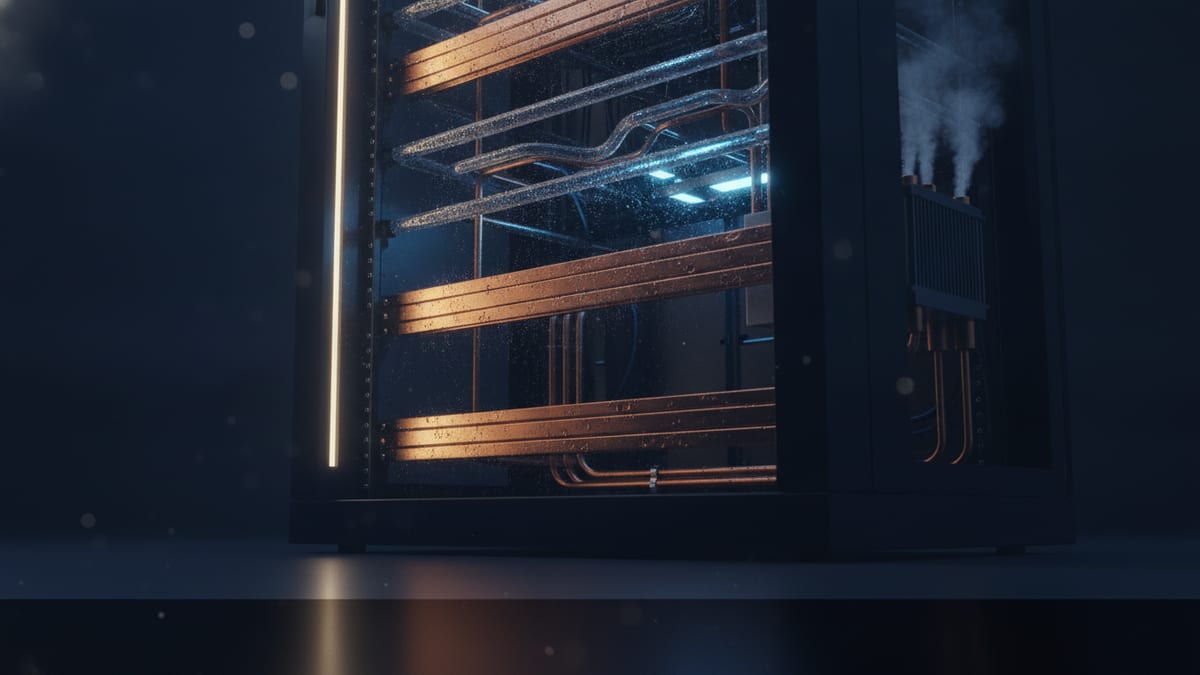
None of those figures are achievable with fans and a raised floor at scale. ServNet UK's colocation cooling analysis is blunt: direct-to-chip liquid cooling is now the default for current AI infrastructure because air cooling tops out long before these densities are reached. Even with liquid loops installed, roughly 70-80% of rack heat is captured directly into liquid, leaving 20-30% still needing conventional air handling — a hybrid design that adds plant complexity even as it enables the density.
CageLab's UK colocation guidance sets out clear thresholds for when the switch actually has to happen: below roughly 20 kW per rack, standard air cooling is generally adequate; above 30 kW it becomes marginal or insufficient; above 40 kW, liquid or direct-to-chip cooling is generally required. That means most GB200-class deployments — and a good share of H100-class ones — are already past the point where air alone is a credible design. See our air vs. liquid cooling for AI servers analysis for the full trade-off, and check your own site's headroom against actual load using a server room cooling needs calculation before committing to a rack density.
The UK Grid Reality: Cost, Connections and Constraints
Cost and connection constraints compound the density problem in the UK specifically. Raconteur cites a UK data-centre provider quoting power costs of 24-28p per kWh — a data-centre contract price, not a household tariff — and a think-tank estimate that powering a 100 MW data centre in the UK costs four times as much as an equivalent project in the US.
Layer onto that Informd's 2026 reporting on UK CIO infrastructure strategy: transformer and switchgear shortages are limiting on-prem AI workloads globally, with power equipment procurement lead times exceeding 18 months in several markets. Even modest enterprise on-prem AI deployments may need power infrastructure upgrades coordinated with facilities teams and, in some cases, National Grid, on timescales of 12-24 months. ServNet UK's own market read reinforces this: grid connections are scarce in busy regions, and AI racks are outstripping the power and cooling assumptions most facilities were built around. For a UK enterprise, the electrical upgrade conversation with your DNO or National Grid needs to start before the GPU business case is signed off, not after. Our GPU rack power density research tracks how these densities are moving as new hardware ships.
A Worked Planning Scenario for a UK Enterprise
Picture a UK enterprise — a mid-sized professional-services or financial-services firm — planning a handful of AI racks on-prem for a mixed training and inference workload built around H100-class GPUs. Per CageLab's figures, each of those racks could draw 30-80 kW+, already two to five times the 15 kW ceiling CageLab assigns to a standard enterprise rack, and comfortably past the roughly 20 kW point where standard air cooling stops being adequate. This isn't a server-room refresh; it's a switchgear, transformer and cooling-plant project.
That project, per Informd's reporting, runs on two overlapping clocks: transformer and switchgear procurement that can exceed 18 months, and facilities/National Grid coordination that typically spans 12-24 months. If the GPU order lands in weeks and the power upgrade lands in over a year, the hardware either sits idle or gets deployed into a site that can't sustain it at full load. The planning sequence has to run backwards from the electrical upgrade, not forwards from the GPU spec sheet — start with right-sizing your AI rack power before you size the compute, and stress-test the site's existing capacity with a UPS sizing calculator before committing capital to any specific rack density.
View the data behind this chart
| Cooling Approach | Air Cooling Adequacy | Typical Example | |
|---|---|---|---|
| Below ~20 kW/rack | Standard air cooling | Generally adequate | Legacy enterprise racks |
| 20-30 kW/rack | Standard air cooling | Becoming marginal | Growing AI workloads |
| Above 30 kW/rack | Standard air cooling | Generally insufficient | Dense AI racks |
| Above 40 kW/rack | Liquid/direct-to-chip | Air alone not viable | GB200-class racks |
On-Prem vs Colocation vs Cloud: Matching Workload to Power Reality
ServNet UK's own guidance offers a useful decision filter here. Keep modest, stable, low-density AI workloads on-prem where the site has genuine electrical headroom. Route dense or growing AI workloads to colocation, where the power and cooling stack is already built to AI densities. Use cloud for elastic or bursty demand that doesn't justify dedicated capacity at all. On-prem AI is viable, per ServNet, where a site has electrical headroom and modest densities — and becomes painful exactly where it doesn't.
This filter matters because it changes what you evaluate, not just how much you buy. A firm with genuine spare capacity and a steady, modest AI workload has a real on-prem case. A firm chasing GB200-class density on a site built for 5-15 kW racks does not — and colocation, where the transformer, switchgear and liquid-cooling investment has already been made by someone else, is very often the pragmatic route for dense AI in 2026.
The Real Cost of AI Power: Beyond the Electricity Bill
The headline electricity price is only one line of the AI power TCO. Raconteur's 24-28p/kWh figure sits inside a bigger picture: the same reporting cites a think-tank estimate that powering a 100 MW UK data centre costs four times as much as an equivalent US project. Add the capital side — transformers and switchgear with lead times exceeding 18 months are, by definition, scarce and expensive to secure fast — and the true cost of AI power for a UK enterprise is a combination of electricity price, capital-equipment scarcity, and the schedule risk baked into a 12-24 month upgrade window.
None of that shows up on a GPU quote. It shows up in facilities capex, in grid-connection costs, and in the opportunity cost of hardware sitting in a data hall that can't yet feed or cool it at rated load. Any AI business case that stops at cost-per-GPU is, by mid-2026, an incomplete business case.
The Road Ahead: Beyond 2026
The trajectory is not levelling off. ServNet UK's own tracking of next-generation rack designs points toward roughly 240 kW per rack — roughly double today's GB200 NVL72 density — which means the switchgear, transformer and cooling upgrade a UK site commissions this year needs headroom for the next hardware generation, not just the current one. Given liquid cooling already needs to handle 70-80% of rack heat at today's densities, tomorrow's racks will push that split further, not reverse it.
The practical implication for UK IT leaders is unglamorous but important: treat power and cooling capacity as a multi-generation asset, not a one-off project tied to a single GPU purchase, and build the grid-connection and facilities conversation into the AI roadmap from day one — not as a change request once the racks arrive.
Sources
Every figure in this article traces to the sources below.
- •ServNet UK — UK data-centre power/energy as the binding constraint on growth
- •ServNet UK — GB200 NVL72 rack power draw, next-gen projections, liquid cooling heat capture
- •Informd — UK CIO AI infrastructure strategy: equipment lead times and coordination timescales
- •CageLab — UK AI colocation guide: rack power and cooling thresholds
- •Data Centre Review — Is AI growth starting to hit the UK's physical limits? (May 2026)
- •National Grid — Data centre impact study: average AI server rack rating
- •Raconteur — UK energy demand and the AI Action Plan: power costs and US/UK cost comparison
View the data behind this chart
| Phase | Starts (week) | Duration (weeks) |
|---|---|---|
| Equipment Procure | 0 | 78 |
| Facilities & Grid | 0 | 104 |