
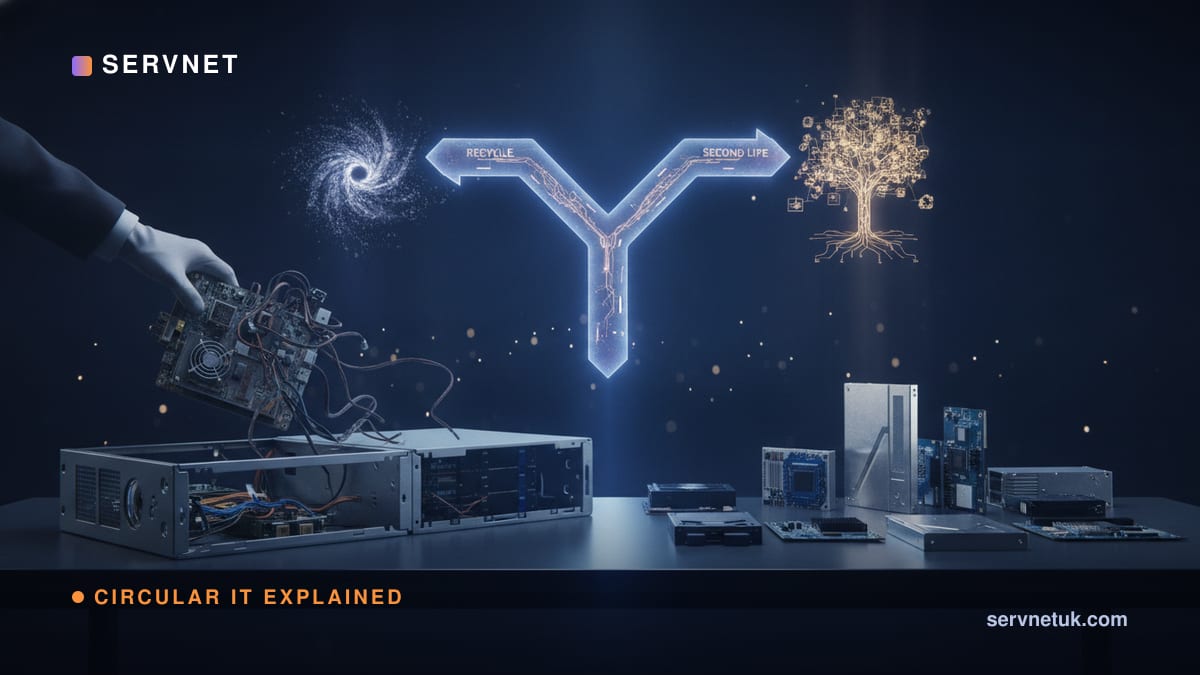
A remanufactured server producing 858.3 kg CO2-eq versus 3,077.2 kg CO2-eq for a newly built equivalent — a difference of 2,218.9 kg CO2-eq per unit, even after allowing for the remanufactured machine using up to 7% more energy in service. That single peer-reviewed comparison is the clearest evidence yet that circular IT — reusing, repairing and remanufacturing hardware before anything is recycled — is not a green marketing label. It's a measurable carbon strategy. For UK IT buyers facing WEEE obligations, Scope 3 reporting pressure and rising new-hardware prices, understanding where remanufacturing sits in the circular hierarchy, and how to prove it in an audit, is now a procurement decision with real financial and compliance weight.
View the data behind this chart
| Layer | Detail |
|---|---|
| Reuse & Repair | Keep the asset in its current role longer |
| Refurbish | Clean, test and resell largely as-is |
| Remanufacture | Replace worn parts, rebuild to like-new spec |
| Cascade | Redeploy to a less demanding workload |
| Recycle | Last resort once no second life is possible |
What Is Circular IT? Beyond the Buzzword
Circular IT applies the classic waste hierarchy to computing hardware: extend, reuse and remanufacture first; recycle only what genuinely cannot be kept in service. It is distinct from simply 'buying refurbished' because it covers the whole asset lifecycle — from procurement decisions that favour repairable, modular hardware, through in-life maintenance that extends service, to structured decommissioning that recovers value rather than sending equipment to landfill or shredders by default.
The terms get used loosely, so precision matters. Refurbished hardware is cleaned, tested and resold largely as-is, typically with the original components. Remanufactured hardware goes further: it is torn down, worn or failing parts are replaced, and the unit is rebuilt to a like-new functional specification, often with a fresh warranty. That distinction matters for procurement teams comparing bids, because the environmental and reliability profile of the two is not identical.

Why Circular IT Matters for UK Businesses: Cost, Compliance and Carbon
The carbon case rests on where emissions actually occur. A UK-focused feature on hardware reuse states that as much as 80% of a device's lifecycle emissions can occur before it is even switched on — in raw material extraction, component fabrication and assembly. That is why extending a working asset's life, rather than replacing it and recycling the old unit, is the higher-leverage carbon action: recycling recovers some material value at end of life, but it cannot claw back emissions already locked into manufacturing a replacement.
On compliance, the UK's WEEE regime requires businesses to recover and recycle IT equipment responsibly, and that obligation is precisely why certified data wiping and a documented audit trail have become central to any compliant reuse or resale chain — you cannot claim a device had a second life if you cannot evidence what happened to it and the data on it. Separately, a 2025 parliamentary evidence submission on electronic waste called explicitly for business models that enable better reuse, modularity and remanufacturing, alongside stronger secondary-material markets and tighter e-waste recycling enforcement — a signal that policy pressure toward circularity is building, not easing. Beyond WEEE itself, independent certification frameworks are also emerging to validate reprocessing operations — UL Solutions' Zero Waste tiers, for example, are the kind of third-party standard increasingly used to demonstrate that reverse-logistics and ITAD facilities manage hardware recovery to a verifiable level, as shown by Amazon's Ireland facility achieving the top Platinum tier for its hardware recovery operations.
The Pillars of Circular IT: Strategies in Action
Circular IT is not one action but a stack of interventions, each capturing value the next tier down would lose. Reuse and repair keep an asset in its current role for longer — extend hardware lifespan with third-party maintenance contracts rather than forcing early replacement when OEM support lapses. Refurbishment prepares retired assets for a second deployment, often in a less demanding role. Remanufacturing goes deeper still, replacing worn components to restore near-original performance and warranty cover.
ITAD (IT Asset Disposition) sits at the point of retirement, and doing it properly is what makes every earlier stage defensible. UK ITAD provider Premier IT Disposal's 2026 sustainability disclosure states that working assets it processes are securely wiped and remarketed, extending product life by 3 to 5 years and avoiding the carbon cost of new manufacture; the same provider claims roughly 1.2 tonnes of CO2e diverted for every tonne of IT processed compared with manufacturing equivalents from virgin material — a vendor-reported figure for its own operation, not an independent benchmark, but indicative of the scale of the prize.
At the largest end of the market, Amazon has reported that its re:Cycle reverse-logistics programme prevented 225,000 metric tons of CO2e cumulatively since 2020 by keeping retired data-centre hardware in circulation through reuse and resale rather than premature scrapping, and its Ireland reverse-logistics facility achieved UL Solutions Platinum Zero Waste certification for hardware recovery. To understand IT Asset Disposition properly is to understand that it's the operational backbone making every reuse and remanufacture claim auditable.
New vs Circular: A Data-Driven Comparison for IT Hardware
The strongest single data point comes from a peer-reviewed case study comparing a remanufactured server against a newly manufactured equivalent across full life-cycle impact categories. The remanufactured scenario scored 858.3 kg CO2-eq on climate-change impact versus 3,077.2 kg CO2-eq for the new-build scenario — even though the remanufactured unit was modelled as consuming up to 7% more energy in operation. Reusing components such as HDDs and memory cards was environmentally beneficial despite that operational energy penalty, because the avoided manufacturing emissions dwarfed it.
The EU Joint Research Centre reached a compatible conclusion from a different angle: a server refurbished with reused HDDs, memory cards, CPUs and main boards can deliver environmental performance similar to a new server — reinforcing that a well-executed second life is not a compromise on outcomes, only on component provenance.
Separate 2026 scenario modelling from UK refurbished-server supplier Nordic Computer reports 15.94 tonnes of manufacturing-emissions offset and 0.53 tonnes of transport offset for its refurbished-hardware scenario, a net total offset of 15.62 tonnes — a supplier-scenario figure rather than an independent study, but directionally consistent with the peer-reviewed result above. Note that separate reuse-sector coverage cites remanufactured hardware reducing carbon emissions by 93.6% and procurement costs by up to 50% versus new — figures reported specifically for that source's hardware category and not directly comparable to the server-specific NCBI study, since a new laptop's production footprint (roughly 331 to 361 kg CO2 in that same coverage) is a materially different scope than a server. Buyers should keep these scopes separate rather than averaging them into one headline number.
For UK procurement teams sizing a specific fleet decision, it's worth running the numbers rather than relying on any single published figure — you can calculate the savings of new versus refurbished servers against your own workload and refresh cycle.
Implementing Circular IT: A Practical Roadmap for UK Enterprises
A credible transition starts with an honest fleet audit: which assets are still fit for their current role, which could be redeployed to a less demanding workload (cascading), and which are genuinely at end of useful life. From there, the practical sequence is to negotiate extended support and maintenance for assets with life left, specify certified refurbished or remanufactured hardware for planned refreshes rather than defaulting to new, and formalise a decommissioning process — including how you'll plan for server end-of-life — before assets physically leave the building.
Documentation is the difference between a circular IT programme and a set of good intentions. A 2026 data-centre decommissioning guide notes that modern ESG reporting expects operators to track the total weight of decommissioned hardware, its disposition path, recycling or reuse certifications, and the carbon emissions associated with transport and processing. Build that tracking into your ITAD contract from day one rather than retrofitting it when an auditor asks.
Beyond data security concerns, the most common practical hurdles are internal: stakeholders questioning whether refurbished or remanufactured hardware belongs in the same procurement process as new equipment, and finance teams weighing the upfront cost of formal ITAD contracts and audit tooling against near-term budget pressure. The cost case can help overcome that resistance directly — certified refurbished hardware reduces Scope 3 carbon by reusing what has already been manufactured while also cutting cost against rising new-hardware prices, and separate reuse-sector coverage cites procurement cost reductions of up to 50% for remanufactured hardware versus new. Embedding circular options into existing procurement frameworks — evaluating certified refurbished and remanufactured hardware as a standard option alongside new, rather than routing it through a separate exception process — removes much of the friction that internal resistance and process misalignment otherwise create.
View the data behind this chart
| Remanufactured server | Newly manufactured server | |
|---|---|---|
| Climate-change impact | kg CO2-eq858.3 | kg CO2-eq3077.2 |
Measuring Impact: ROI and ESG Reporting for Circular IT
As UK-focused analysis from ServNet UK notes, certified refurbished hardware reduces Scope 3 carbon by reusing what has already been manufactured, while simultaneously cutting cost against rising new-hardware prices — a combination that makes circular procurement one of the few sustainability moves that also improves the P&L rather than only the carbon ledger.
For ESG reporting specifically, the evidence trail matters more than the headline claim. Disposition-path data, erasure certificates, and downstream processing records are what convert a reuse programme into a defensible Scope 3 reduction claim rather than an unverifiable assertion. Where a vendor's avoided-emissions figure — such as the 1.2 tonnes CO2e per tonne processed cited above — is used in external reporting, it should be clearly labelled as a provider-reported metric for that provider's own programme, distinct from independently published life-cycle studies like the NCBI server comparison.
UK businesses can use a simple checklist, drawn from current decommissioning and ESG-reporting guidance, to assess how circular their IT estate really is:
- Total weight of hardware decommissioned each reporting period
- Disposition path per asset — reuse, remanufacture, refurbish, cascade or recycle
- Recycling and reuse certifications held by ITAD and reverse-logistics partners
- Carbon emissions associated with transport and processing
- Erasure certificates and chain-of-custody records per asset
Data Security Through the Circular IT Lifecycle
Data security is the objection that stalls most circular IT programmes before they start, and it is answerable with process rather than avoidance. The UK's WEEE regime is the regulatory anchor here: it requires businesses to recover and recycle IT gear responsibly, and that is precisely why certified data wiping and a documented audit trail sit at the centre of any compliant reuse or resale chain. A robust ITAD process should produce erasure certification per asset, a chain-of-custody record from collection to final disposition, and clear reporting of which route — reuse, remanufacture or recycle — each asset actually took.
Performance anxiety around refurbished or remanufactured gear is a related but separate concern, and the evidence above addresses it directly: the JRC's finding that refurbished servers with reused core components can match new-server environmental performance implies the underlying hardware is genuinely fit for continued production use, not merely a lower-cost compromise.
The Future of Circular IT: Trends and Innovations
Policy direction points firmly toward more circularity, not less. The 2025 parliamentary evidence submission calling for business models enabling reuse, modularity and remanufacturing, stronger secondary-material markets and tighter recycling enforcement suggests UK regulation will keep raising the bar on documented disposition rather than relaxing it. At the same time, large-scale operators like Amazon achieving top-tier zero-waste certification for hardware recovery facilities signals that circular IT infrastructure is professionalising, not remaining a niche ITAD activity.
For UK businesses, the practical takeaway is to treat circular IT as core procurement and infrastructure strategy rather than a CSR add-on — and to delve deeper into Circular IT, ITAD, and ESG in the UK as reporting requirements tighten further through 2026 and beyond.
Sources
Every figure in this article traces to the sources below.
- •NCBI / peer-reviewed article — remanufactured vs new server climate-change impact and energy-use comparison
- •European Commission Joint Research Centre — refurbished server environmental performance vs new
- •Resource Recycling — Amazon re:Cycle hardware reuse CO2e prevention and Zero Waste certification
- •Premier IT Disposal — UK ITAD sustainability claims on life extension and CO2e diversion
- •ServNet UK — circular IT, ITAD and ESG reporting context for UK buyers
- •Networking Plus — UK WEEE compliance and lifecycle emissions share before device use
- •Circular Computing / reuse-tech coverage — claimed carbon and procurement cost reduction for remanufactured hardware
- •Nordic Computer — refurbished server scenario manufacturing and transport offset figures
- •UK Parliament committees — written evidence on e-waste, reuse and remanufacturing business models
- •Data Centers Relocation — 2026 decommissioning guide on ESG tracking expectations
View the data behind this chart
| New | Refurbished | Remanufactured | |
|---|---|---|---|
| Component condition | All new | Original, tested | Worn parts replaced |
| Warranty scope | Full OEM | Provider-set terms | Fresh, like-new |
| Embodied carbon | Highest | Lower, reused parts | Lower, rebuilt core |
| Upfront cost | Highest | Reduced | Reduced |
| Lead time | OEM order cycle | Often faster | Rebuild dependent |