
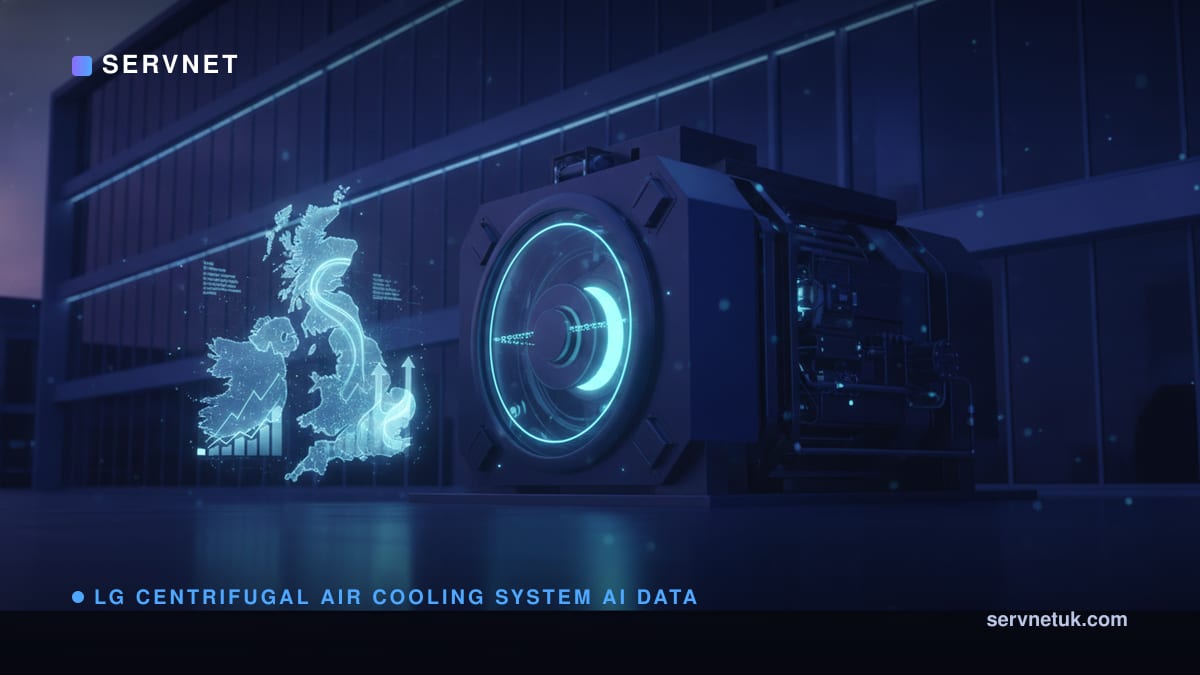
LG has launched an oil-free, magnetic-bearing centrifugal chiller aimed squarely at AI data centers, promising up to 30 percent lower energy use than conventional liquid-based free cooling. For UK buyers weighing air vs. liquid cooling for AI servers, it's a notable entrant.
View the data behind this chart
| Min configuration | Max configuration | |
|---|---|---|
| Cooling capacity | RT480 | RT600 |
What LG actually launched
LG unveiled the system on 21 September 2026 as an air-cooled, oil-free, centrifugal chiller aimed at the AI data center market. The core innovation is an oil-free magnetic bearing centrifugal compressor: the rotating shaft is suspended by magnetic force rather than physical contact, removing the need for lubricating oil entirely.
LG says this cuts mechanical friction losses and improves compression performance. In its refrigerant free-cooling mode, it uses cool outdoor air and circulates refrigerant directly, without an intermediate heat exchanger or glycol — a design choice LG says reduces heat and pressure losses while simplifying maintenance.
Units are available across a 480 to 600 refrigeration ton range and can be configured to match a specific facility's cooling requirements, according to LG. The company has not disclosed the absolute heat-removal figures for each configuration.
Why oil-free bearings matter for UK operations teams
Eliminating the lubrication system may reduce maintenance requirements. Schneider's Uniflair XCA line similarly uses oil-free magnetic-bearing centrifugal compressors and eliminates the lubrication system, deploying variable-speed drives across 1.2 MW to 2.5 MW units.
Industry commentary on magnetic bearing chillers more broadly has noted they can return to full cooling load in as little as three minutes after a power interruption, and that some designs use R-1234ze, a refrigerant with very low global-warming potential. Neither of those specific figures has been confirmed for LG's new system, but they illustrate why the category is attracting attention from facilities managers who need both reliability and a credible emissions story.
The energy and cost case for UK sites
LG's headline claim is that the new system can consume up to 30 percent less energy than traditional free-cooling systems that rely on liquid intermediaries, based on LG's internal simulation. That matters in the UK, where older DCD cost modelling put average enterprise data centre electricity at roughly £0.17 per kWh of delivered IT load, based on a 10p/kWh unit price and a PUE of 1.7. The actual cost impact of chiller efficiency gains will vary by site, depending on cooling's share of total facility power draw.
For operators planning new AI capacity, this is one more data point in the broader question of air vs. liquid cooling for AI servers: traditional air cooling remains in widespread use, although liquid cooling is increasingly used where rack densities are higher. LG's pitch is that air cooling itself can be made significantly more efficient without switching cooling media.
Where this sits in LG's wider cooling strategy
This chiller doesn't arrive in isolation. LG's data centre cooling portfolio now spans cold plates, coolant distribution units, water-cooled oil-free centrifugal chillers and CRAH units, and the company has separately been reported to be working with Microsoft on thermal management for next-generation AI facilities. DCD reported that LG and SK are partnering on cooling and energy solutions for AI data centers, providing direct-to-chip cooling via CDUs alongside water- and air-cooled inverter chillers. DCD also reported that Flex and LG are combining Flex's liquid-cooling portfolio and IT infrastructure with LG's air- and liquid-cooling products.
Read together, these moves point to LG building an ecosystem play rather than selling standalone boxes — useful context for buyers evaluating vendors who are increasingly bundling cooling, power and IT infrastructure into single procurement conversations.
What UK buyers should do next
There's no UK-specific deployment date attached to this launch in the reporting so far, and LG has not published the absolute heat-removal figures needed to size the units against a specific facility. UK operators should treat this as a product to evaluate against existing air-cooled and liquid-cooled roadmaps rather than something to specify immediately.
Given the density trends driving UK AI data centre build-out trends, the practical starting point is a thermal audit: understand current rack density, projected AI workload growth, and where preparing your server room for high rack density intersects with your cooling refresh cycle. Compare oil-free centrifugal air systems like LG's against liquid alternatives on total cost of ownership, not just headline efficiency percentages, and factor in maintenance contract changes now that oil servicing is removed from the equation.
For teams sizing compute alongside cooling upgrades, working through server configuration options for upcoming AI deployments — whether via the Dell server configurator, HPE server configurator or Lenovo server configurator — alongside cooling procurement will give a more accurate picture of facility-level power and thermal headroom before committing capital.
- 01DataCenterDynamics — LG launches centrifugal air cooling system for AI data centers · 21 September 2026
- 02DataCenterDynamics — Microsoft to use LG Electronics cooling infrastructure in some AI data centers · 1 July 2026
- 03DataCenterDynamics — Schneider Electric launches new line of data center chillers · 1 January 2026
- 04DataCenterDynamics — LG, SK partner for cooling and energy solutions for AI data centers · 1 January 2026
- 05DataCenterDynamics — Flex and LG team up on modular cooling solutions · 1 January 2026
- 06DataCenterDynamics — Centrifugal compressors are best (opinion) · 1 January 2024
- 07DataCenterDynamics — Revolutionizing data center sustainability with intelligent purpose-built solutions · 1 January 2024
- 08datacenterdynamics.com