

AirTrunk has signed an MoU with deep-tech firm Emergence Quantum to explore cryogenic cooling for AI silicon and future quantum systems. It's an early-stage pilot, not a shipping product — and, in our analysis, it lands alongside a broader shift as rising rack densities push UK operators toward liquid cooling as a baseline.
View the data behind this chart
| GB300 2026 | NVL144 2026 | NVL576 2027 | |
|---|---|---|---|
| Projected peak rack power | kW163 | kW300 | kW600 |
What AirTrunk and Emergence Quantum actually announced
AirTrunk, founded in 2018, this week confirmed a partnership and memorandum of understanding with Emergence Quantum (EQ) aimed at bringing cryogenic cooling and quantum computing into its facilities. The companies say cryo-cooling can "significantly improve" the speed and energy efficiency of today's silicon chips, and that the same infrastructure is foundational to future quantum systems.
AirTrunk VP for innovation and intelligence Jose Castaneda framed it as part of a push to keep the company "redefining data centers with cutting-edge technologies," while EQ co-founder and CEO Professor David Reilly put the underlying physics bluntly: "It's been understood for decades that computers run significantly faster and more efficiently in the cold... the cryo-computing epoch has arrived." AirTrunk's current campuses are in Sydney, Melbourne, Singapore, Hong Kong, Johor, Tokyo and Osaka.
Why cryogenic cooling is surfacing now, not five years ago
This isn't happening in isolation. IBM announced on 19 August 2026 that it had joined and cooled two modular cryogenic systems together for the first time, with individual modules standing over 8 feet tall and wide, reaching 4 Kelvin in under five days before falling below 15 millikelvin shortly after. IBM frames this explicitly as a scaling step toward fault-tolerant quantum computing, with plans to install its Quantum Nighthawk processors into the modules later in 2026.
The modules, linked by protected cryogenic tunnels, represent the kind of engineering detail a facilities team would need before even beginning a site feasibility study. That level of specificity, alongside AirTrunk's AI-silicon pilot, suggests cryogenics is edging from physics lab into infrastructure planning conversation, even if commercial deployment remains distant.
The bigger driver: liquid cooling is already becoming mandatory
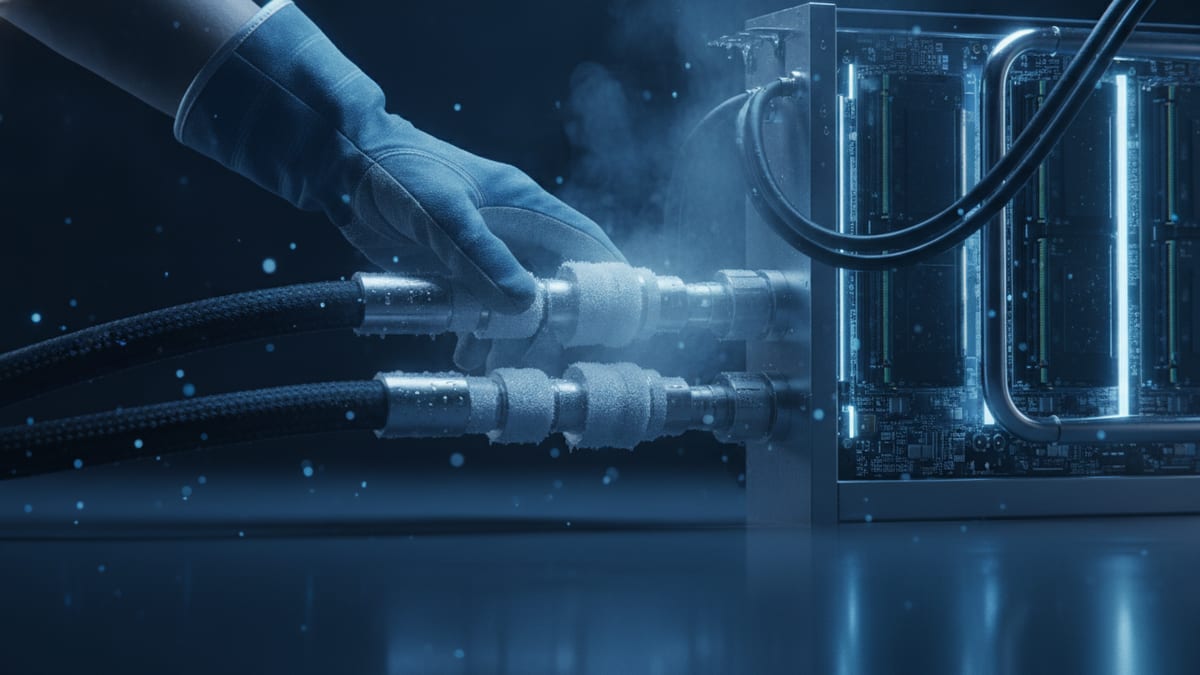
The more immediate pressure on UK buyers isn't cryogenics — it's the pace at which conventional liquid cooling has gone from optional to unavoidable. Industry analyses project Blackwell GB300 racks to hit 163kW by the end of 2026, Vera Rubin NVL144 racks to need 300kW or more this year, and Rubin Ultra NVL576 racks to exceed 600kW per rack by 2027.
The Register reported that separate tests on two-phase cooling systems found facility water temperatures tolerated up to 54°C (59°C at higher flow), and that a Dell PowerEdge XE9680L fitted with Nvidia B200 accelerators saw cold-plate temperatures cut by as much as 19°C. These figures point to how rapidly thermal design margins are tightening as rack density climbs.
What this means for UK hyperscalers and colocation operators
For UK buyers, the practical takeaway is a layered one. Cryogenic cooling — as explored by AirTrunk and EQ, and as demonstrated at module scale by IBM — remains a research-and-pilot proposition tied largely to quantum roadmaps, not a near-term retrofit option for commercial AI halls. The real, immediate decision facing UK operators is whether their next-generation racks will need direct-to-chip liquid cooling as standard, given where GB300 and Vera Rubin density curves are heading.
Hyperscalers such as Microsoft are also exploring parallel thermal paths like microfluidics, though independently verified performance figures are not yet publicly available — a reminder that vendors are hedging across several next-generation thermal approaches simultaneously, not betting on one. UK colocation providers evaluating hosting AI racks in UK colocation facilities should treat this as a signal that thermal architecture, not just floor space, is fast becoming a binding constraint on which AI tenants they can serve.
Decision points for buyers planning 2026-2027 refresh cycles
Three things follow directly from the brief facts. First, density is the real trigger: any UK operator planning for GB300, NVL144 or NVL576-class deployments should model rack power density requirements now rather than waiting for hardware delivery dates. Second, power as the real AI bottleneck compounds the cooling question — high-density racks strain both electrical and thermal capacity together, and site selection decisions should reflect that jointly. Third, cryogenics belongs on the watch list, not the 2026 procurement list; it is worth tracking via the UK AI data centre buildout tracker as AirTrunk, EQ and IBM publish further pilot results, but current UK build decisions should be made against liquid-cooling specifications that are already shipping.
Buyers modelling their next refresh should run the numbers through power and cooling tools before committing to a rack architecture, since the gap between air-cooled legacy estates and liquid-ready halls is now measured in hundreds of kilowatts per rack, not tens.
- 01DataCenterDynamics — AirTrunk partners with Emergence Quantum to explore cryogenic cooling in data centers · 15 September 2026
- 02IBM Newsroom — IBM connects its first modular cryogenic systems in milestone toward fault-tolerant quantum computing · 19 August 2026
- 03The Register — IBM says super-chill boxes that connect through cryogenic tunnels will get quantum computers scaling · 20 August 2026
- 04The Register — Scalding hot AI accelerators have put datacenters in hot water: two-phase cooling could chill them out · 21 July 2026