
All-flash arrays still cost 5–7 times more than HDD-based storage on a blended TCO basis, yet 2026 data shows they can cut power draw per effective terabyte by 60–80% in dense AI environments — enough to flip the economics for hot, latency-sensitive workloads while leaving hybrid firmly in charge of bulk capacity. This data study compiles verified 2026 figures on media cost, power, density and multi-year TCO to show exactly where all-flash earns its premium and where it doesn't. For the underlying media economics, see a deeper dive into the TCO of all-flash versus nearline HDDs. The verdict: workload segmentation, not vendor preference, should drive the 2026 storage decision.
View the data behind this chart
| Nearline HDD / hybrid tier | All-flash tier | |
|---|---|---|
| Indicative media cost | £/TB60 | £/TB1350 |
All-Flash vs Hybrid: The 2026 TCO Verdict, By the Numbers
Two figures currently circulating in 2026 storage research look contradictory until you check their scope. Exxact's mid-2026 vendor guidance says hybrid storage can deliver 60%+ lower total cost of ownership than all-flash at comparable performance levels. Servnet UK's 2026 analysis, meanwhile, puts blended enterprise SSD TCO at 5–7 times higher than HDD TCO across a wide range of workloads, even after power and rack savings are counted.
Both numbers are correct because they answer different questions. Exxact's figure describes a hybrid architecture engineered to match flash-level performance at lower cost; Servnet's figure describes the average premium of SSD-based TCO over HDD-based TCO across a mixed estate. Neither is an argument for buying one architecture outright — they are evidence that 2026 storage economics are workload-specific, and any TCO model built on an estate-wide average will mislead a UK buyer more than it helps.
The 2026 Backdrop: AI Demand Keeps Flash Pricing Under Pressure
The context behind both figures is a NAND market still being reshaped by AI training and inference demand through 2026. MarketIntelo's AI data-centre storage report frames this directly: in dense AI workload environments, all-flash can reach TCO parity with hybrid in as little as 18–30 months, a window that has shortened as flash density and reduction technology have improved even as raw media pricing stays volatile.
Older structural work from IDC and Carnegie Mellon's PDL group still holds as a framework for where that parity comes from: the factors that move all-flash TCO are energy, floor space, server count, software licensing, administration cost and device reliability — not media price alone. In a UK context, where electricity and data-centre space are both under cost and sustainability pressure, those non-media levers are exactly why flash can win even at a 4x-plus media premium for the right workload.
Deconstructing All-Flash TCO: Where the Premium Pays for Itself
In dense AI environments specifically, MarketIntelo's 2026 modelling finds all-flash can cut power consumption per terabyte of effective capacity by 60–80% versus spinning-disk-based systems, while inline deduplication and compression can push effective storage density 5–10 times higher than equivalent hybrid systems. The knock-on effect is a 30–50% reduction in rack-space and cooling cost when all-flash displaces hybrid in those same dense AI deployments.
Servnet UK's own workload analysis lines up with this: AI training, transactional/OLTP databases, and rapid-restore resilience tiers are the three workload classes where it finds all-flash achieves TCO parity or wins outright. These are precisely the workloads where latency, recovery speed and rack-and-power density dominate the cost equation — the scenarios buyers should learn more about rack power density for before sizing a flash-heavy design, and where it's worth running the numbers to calculate your server room cooling requirements against a spinning-disk baseline.
Hybrid TCO Re-Evaluated: Where Spinning Disk Still Wins
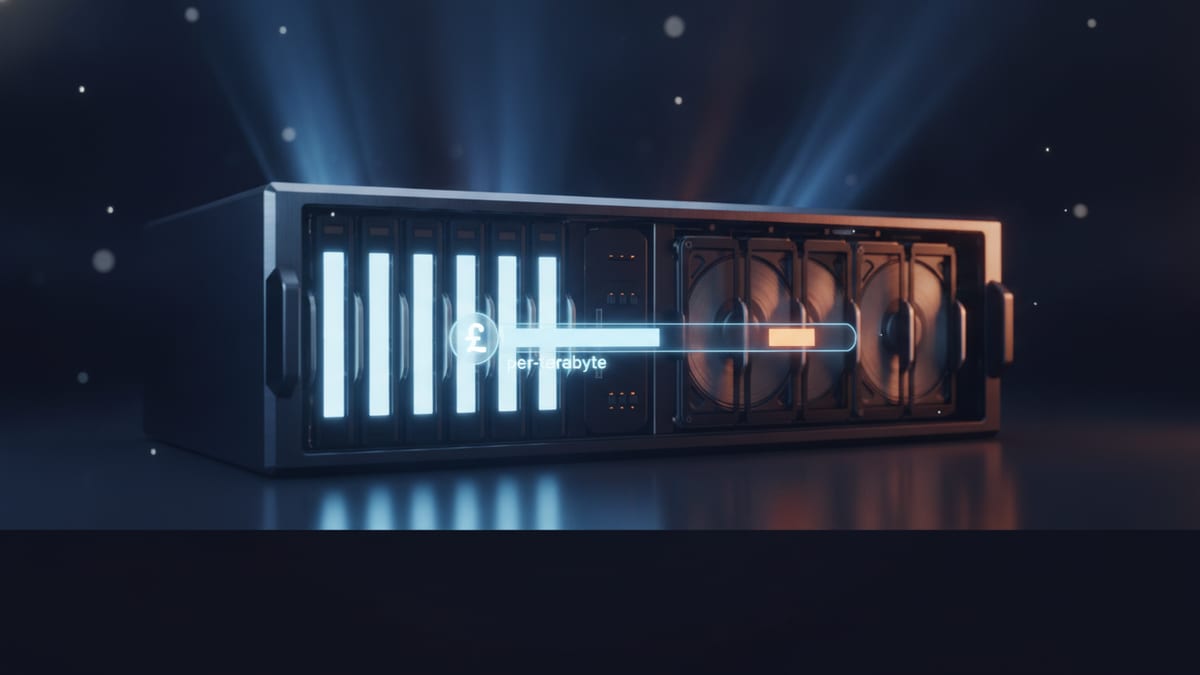
Outside those hot tiers, the case for hybrid remains strong on cost grounds. Servnet UK's indicative 2026 media-cost table shows a spread of roughly £60/TB for one tier against £1,350/TB for another — a gap wide enough on its own to explain why capacity-heavy workloads still favour HDD-based designs, before power or admin costs are even factored in.
That spread is reflected in usage: HDDs still hold roughly 80% of archival workloads on cost grounds, according to Servnet UK, and Exxact's comparison finds hybrid delivering more than 2x the energy efficiency of all-flash in its modelled scenarios. Servnet UK also names warm analytics as the workload where hybrid tiering strikes the best balance between cost and speed — and its overall conclusion is that a hybrid architecture is the rational default for UK buyers whenever the estate includes both hot and cold data. Readers building out that architecture may want to a deeper dive into the TCO of all-flash versus nearline HDDs for the full nearline comparison.
Worked Example: 200TB Usable Capacity Over Five Years
Applying Servnet UK's indicative media-cost figures to a 200TB usable estate illustrates the scale of the gap before any other TCO factor is added. At roughly £60/TB, a nearline HDD/hybrid tier of that size prices out at around £12,000 in media cost; at roughly £1,350/TB, an equivalent all-flash tier prices out at around £270,000 — a 22.5x difference on media alone.
That raw multiple narrows once power, floor space, licensing, administration and refresh cycles are folded in, which is exactly why Servnet UK's full TCO modelling lands on a blended 5–7x premium rather than the 22.5x seen on media price. For a UK buyer with a genuinely mixed 200TB estate — some AI training or OLTP data, some warm analytics, a large cold-archive tail — the workload-segmented approach means putting only the hot slice on flash and leaving the rest on hybrid, rather than pricing the whole 200TB against either extreme.
View the data behind this chart
| Best-Fit Array | Primary Cost… | 2026 Verdict | |
|---|---|---|---|
| AI training data | All-flash | Density & speed | Flash wins |
| OLTP / transactional… | All-flash | Latency & IOPS | Flash wins |
| Rapid-restore resilien… | All-flash | Recovery speed | Flash wins |
| Warm analytics | Hybrid tiering | Cost/speed balance | Hybrid wins |
| Archive & cold data | HDD / hybrid | Media £/TB | HDD wins |
Vendor Choice and Mitigation: The Levers Beyond Media Type
TCO variance isn't only about flash versus hybrid — it's also about which all-flash architecture you pick. Dell has cited ESG modelling projecting that an organisation could realise $1–3 million more over five years by deploying XtremIO rather than the other all-flash arrays modelled in the same comparison. That's a five-year swing driven entirely by vendor architecture and licensing choices within the all-flash category itself, which is a reminder that subscription and consumption-based commercial models can move TCO as much as the hardware decision does.
At the other end of the scale, a VAST/Solidigm comparison cited by VDURA found that over a 10-year horizon and 1 exabyte of data, an all-SSD design delivered 58.9% lower TCO than a Ceph/Seagate HDD system — a genuinely different data point from Servnet's 5–7x figure, using a different vendor stack, time horizon and baseline, and it shouldn't be read as contradicting the general enterprise finding. For mitigation, three levers recur across the 2026 research: inline deduplication and compression to lift effective density (5–10x in MarketIntelo's dense AI cases), intelligent tiering to keep only genuinely hot data on flash, and buyers should consider refurbished storage options to further optimise TCO on the capacity-heavy tiers where media cost dominates.
Making the Call: Workload-by-Workload Guidance for UK Buyers
The workload matrix below summarises where the 2026 evidence points. All-flash earns its 4x-plus media premium in AI training, OLTP and rapid-restore resilience because power, density and recovery speed dominate those cost equations. Hybrid tiering remains the better balance for warm analytics, and HDD-based or hybrid designs stay the default for archival and cold capacity, where roughly 80% of the workload still sits on spinning disk for cost reasons.
Looking beyond 2026, the consistent theme across IDC, CMU and the 2026 vendor research is that TCO should be modelled by workload slice, not estate average — the same platform can be a clear winner in AI training and a clear loser in cold storage. As flash density and reduction technology keep improving and NAND demand from AI keeps pricing volatile, UK buyers are better served revisiting that workload-by-workload model regularly than locking into an all-flash-only or hybrid-only estate strategy.
Methodology
This study compiles TCO and cost figures published between mid-2025 and July 2026 by storage vendors, analyst firms and academic researchers covering all-flash and hybrid array economics, including Exxact's hybrid-storage TCO comparison, Servnet UK's all-flash-versus-nearline-HDD analysis, MarketIntelo's AI data-centre storage market report, VDURA's citation of a VAST/Solidigm exabyte-scale comparison, Dell's ESG-modelled flash TCO analysis, and structural TCO-lever frameworks from IDC and Carnegie Mellon University's Parallel Data Laboratory.
Each figure was checked against its original scope — metric, workload class, time horizon and comparison baseline — before use, and figures from different sources were never merged or averaged even where they addressed similar-sounding claims. Where two data points could appear to contradict (for example, Servnet's blended 5–7x SSD TCO premium versus VDURA's exascale 58.9% all-SSD advantage), both are presented as distinct findings with their vendor, workload and time-horizon scope stated explicitly, rather than resolved into a single number.
The worked 200TB example applies Servnet UK's own indicative £/TB media-cost figures arithmetically to illustrate scale; it is presented as an indicative media-cost calculation, not a full audited TCO model, and is clearly separated from the blended 5–7x TCO premium that includes power, space, licensing and administration cost.
Sources
Every figure in this article traces to the sources below.
- •Exxact — hybrid vs all-flash TCO and energy-efficiency comparison
- •Servnet UK — all-flash vs nearline HDD TCO analysis and media-cost table
- •MarketIntelo — all-flash array storage for AI data centres market report
- •VDURA — VAST/Solidigm exabyte-scale 10-year TCO comparison
- •Dell — ESG-modelled flash storage TCO comparison
- •Carnegie Mellon University PDL — storage TCO modelling levers
- •IDC — six factors that lower all-flash array TCO
View the data behind this chart
| Layer | Detail |
|---|---|
| Power per effective TB | 60–80% lower vs hybrid (dense AI) |
| Effective storage density | 5–10x higher with inline dedupe |
| Rack & cooling footprint | 30–50% lower cost (dense AI) |
| TCO parity timeline | Reached in 18–30 months (AI workloads) |
The 14 verified data points behind this study are free to download and reuse with attribution (CC BY 4.0).
Cite as: Servnet Research, “All-Flash vs Hybrid TCO 2026: The 60–80% Power Argument”, servnetuk.com, 2026.