
⚡ Dell XE9680 vs Supermicro SYS-821GE
AI-powered analysis across 24 matched specifications

Performance Overview
Scores based on quantifiable specification values (1-10 scale)
Detailed Specifications
| Specification | PowerEdge XE9680 Dell | SYS-821GE-TNHR Supermicro |
|---|---|---|
| Key Metrics | ||
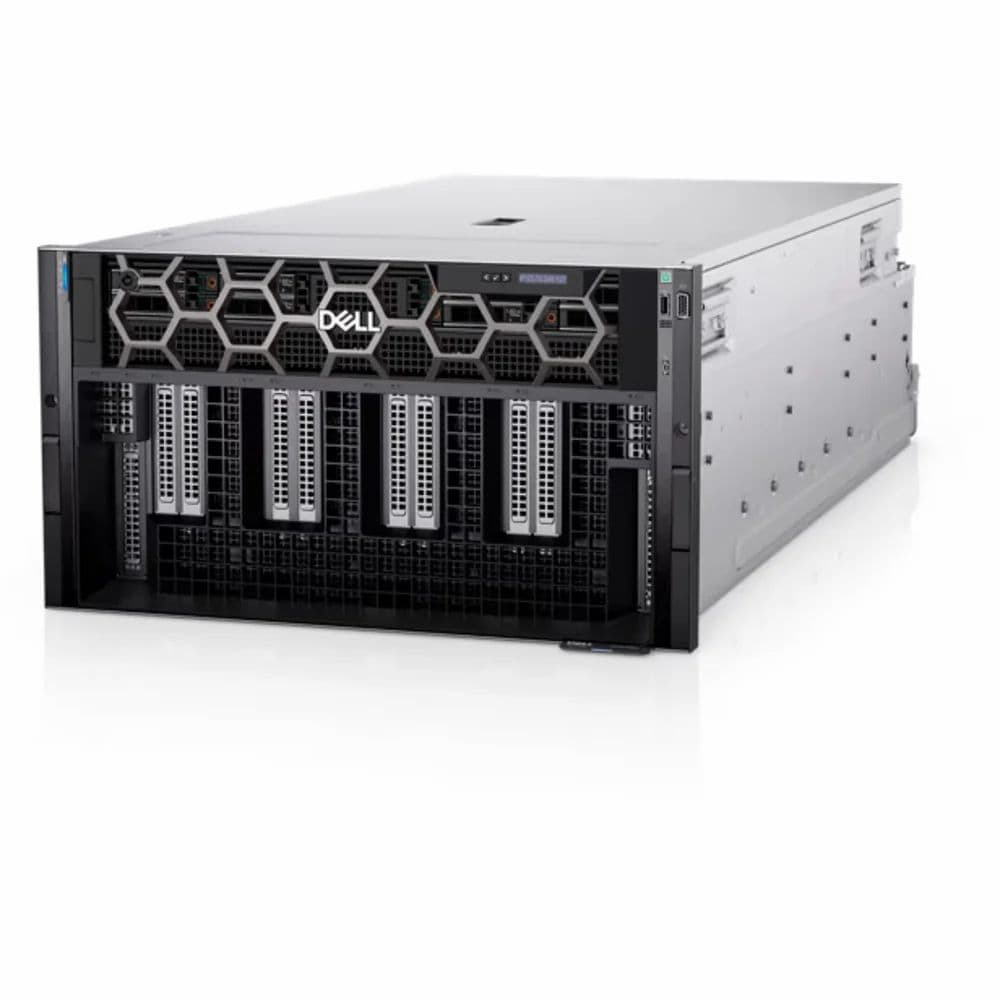
| Form Factor | 6U Rack Server | 8U Rackmount (CSE-GP801TS chassis) |
| GPU Configuration | 8× GPUs per Node (H100/H200/MI300X/Gaudi3) | 8× GPUs (HGX H100/H200 SXM onboard) |
| GPU Memory (Max) | 1.12TB (8× H200 NVLink pool) | 1.128TB (8× H200 141GB) |
| GPU Interconnect Bandwidth | 900 GB/s (NVLink full-mesh) | 900 GB/s (NVLink 4.0 + NVSwitch) |
| System Memory (Max) | 4TB (32 DIMMs DDR5 5600 MT/s) | 8TB (32 DIMMs DDR5 4400 MT/s) |
| PCIe Slots (Gen5 x16) | 10× PCIe Gen5 Slots | 8× PCIe 5.0 x16 LP + 2× PCIe 5.0 x16 FHHL (optional: 2 additional FHHL) |
| Compute | ||
| Processor | Dual Intel Xeon Scalable 5th Gen (up to 64 cores) or 4th Gen (up to 56 cores) | Dual Socket E (LGA-4677) — 5th/4th Gen Intel Xeon Scalable; up to 64C/128T, 320MB LLC, 350W TDP |
| CPU-GPU Interconnect | PCIe Gen5 x16 | PCIe 5.0 x16 |
| Memory | ||
| Memory | 32 DDR5 DIMMs, up to 4 TB @ 5600 MT/s (5th Gen) | 32× DDR5 DIMM slots; up to 4TB at 5600MT/s (1DPC) or 8TB at 4400MT/s (2DPC) ECC RDIMM |
| Storage | ||
| Storage Options | 8× 2.5" NVMe/SAS/SATA or 16× E3.S NVMe — up to 122.88 TB | 12× front hot-swap 2.5" NVMe (default); optional 4× additional NVMe; 3× 2.5" SATA; 2× M.2 NVMe |
| Networking | ||
| Networking | 1× OCP 3.0 + 2× 1GbE LOM; PCIe InfiniBand/Ethernet via slots | Flexible — PCIe 5.0 slots support 400GbE / NDR InfiniBand NICs |
| GPU / Accelerators | ||
| GPU Accelerators | 8× NVIDIA HGX H200 (141 GB) / H100 (80 GB) / H20; 8× AMD MI300X (192 GB); 8× Intel Gaudi3 (128 GB) | 8× NVIDIA HGX H100 8-GPU (80GB HBM2e) or HGX H200 8-GPU (141GB HBM3e); SXM form factor |
| GPU Interconnect | NVLink full-mesh 900 GB/s (NVIDIA) / Infinity Fabric (AMD) | NVIDIA NVLink 4.0 + NVSwitch — 900 GB/s all-to-all bandwidth |
| Expansion / PCIe | ||
| PCIe Expansion | 10× PCIe Gen5 x16 (8 with Intel Gaudi3) | 8× PCIe 5.0 x16 LP + 2× PCIe 5.0 x16 FHHL (optional: 2 additional FHHL) |
| I/O & Ports | ||
| I/O Ports | -- | -- |
| Management | ||
| Management | iDRAC9 Enterprise / Datacenter, Redfish API, CloudIQ, OpenManage Enterprise | IPMI 2.0, dedicated BMC port, SuperDoctor; ACPI power management |
| Power | ||
| Power Supplies | 6× 3200W Titanium (277V) / 2800W Titanium (200–240V), 3+3 FTR | 6× 3,000W redundant (4+2) Titanium 96% efficiency |
| Physical / Environmental | ||
| Cooling | Air-cooled, 16 fans, 1200 CFM, 10–35°C ambient | Air-cooled — 10 heavy-duty fans with PWM speed control; no CDU required |
| Dimensions | 10.36" H × 18.97" W × 39.71" D (with bezel) | 14"H × 17.2"W × 33.2"D (355.6 × 437 × 843.28 mm) |
| Weight | Up to 251 lbs / 114 kg (configuration dependent) | Net: 75.3 kg (166 lbs); Gross: 102.1 kg (225 lbs) |
| Operating Temperature | 10–35°C ambient | 10°C to 35°C (50°F to 95°F) |
| Security | ||
| Security | Silicon Root of Trust, Secure Boot, Secure Component Verification, SEDs | Silicon RoT (NIST 800-193), Secure Boot, TPM header, cryptographically signed firmware |
| Software & OS Compatibility | ||
| Software & OS Compatibility | -- | -- |
| Warranty & Support | ||
| Warranty & Support | -- | -- |
Expert Analysis
The Dell PowerEdge XE9680 and Supermicro SYS-821GE-TNHR represent two formidable approaches to 8-GPU AI/ML server design, each with distinct architectural priorities. The Dell system offers superior flexibility with its support for NVIDIA, AMD, and Intel GPU accelerators—a significant advantage for organisations pursuing multi-vendor AI strategies or requiring specific accelerator compatibility. Its 10 PCIe Gen5 slots provide exceptional expansion capability for high-speed networking adapters and DPUs, while the integrated OCP 3.0 networking offers immediate out-of-box connectivity. The iDRAC9 management platform with CloudIQ predictive analytics delivers enterprise-grade remote management capabilities.
The Supermicro solution distinguishes itself with double the maximum system memory capacity at 8TB—a crucial advantage for memory-intensive workloads like large language model training or complex scientific simulations. While more specialised around NVIDIA GPUs, its 8U form factor provides additional internal space that may benefit cooling efficiency and serviceability. The system's storage configuration offers excellent NVMe density with 16 potential bays, though Dell's support for E3.S form factors provides alternative storage topology options. Supermicro's management interface, while functional, lacks the depth of Dell's integrated ecosystem.
Value propositions differ significantly: Dell delivers a more complete, vendor-integrated solution with superior management and multi-GPU vendor support, while Supermicro offers maximum memory capacity and potentially better cost-efficiency for pure NVIDIA-based deployments. Organisations requiring heterogeneous AI acceleration or extensive management capabilities will favour the Dell system, while those prioritising maximum memory for large-model training or seeking cost-optimised NVIDIA-focused deployments may prefer the Supermicro approach.
Ready to proceed?
Not sure which one fits your environment?
Our UK specialists will recommend the right option for your workload and send itemised pricing — vendor-neutral, no obligation.
Response within 4 business hours · 20+ yr UK reseller
Want to compare different products or add more to this comparison?
Open Interactive Comparison Tool →Made your choice? Spread the cost.
Whichever you choose, you don't have to pay for it all upfront — finance your new hardware from £1,935/mo ex VAT on hire purchase or lease. Compare monthly payments and terms in seconds.
See finance from £1,935/mo →Indicative estimate · subject to change · no credit check at this stage · hire purchase, lease & subscription for UK businesses
Indicative illustration only. Servnet Limited is not authorised or regulated by the FCA and does not provide financial advice or arrange finance. All finance opportunities are referred to Number Eight Business Finance. Finance policy
Related comparisons
Other head-to-heads featuring these models — useful if you’re still shortlisting.
Talk to a UK specialist
Get expert advice or a no-obligation quote — servers, storage, networking, maintenance, finance and cloud. We reply the same working day.