
☁️ Nutanix vs VMware vSAN vs Azure Stack HCI
Nutanix Cloud Platform vs VMware vSAN (ESA) vs Azure Stack HCI (Azure Local) compared across 27 matched specifications — scores, the full spec table and a verdict.

Nutanix vs VMware vSAN vs Azure Stack HCI: performance overview
Scores based on quantifiable specification values (1-10 scale)
Detailed Specifications
| Specification | Nutanix Cloud Platform Nutanix | VMware vSAN (ESA) VMware | Azure Stack HCI (Azure Local) Microsoft |
|---|---|---|---|
| Key Metrics | |||
| Customer Base / Market Recognition | 27K+ Customers (Globally across all industries) / 9× Leader (Gartner Magic Quadrant) | 70% More Capacity (vs vSAN OSA) / 10.6× Performance Uplift / 40% Cost Reduction / 365% 3-Year ROI | 16 Max Nodes / 4PB Storage/Cluster / 1,024 VMs/Host / $10 /Core/Month / 24TB Max RAM/Host / Arc Azure Integration |
| Platform Architecture | One Platform (For VMs, containers & cloud) | Express Storage Architecture (ESA) — single NVMe tier | Azure Stack HCI / Azure Local (version 2603, March 2026) |
| Resilience / Redundancy | RF3 Resilience (Max redundancy with erasure coding) | RAID-1 (FTT=1,2,3), RAID-5/6 Erasure Coding | Storage Spaces Direct (S2D) — software-defined NVMe/SSD/HDD storage across all nodes |
| Compute | |||
| Hypervisor / Virtualisation Platform | AHV (included) / VMware ESXi / Hyper-V | ESXi (via vCenter Server) | Hyper-V (Windows Server-based) |
| Maximum vCPUs per Host | -- | -- | 2,048 virtual processors (Generation 2 VM) |
| Maximum VMs per Host | -- | 500+ VMs per host | 1,024 VMs per host |
| Kubernetes Support | Unlimited K8s clusters (Pro+); Cloud Native AOS (2025) | -- | AKS enabled by Azure Arc — run Kubernetes workloads on-prem, managed from Azure |
| Memory | |||
| Minimum Host Memory | -- | 128 GB per ESXi host | -- |
| Maximum RAM per Host | -- | -- | 24 TB per host |
| Storage | |||
| Storage Architecture | Scale-out HCI storage with built-in enterprise hypervisor | Single-tier NVMe architecture — every device contributes to capacity and performance | Storage Spaces Direct (S2D) — software-defined NVMe/SSD/HDD storage across all nodes |
| Storage Devices / Types | Supported Hardware: Nutanix NX / Dell XC / HPE DX / Lenovo HX / Third-party | NVMe TLC flash (certified in Broadcom HCL) | NVMe, SSD, HDD — all-flash or hybrid configurations |
| Maximum Cluster Capacity | -- | 8.5 PB per vSAN cluster | 4 PB per cluster (Storage Spaces Direct) |
| Maximum Storage per Node | -- | -- | 400 TB per server |
| Volume Size / Volumes per Cluster | -- | -- | Up to 64 TB per volume; up to 64 volumes per cluster |
| Data Reduction / Efficiency | Erasure Coding (Pro+) | RAID-6 erasure coding efficiency with RAID-1 write performance | -- |
| Encryption | SED/Software encryption | Data-at-Rest Encryption (AES-256, KMIP external KMS) | -- |
| Networking | |||
| Networking Speeds | -- | 10/25/100 GbE (25 GbE minimum recommended for ESA) | 10/25/100 GbE with RDMA (iWARP or RoCEv2); SDN via Network Controller |
| GPU / Accelerators | |||
| GPU Support | -- | -- | NVIDIA A16, L4, L40S, RTX PRO 6000 Blackwell (latest releases) |
| Expansion / PCIe | |||
| Cluster Scale / Nodes | Min Starter Cluster: 3 nodes (max 12 nodes at Starter) / Pro/Ultimate Cluster: Up to 32 nodes per AHV cluster | 3–64 ESXi hosts per vSAN cluster | 1–16 nodes per cluster (2–8 per site for stretched clusters) |
| Management | |||
| Management Interface | Prism Central: single-pane-of-glass management for unlimited nodes and clusters / Nutanix Cloud Manager: intelligent automation, cost governance, and security compliance | Fully integrated in vCenter Server — no separate UI | Azure portal, Windows Admin Center, Azure Arc |
| Lifecycle Management | One-click infrastructure lifecycle management and non-disruptive upgrades | -- | -- |
| Cloud Integration | Cloud Support: AWS NC2 / Microsoft Azure / Google Cloud | -- | Azure Integration: Arc Resource Bridge, AKS Arc, Azure Monitor, Defender for Cloud / Managed from the Azure portal with unified billing to your Azure subscription |
| Security | |||
| Security Features | Microsegmentation (Ultimate) / STIG | -- | -- |
| Software & OS Compatibility | |||
| Editions / Licensing Model | Editions: NCP Starter / NCP Pro / NCP Ultimate / Licensing: Per core, term license (6–60 months) | Licensing: Subscription per core via VCF or VVF; vSAN Add-on per TiB available | Licensing: $10/core/month host fee (Standard), plus $23.30/core/month for the optional Windows Server guest subscription |
| Disaster Recovery RPO | DR RPO — Starter: 1 hour minimum RPO / DR RPO — Pro: Multi-site async DR (RPO > 1 hour) / DR RPO — Ultimate: NearSync (RPO 1.15 min) and Sync (RPO = 0) | -- | -- |
| Version / Minimum Requirements | Min AOS Version: AOS 6.1.1 (LTS: AOS 6.5) / Prism Central 2022.4+ | Version: vSAN 9.0 (part of VCF 9.0) — current release 2025 | -- |
| Hardware Compatibility | Supported Hardware: Nutanix NX / Dell XC / HPE DX / Lenovo HX / Third-party | Hardware: vSAN ReadyNode certified platforms (Dell, HPE, Lenovo, Cisco, Supermicro) | Run Azure services on-premises — VMs, AKS, Arc-enabled services — on validated hardware |
Expert Analysis
The Nutanix Cloud Platform excels as a comprehensive, multi-cloud hyperconverged infrastructure solution, offering exceptional flexibility with support for multiple hypervisors (AHV, ESXi, Hyper-V), unlimited Kubernetes clusters in its Pro and Ultimate editions, and strong multi-cloud integration across AWS, Azure, and Google Cloud. Its management capabilities through Prism Central and Nutanix Cloud Manager provide sophisticated automation and single-pane-of-glass oversight, making it particularly suitable for organisations seeking to avoid vendor lock-in while maintaining enterprise-grade resilience with RF3 redundancy and erasure coding. The platform's strength lies in its ability to support diverse workloads across virtual machines, containers, and cloud services from a unified architecture.
VMware vSAN (ESA) demonstrates superior storage performance and efficiency with its single-tier NVMe architecture, delivering up to 10.6× performance improvement and 70% more usable capacity compared to its predecessor. The tight integration with vCenter Server eliminates separate management overhead, while the architecture's support for up to 64 nodes and 8.5PB per cluster provides substantial scalability for storage-intensive workloads. This solution is particularly compelling for existing VMware estates seeking to maximise storage performance without adding complexity, with certified hardware across major OEMs ensuring compatibility and support for business-critical database deployments where performance and reliability are paramount.
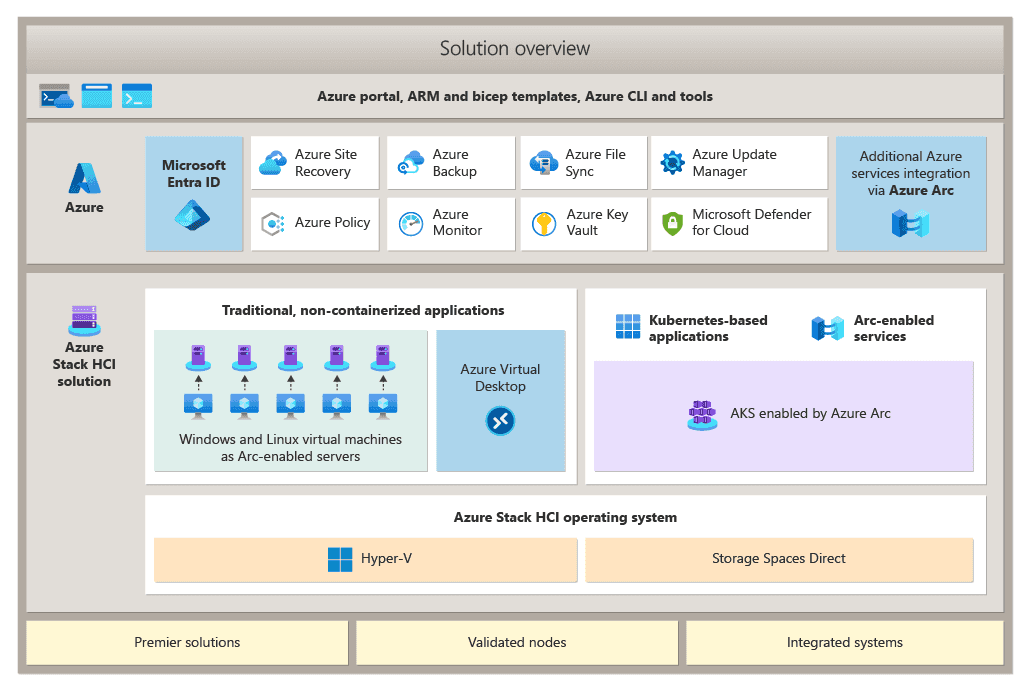
Azure Stack HCI offers the deepest Azure integration of the three platforms, with native management through the Azure portal, unified billing, and comprehensive Arc-enabled services including AKS and VM management. The platform supports impressive compute density with up to 1,024 VMs per host and 2,048 vCPUs, alongside strong GPU support for accelerated workloads. While its 16-node cluster limit and 4PB maximum capacity are more constrained than vSAN's specifications, the $10 per core monthly subscription provides predictable operational expenditure, particularly attractive for organisations already invested in the Microsoft ecosystem seeking to extend Azure services to their on-premises infrastructure with consistent management experience.
Ready to proceed?
Not sure which one fits your environment?
Our UK specialists will recommend the right option for your workload and send itemised pricing — vendor-neutral, no obligation.
Response within 4 business hours · 20+ yr UK reseller
Want to compare different products or add more to this comparison?
Open Interactive Comparison Tool →Made your choice? Spread the cost.
Whichever you choose, you don't have to pay for it all upfront — finance your new hardware from £860/mo ex VAT on hire purchase or lease. Compare monthly payments and terms in seconds.
See finance from £860/mo →Indicative estimate · subject to change · no credit check at this stage · hire purchase, lease & subscription for UK businesses
Indicative illustration only. Servnet Limited is not authorised or regulated by the FCA and does not provide financial advice or arrange finance. All finance opportunities are referred to Number Eight Business Finance. Finance policy
Turn one workload into a node count across vSAN, Nutanix and Azure Local — then get the nodes quoted.
Related comparisons
Other head-to-heads featuring these models — useful if you’re still shortlisting.
Talk to a UK specialist
Get expert advice or a no-obligation quote — servers, storage, networking, maintenance, finance and cloud. We reply the same working day.