
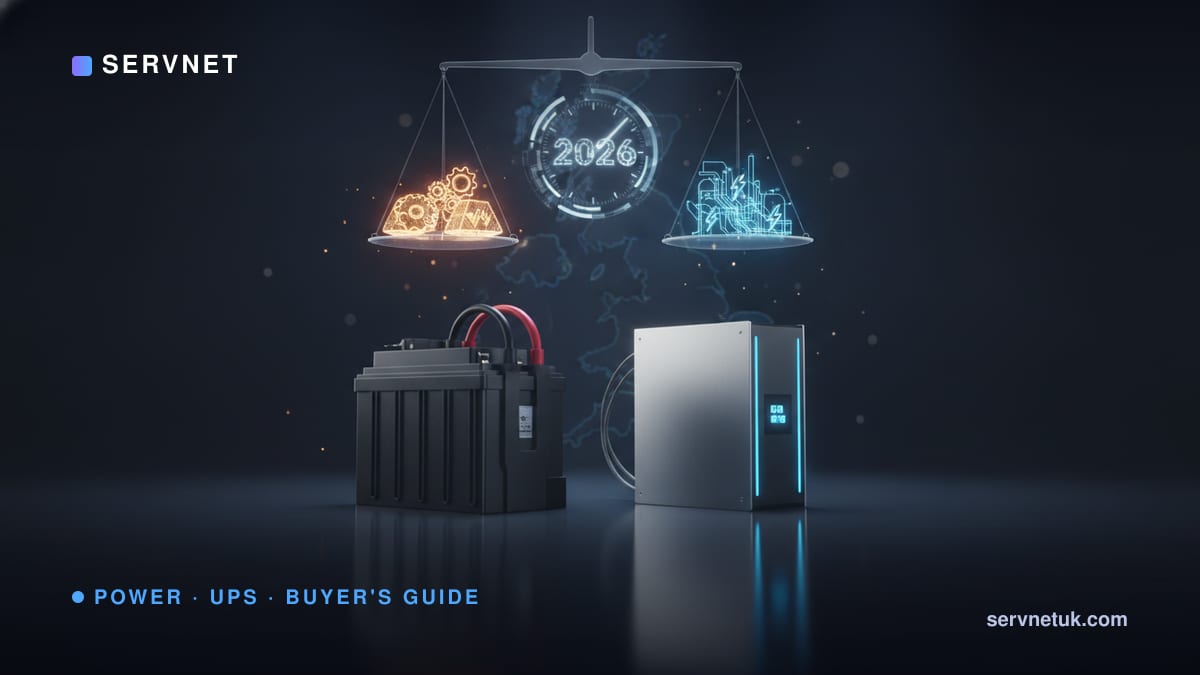
The battery is the part of a UPS that wears out — and the choice between valve-regulated lead-acid (VRLA) and lithium-ion now changes the whole ownership story. Lithium costs more upfront but lasts far longer, tolerates heat and holds capacity better under load. This guide compares the two so you choose well; size the UPS itself with our UPS calculator.
View the data behind this chart
| Cumulative cost (indexed) | 0 | 3 | 5 | 7 | 10 |
|---|---|---|---|---|---|
| VRLA (replacements) | 10 | 16 | 30 | 36 | 50 |
| Lithium-ion | 16 | 17 | 18 | 19 | 22 |
VRLA — the incumbent
Valve-regulated lead-acid has powered UPS for decades: cheap, proven and recyclable. The trade-offs are a 3–5 year service life, sensitivity to heat (life roughly halves per 10°C above 25°C), and a significant Peukert penalty — it gives up noticeably less capacity at high UPS discharge rates.
It remains a sensible choice for short runtimes, cost-sensitive secondary sites and rooms where the (modest) extra cost of lithium is hard to justify.
Lithium-ion — the new mainstream
Lithium-ion (typically LFP in UPS) now leads new deployments. It offers an 8–10 year service life, far better tolerance of warm environments, a small fraction of the weight and footprint for the same energy, built-in battery monitoring, and a much smaller Peukert effect so runtime holds up better under load.
APC Smart-UPS Ultra, lithium variants of the Eaton 9PX, and Riello’s lithium ranges are all available in 2026.
Lifespan and total cost
Lithium typically costs more upfront (commonly 30–50% more for the battery), but a VRLA UPS usually needs one or two full battery replacements over a 10-year life while a lithium system often runs the whole period on its original pack. Once you count replacement parts, labour and the downtime risk of ageing batteries, lithium frequently wins over 6–10 years.
The crossover point depends on your runtime, site temperature and replacement labour. We model it against your specific load and site when we quote.
Footprint, weight and temperature
Lithium’s energy density means more runtime in the same rack U-space, or the same runtime in far less — useful where rack space is scarce. It is also markedly lighter, which matters for floor loading and for upper-rack mounting.
Crucially, lithium tolerates warmer rooms with far less life penalty than VRLA. In a comms cupboard that runs warm, lithium’s longevity advantage widens — though good cooling still pays off (see the cooling calculator).
Replacement, monitoring and disposal
Both chemistries are recyclable and both should be replaced proactively, not run to failure. Lithium UPS include a battery management system that reports state-of-health, so you replace on data rather than a fixed calendar. VRLA replacement is well-understood and we stock cartridges for APC and Eaton with same-day UK shipping.
Whichever you choose, size the UPS and runtime first with the UPS calculator, then compare brands in APC vs Eaton vs Riello — we quote both battery options on the same load.