
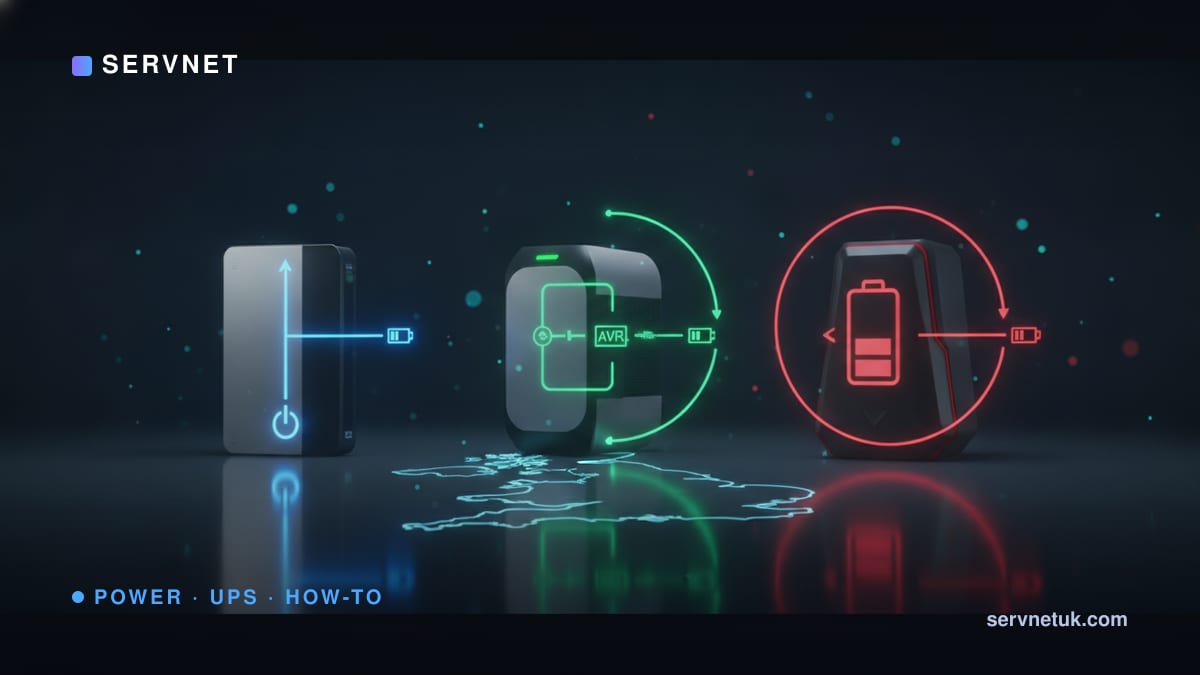
UPS come in three topologies — standby, line-interactive and online double-conversion — defined by the IEC 62040-3 standard (VFD, VI and VFI). They differ in how cleanly they protect the load and how much they cost to run. This guide explains each so you buy the right class, not just the right kVA. Size the rating with our UPS calculator.
View the data behind this chart
| Standby (VFD) | Line-int. (VI) | Online (VFI) | |
|---|---|---|---|
| Transfer time | up to ~10 ms | ~2–4 ms | zero |
| Voltage reg (AVR) | No | Yes | Regulated |
| Efficiency | ~98 % | ~97–98 % | ~92–96 % (ECO ~99 %) |
| Protection | Basic | Good | Full isolation |
| Best for | Desktop / till | SMB server room | Data centre / critical |
The three classes
Standby (VFD — Voltage and Frequency Dependent): the load runs on raw mains; the UPS switches to battery only when mains fails. Cheapest, used for desktops and tills.
Line-interactive (VI — Voltage Independent): adds automatic voltage regulation (AVR) to correct sags and surges without using the battery. The sweet spot for small server rooms and network closets.
Online double-conversion (VFI — Voltage and Frequency Independent): continuously rebuilds the output from DC, fully isolating the load from every mains disturbance with zero transfer time. The choice for data centres and critical loads.
Standby (offline)
In a standby UPS the kit is fed straight from the mains until it drops, then the inverter takes over within a few milliseconds. It is inexpensive and efficient, but offers no regulation and a (brief) transfer gap.
Fine for a single PC, POS terminal or home office. Not appropriate for servers, storage or anything sensitive to power quality.
Line-interactive
A line-interactive UPS adds AVR (a tap-changing transformer), so it can correct under- and over-voltage without draining the battery — valuable on UK supplies with frequent minor sags. Transfer to battery on a full outage is typically 2–4 ms, well within any IT power supply’s ride-through.
It is the best value for SMB server rooms and comms cabinets. The APC Smart-UPS SMT and Riello Sentinel Dual are typical line-interactive units in the 1–10 kVA range.
Online double-conversion
An online UPS converts incoming AC to DC and back to a clean, regulated AC sine wave continuously, so the load is always on inverter power — there is no transfer time at all, and frequency as well as voltage is regulated.
This is what data centres, medical and industrial loads need. Eaton 9PX, APC Smart-UPS Ultra and Eaton 93PM are online units; many add a high-efficiency “ECO” mode (~99%) that bypasses double-conversion when conditions are clean.
Which should you choose?
Single PC or till → standby. Small server room or network closet on a reasonable supply → line-interactive. Servers, storage, virtualisation, anything you cannot afford to drop, or a poor/frequently-disturbed supply → online double-conversion.
Once the class is decided, size the rating and runtime with the UPS calculator, then compare APC, Eaton and Riello on the same spec and we quote all three.