
A BOSS card (commonly expanded as Boot Optimized Storage Solution) is Dell's branded dedicated boot RAID device designed to host and protect a server's operating system on mirrored M.2 solid-state drives, completely separate from primary storage bays. In modern enterprise infrastructure, dedicating two front-facing drive bays merely to run an operating system mirror often wastes costly drive slots and backplane lanes compared with using a dedicated boot module. Hardware boot devices eliminate that penalty by moving the hypervisor or OS volume onto internal or rear-accessible M.2 media. Dell, HPE, and Lenovo each market boot-device families for mirrored OS storage under names such as Dell BOSS, HPE NS204i, and Lenovo ThinkSystem M.2 with Mirroring. HPE’s NS204i-u NVMe OS Boot Device is described as a self-contained, pre-configured dedicated slot card that includes two 480 GB M.2 NVMe SSDs to mirror the operating system through hardware RAID 1, and HPE advertises up to 4x faster read capability than legacy SATA boot solutions; this design helps keep primary backplanes focused on data storage.
View the data behind this chart
| Legacy SATA Boot | HPE NS204i-u NVMe | |
|---|---|---|
| Relative Read Index | x1 | x4 |
What is a BOSS Card and Why Does Modern Architecture Require It?
A BOSS card is Dell’s Boot Optimized Server Storage module, a dedicated boot device that typically houses dual M.2 SSDs behind a hardware RAID 1 controller. While 'BOSS' is Dell's proprietary branded term, other manufacturers market distinct equivalent boot-device families: HPE offers its NS204i boot devices, and Lenovo provides ThinkSystem M.2 with Mirroring enablement kits. These vendor solutions are not identical products, but they share the same architectural objective: isolating the operating system onto dedicated, mirrored storage so that primary backplane bays remain entirely available for user data.
In plain language, a dedicated boot card separates OS storage from front-bay data SSDs to maximise usable capacity and maintain operational isolation. Front-facing drive bays connect to primary storage controllers and backplanes engineered for bulk storage and transactional workloads. Historically, some servers used mirrored SAS or SATA drives in standard drive bays for the operating system, which reduced capacity available for data. In an eight-bay or twelve-bay chassis, dedicating two bays to low-capacity operating system disks reduces the bays available for data by roughly 25% in an 8-bay chassis and about 17% in a 12-bay chassis before any production data is stored.
The alternative was relying on internal USB flash drives or dual SD card modules (IDSDM). However, USB and SD boot media generally offer lower endurance and less robust operational monitoring than dedicated mirrored boot devices, which can increase boot-risk in heavily written server roles. From a buying perspective, a single boot SSD may be acceptable in non-resilient environments where downtime is tolerated or where server nodes are fully stateless and easily replaced. However, the main risk to avoid is assuming a single boot SSD is enough for resilient server operations; mirrored boot modules provide automated hardware-level redundancy and a dependable replacement path when an OS drive fails.
How Dedicated OS Boot Devices Differ from Traditional Boot Methods
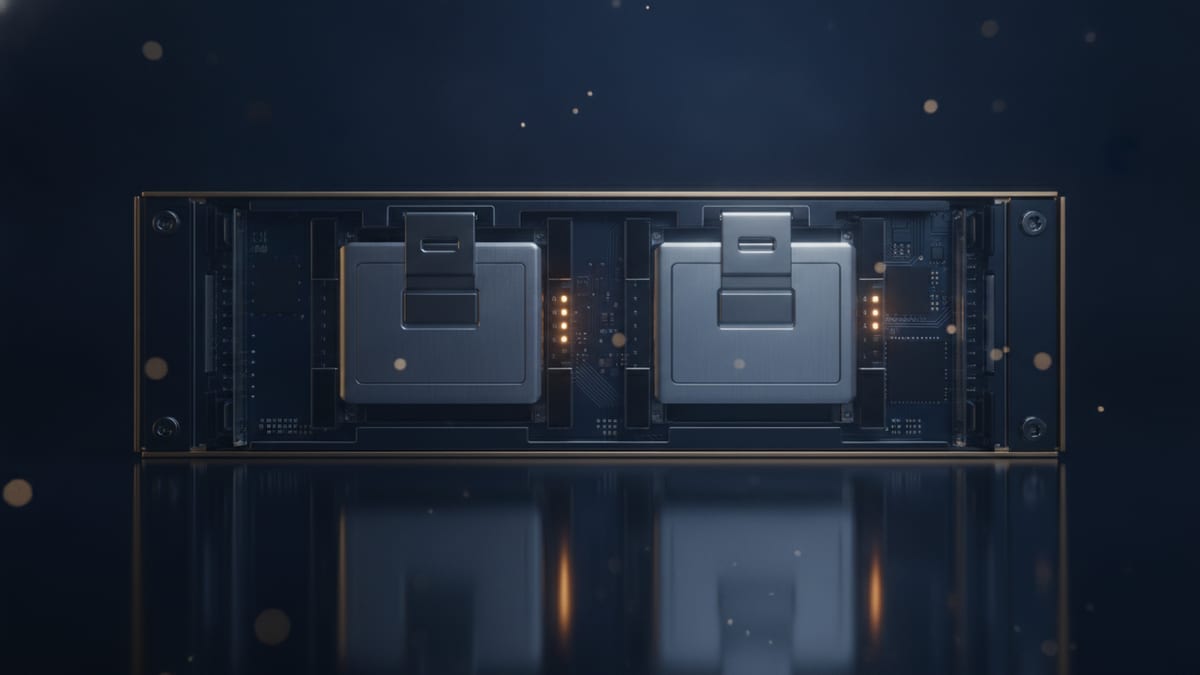
A dedicated enterprise boot device, such as Dell BOSS or HPE NS204i, typically provides hardware-managed redundancy and presents a dedicated logical boot volume to the host. Rather than relying on host operating system software RAID, dedicated boot modules isolate the mirror configuration entirely on their own onboard hardware controllers.
According to technical documentation for HPE OS boot options, cards such as the NS204i operate strictly in hardware RAID 1 mode and will not operate in any other RAID mode. For devices like HPE's NS204i family, the host operating system does not see two individual physical M.2 drives; instead, it detects a single, pre-configured logical unit. Because the RAID 1 array is managed at the hardware controller level, the boot volume appears as a single standard disk to the OS and typically requires no special RAID drivers, management GUI, or pre-installation array configuration by deployment engineers.
HPE documentation says the NS204i family uses UEFI boot mode. By offloading drive monitoring and array synchronization to a dedicated controller, hardware boot modules isolate drive rebuild operations entirely from the server's main host bus adapters (HBAs) and primary storage controllers.
Dell BOSS Architecture: From S-Series to BOSS-N1
Dell Technologies uses the Boot Optimized Server Storage (BOSS) name for its boot-device portfolio, designed to streamline OS installation on PowerEdge platforms. Dell support documentation covers the BOSS-N1 DC-MHS M.2 NVMe SSD card, detailing M.2 NVMe SSD card installation and carrier replacement within the Data Center-Ready Modular Hardware System (DC-MHS) framework.
Using NVMe media can reduce the storage bottlenecks associated with SATA compared with older boot-device designs. For organisations sizing PowerEdge infrastructure, administrators can select these dedicated modules directly via the Dell server configurator to ensure primary drive bays remain reserved for NVMe data pools.
Vendor Implementations: HPE NS204i vs Lenovo ThinkSystem M.2
Hewlett Packard Enterprise delivers boot isolation through distinct product families. In its Gen11 portfolio, HPE features the NS204i-u boot device, designed as a self-contained boot solution in a pre-configured dedicated slot card that requires no GUI or user setup. It mirrors the operating system through hardware RAID 1 across two physical M.2 SSDs.
HPE’s NS204i-u is offered in 480 GB and 960 GB variants, and HPE’s v2 data sheet describes them as NVMe and hot-plug. HPE’s product-catalog page says the 960 GB NS204i-u variant includes optional SED capability, and HPE states the NS204i-u delivers up to 4x faster read capability than legacy SATA boot solutions. By contrast, HPE's older NS204i-p is a PCIe HHHL card (using a physical PCIe x8 and electrical PCIe x4 interface) that uses dual 22110 form-factor 480 GB SSDs with power-loss protection, preconfigured with hardware RAID 1 for OS boot only. Infrastructure teams can specify these options via the HPE server configurator.
Lenovo addresses boot isolation using its ThinkSystem M.2 with Mirroring Enablement Kit. Lenovo states that the kit contains the dual M.2 boot adapter and supports 1 or 2 drives, installing into a dedicated slot on the system board. In documentation for platforms like the ThinkSystem SR850, Lenovo notes that two M.2 drives are configured by default as a RAID-1 mirrored pair for redundancy. Lenovo continues to ship firmware updates for its NVMe 7mm M.2 mirroring enablement kits, indicating ongoing vendor support for these boot-device options in systems configured through the Lenovo server configurator.
View the data behind this chart
| Layer | Detail |
|---|---|
| Operating System / Hypervisor | Isolated on mirrored hardware RAID 1 M.2 drives |
| Dedicated Boot Hardware | Dell BOSS, HPE NS204i, or Lenovo M.2 adapter |
| Primary Drive Bays & Backplane | 100% capacity reserved for data and workloads |
Storage Bay Economics and Real-World HCI Deployment
Evaluating a dedicated boot module requires analyzing physical chassis economics alongside operational resilience. In enterprise configurations, physical backplane slots carry a substantial premium. In an eight-bay or twelve-bay chassis, dedicating standard front drive bays to low-capacity operating system disks reduces the bays available for production storage by roughly 25% and 17% respectively. By offloading boot operations onto a dedicated internal adapter or rear-facing module, all front-facing backplane slots remain available for primary data pools.
Isolating the operating system onto dedicated hardware RAID 1 drives also prevents I/O contention. Heavy application read and write bursts across primary data arrays cannot starve hypervisor or OS operations of disk cycles, preventing false-positive cluster evictions or unresponsive management agents. To see how RAID mirroring behaves across storage media, administrators can understand RAID levels and their fault-tolerance characteristics.
This architectural separation provides vital stability in hyperconverged infrastructure (HCI) environments such as VMware vSAN, Nutanix, and Microsoft Azure Stack HCI. In standard hyperconverged topologies, software-defined storage layers take ownership of physical storage controllers and all attached backplane media. Installing an operating system onto disks managed by an SDS layer creates complications during bootstrap or failure recovery. A dedicated boot device like a Dell BOSS-N1 or HPE NS204i removes this dependency, allowing the host to boot cleanly from its hardware RAID 1 volume before the storage controller initializes. For configurations supporting hot-plug drive carriers—such as the HPE NS204i-u v2 or Dell BOSS systems with carrier replacement designs—technicians can replace a degraded M.2 drive and rebuild the mirror in the background with minimal operational disruption.
The UK Market Perspective: Procurement and Fleet Standardisation
When procuring servers across multi-vendor enterprise fleets in the UK—whether via Crown Commercial Service (CCS) technology frameworks or direct channel procurement—architectural consistency matters more than vendor-specific branding. Whether standardising on Dell PowerEdge, HPE ProLiant, or Lenovo ThinkSystem, the core requirement remains identical: ensuring server configurations specify dual-drive mirrored boot kits rather than single non-redundant M.2 drives or standard front bays.
From a commercial perspective, adding a dedicated mirrored boot kit generally represents a modest uplift cost per server compared with consuming two costly high-performance NVMe data bays. Because boot hardware is supplied through channel distribution, buyers should validate pricing directly in GBP at quotation stage rather than relying on converted international list prices. Additionally, confirming local UK spares availability for replacement M.2 modules and carriers ensures engineering teams can satisfy standard four-hour or next-business-day hardware service level agreements without unexpected downtime.
Sources
Every figure in this article traces to the sources below.
- •Dell Technologies — BOSS-S1 and BOSS-N1 DC-MHS Documentation
- •HPE — NS204i-u Gen11 Boot Device Specifications
- •HPE — NS204i-u v2 Hot-Plug NVMe Boot Device Data Sheet
- •HPE — OS Boot Device Options QuickSpecs
- •Lenovo — ThinkSystem M.2 with Mirroring Enablement Kit
- •Lenovo Press — ThinkSystem SR850 Server Product Guide
- •Lenovo Support — NVMe 7mm M.2 with Mirroring Enablement Kit Firmware Update