Head-to-head · every figure from the vendor documents
Dell R740xd vs Lenovo SR665 V3
A specification-by-specification comparison of the Dell PowerEdge R740xd and the Lenovo ThinkSystem SR665 V3, built from Dell’s and Lenovo’s own documents. None of the headline measures favour the R740xd; 6 favour the SR665 V3, and they share no processors.
Bottom line. SR665 V3 leads on virtualisation, databases and in-memory work, storage density, AI and acceleration, network throughput. Neither vendor publishes benchmarks for these machines, so every call here is made on what their documents state.
Each row is a figure both vendors publish. Bars show the split between the two; a badge marks the larger figure, which is not always the better buy — a shallower chassis or a lower power ceiling can matter more.
R740xd2
Processor sockets
SR665 V32
R740xd56
Cores, fully populated
Largest listed processor × its socket count
SR665 V3320Higher
R740xd3 TB
Memory ceiling
As each document states it
SR665 V36 TBHigher
R740xd24
Drive bays
SR665 V340Higher
R740xdUp to 6
Accelerators
SR665 V3Up to 7Higher
R740xd2,400 W
Largest power supply
SR665 V32,600 WHigher
R740xd2U Rack
Rack height
SR665 V32U Rack
R740xd25 GbE class
Fastest network option
SR665 V3400 GbE classHigher
02 — Verdict
Which one, and why
Drawn from the measures above and each model’s own data sheet. Neither vendor publishes benchmark results for these servers, so nothing here claims one is “faster”.
Choose the R740xd if…
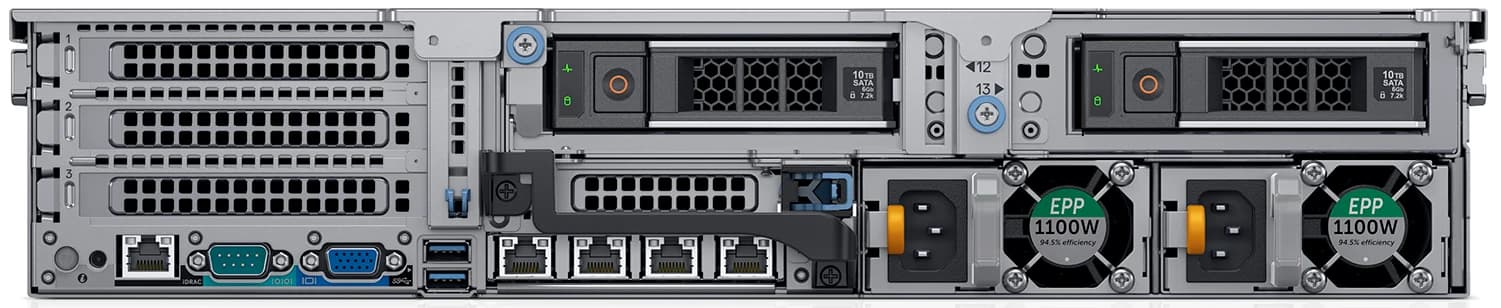
Dell’s specification table gives this chassis three separate rows of drive bays — front, mid-chassis and rear — where the R740 printed in the same document has front bays only.
Choose the SR665 V3 if…
Cores, fully populated: 320 against 56 on the R740xd
Memory ceiling: 6 TB against 3 TB on the R740xd
Drive bays: 40 against 24 on the R740xd
Lenovo lists 48 processors across two EPYC generations in one chassis, spanning 8 cores (EPYC 9015) to 160 (EPYC 9845) at up to 400 W.
03 — By workload
Where each one pulls ahead
Calls made on documented capacity only — cores, memory, bays, accelerators and network options — with the figures behind each one shown.
VirtualisationR740xd: 56 cores with 3 TB. SR665 V3: 320 cores with 6 TB.SR665 V3
Databases & in-memoryMemory ceiling 3 TB against 6 TB, across 24 and 24 DIMM slots.SR665 V3
Storage density24 bays in 2U against 40 in 2U.SR665 V3
AI & acceleration6 accelerators against 7 in the vendor documents.SR665 V3
Network throughputFastest card listed: 25 GbE class against 400 GbE class.SR665 V3
04 — Specifications
Side by side, differences first
Everything both documents state, grouped. The default view hides rows where the two machines are identical.
Processors
Every processor each vendor lists for the model, from its own document.
Chassis depthVendors measure depth differently — see each data sheet
Tables 4/17: height 86.8 mm
766 mm
05 — The data
Processors, memory, bays and power
The same charts each data sheet carries, drawn to the same scale so the two ranges can be read against each other.
R740xd: processors by cores and TDP
Intel Xeon Processor Scalable Family 111Bubble size = L3 cache · hover a bubble for the full SKU
SR665 V3: processors by cores and TDP
AMD EPYC 9005 25AMD EPYC 9004 23Bubble size = L3 cache · hover a bubble for the full SKU
R740xd: memory with every slot filled
SR665 V3: memory with every slot filled
R740xd: drive bays
Front panel
24 × 2.5" SAS/SATA + NVMe at the front — 24 bays in total.
SAS/SATANVMeSAS/SATA + NVMe
SR665 V3: drive bays
Front panel
24 × 2.5" SAS/SATA at the front — 24 bays in total.
SAS/SATANVMeSAS/SATA + NVMe
R740xd: power supplies
AC−48 V DC
SR665 V3: power supplies
AC−48 V DC
07 — Questions
R740xd vs SR665 V3, answered
Is the R740xd or the SR665 V3 the faster server?
Neither document publishes benchmark results, so this page compares what they do state. The R740xd lists 111 processors up to 28 cores at 205 W; the SR665 V3 lists 48 up to 160 cores at 400 W. Fully populated that is 56 cores against 320.
Which holds more memory?
The R740xd has 24 DIMM slots and a stated ceiling of 3 TB with RDIMM/LRDIMM. The SR665 V3 has 24 and 6 TB.
Which takes more drives?
R740xd: 24 bays across 6 documented layouts. SR665 V3: 40 across 19. Counts include rear and mid-chassis positions where the vendor documents them.
Can either take GPUs?
R740xd: up to 6 accelerators, 2 double-wide cards listed. SR665 V3: up to 7, 6 double-wide listed.
Do they share any processors?
No. The two documents list different processors, so a like-for-like processor build is not possible across these two.
Where these figures come from. R740xd: Dell EMC PowerEdge R740 and R740xd Technical Guide (Rev. A12, August 2022) (Dell document). SR665 V3: Lenovo ThinkSystem SR665 V3 Server Product Guide (publication date is not printed in the text export; guide contains 'New as of July 2026' notes) (Lenovo document). Each claim on this page is derived from those documents, checked page by page on the two data sheets, and carries no pricing.