UK’s trusted IT infrastructure partner since 2003
Servnet
FinanceToolsConfiguratorGet in Touch
Technical data sheet · PowerEdge 14G · 2U storage-dense · supplied refurbished

Dell PowerEdge R740xdSpecifications, configurations & comparisons

Every drive bay Dell could fit into a 2U box is the point of the R740xd: twenty-four 2.5-inch or twelve 3.5-inch slots across the front, a four-drive tray buried mid-chassis, and two or four more at the back. It is a 2017 14th-generation platform that left Dell’s new-build catalogue years ago — we supply it refurbished and re-certified, not new. What follows is what its own technical guide says the chassis will take.

2U Rack1 or 2 socketsIntel Xeon Processor Scalable FamilyiDRAC9
24front drive bays2.5-inch · or twelve 3.5-inch
8mid and rear baysup to 4 mid-chassis + 4 rear
24NVMe drivesthe generational table’s ceiling
3TBDDR4 maximum24 slots · 7.68 TB with Optane
8PCIe 3.0 slotsat most four of them x16
2,400Wlargest supplyPlatinum · ten documented units

Every figure checked against the Dell EMC PowerEdge R740 and R740xd Technical Guide (Aug 2022, Rev. A12)

Form factor
2U Rack · 2 sockets
Processors
Intel Xeon Processor Family
Memory
24 × DDR4 RDIMM · up to 3 TB with RDIMM/LRDIMM
Drive bays
Up to 24 · 6 drive-bay layouts
Expansion
8 × PCIe
GPUs
Up to 6 · 5 listed
Boot
M.2 and BOSS and microSD · 2 boot options
Management
iDRAC9
01 — Overview

The R740xd at a glance

Our read of Dell’s documentation: where the R740xd is strong, and the limits worth knowing before you spec one.

Strengths

  • Dell’s specification table gives this chassis three separate rows of drive bays — front, mid-chassis and rear — where the R740 printed in the same document has front bays only.
  • The mid-chassis tray is the unusual one: four 3.5-inch slots that will also carry 2.5-inch disks in a hybrid carrier, hidden behind the fan wall where nothing else fits.
  • Twenty-four NVMe drives is what the generational comparison table claims for this pair, against the four PCIe SSDs and a common slot that the R730xd managed.
  • Memory is not rationed to pay for the bays: 24 DDR4 slots reach 3 TB on LRDIMMs, or 7.68 TB once Optane persistent memory is mixed in alongside them.
  • A mono-form HBA350i is listed for this model and withheld from the R740 — passthrough for software-defined storage without spending a PCIe slot on it.

Watch-outs

  • Rear bays are paid for in slots. Of the eight riser configurations Dell tabulates, only three are marked as leaving rear storage possible, and none of those three offers more than four PCIe slots.
  • Dell quotes a capacity ceiling for the front, the mid-chassis tray and the rear bays separately, and never prints a whole-chassis total — so any single headline drive count for this model is arithmetic, not a quoted figure.
  • Accelerators are fenced off: cards are permitted only on the 24 × 2.5-inch chassis, an NVMe front cuts the limit to two, and the one GPU the guide names by model is capped at two as well.
  • Loaded with 3.5-inch disks it weighs 33.1 kg against 28.6 kg for the equivalent R740 — worth checking against shelf and rail ratings before it goes up a rack.
  • The recommended inlet temperature is 30 °C in general, and the guide flags this model’s GPU and NVMe builds as exceptions to that figure without stating what they are.
Processors111 SKUs
Cores / CPU4–28
DIMM slots24
Drive layouts6
Max bays24
GPUsup to 6
PSU options10 · to 2,400 W
02 — Processors

111 supported processors, mapped

One processor table serves both machines in this guide — it is headed for the R740, Dell states it is the only such list in the document, and no R740xd-specific restriction appears anywhere. It runs to 111 SKUs spanning both the 1st and the 2nd generation of Xeon Scalable, from six-core Bronze parts up to 28 cores. The chart puts every one of them on core count against power draw.

Processor landscape — cores × TDP

111 SKUs · 1 family
Dell PowerEdge R740xd: every supported processor by cores and TDP081624320 W50 W100 W150 W200 W250 WCores per processorIntel Xeon Platinum 8280L — 28 cores · 205 W · 2.7 GHz base · 38.5 MB cache · DDR4-2933Intel Xeon Platinum 8280M — 28 cores · 205 W · 2.7 GHz base · 38.5 MB cache · DDR4-2933Intel Xeon Platinum 8280 — 28 cores · 205 W · 2.7 GHz base · 38.5 MB cache · DDR4-2933Intel Xeon Platinum 8180M — 28 cores · 205 W · 2.5 GHz base · 38.5 MB cache · DDR4-2667Intel Xeon Platinum 8180 — 28 cores · 205 W · 2.5 GHz base · 38.5 MB cache · DDR4-2667Intel Xeon Gold 6258R — 28 cores · 205 W · 2.7 GHz base · 38.5 MB cache · DDR4-2933Intel Xeon Platinum 8276L — 28 cores · 165 W · 2.2 GHz base · DDR4-2933Intel Xeon Platinum 8276M — 28 cores · 165 W · 2.2 GHz base · DDR4-2933Intel Xeon Platinum 8276 — 28 cores · 165 W · 2.2 GHz base · DDR4-2933Intel Xeon Platinum 8176M — 28 cores · 165 W · 2.1 GHz base · 38 MB cache · DDR4-2667Intel Xeon Platinum 8176 — 28 cores · 165 W · 2.1 GHz base · 38 MB cache · DDR4-2667Intel Xeon Gold 6238R — 28 cores · 165 W · 2.2 GHz base · 38.5 MB cache · DDR4-2933Intel Xeon Platinum 8270 — 26 cores · 205 W · 2.7 GHz base · DDR4-2933Intel Xeon Platinum 8164 — 26 cores · 205 W · 2.7 GHz base · 33 MB cache · DDR4-2667Intel Xeon Platinum 8170M — 26 cores · 165 W · 2.1 GHz base · 36 MB cache · DDR4-2667Intel Xeon Platinum 8170 — 26 cores · 165 W · 2.1 GHz base · 36 MB cache · DDR4-2667Intel Xeon Gold 6230R — 26 cores · 150 W · 2.1 GHz base · 35.75 MB cache · DDR4-2933Intel Xeon Platinum 8268 — 24 cores · 205 W · 2.9 GHz base · DDR4-2933Intel Xeon Platinum 8168 — 24 cores · 205 W · 2.7 GHz base · 33 MB cache · DDR4-2667Intel Xeon Gold 6248R — 24 cores · 205 W · 3 GHz base · 35.75 MB cache · DDR4-2933Intel Xeon Platinum 8260L — 24 cores · 165 W · 2.4 GHz base · DDR4-2933Intel Xeon Platinum 8260M — 24 cores · 165 W · 2.4 GHz base · DDR4-2933Intel Xeon Platinum 8260Y — 24 cores · 165 W · 2.4 GHz base · DDR4-2933Intel Xeon Platinum 8260 — 24 cores · 165 W · 2.4 GHz base · DDR4-2933Intel Xeon Gold 6240 — 24 cores · 165 W · 2.6 GHz base · DDR4-2933Intel Xeon Gold 6240R — 24 cores · 165 W · 2.4 GHz base · 35.75 MB cache · DDR4-2933Intel Xeon Gold 6212U — 24 cores · 165 W · 2.4 GHz base · DDR4-2933Intel Xeon Platinum 8160M — 24 cores · 150 W · 2.1 GHz base · 33 MB cache · DDR4-2667Intel Xeon Platinum 8160 — 24 cores · 150 W · 2.1 GHz base · 33 MB cache · DDR4-2667Intel Xeon Gold 6252 — 24 cores · 150 W · 2.1 GHz base · DDR4-2933Intel Xeon Gold 6252N — 24 cores · 150 W · 3 GHz base · 35.75 MB cache · DDR4-2933Intel Xeon Gold 5220R — 24 cores · 150 W · 2.2 GHz base · 35.75 MB cache · DDR4-2933Intel Xeon Platinum 6262V — 24 cores · 135 W · 1.9 GHz base · 33 MB cache · DDR4-2400Intel Xeon Gold 6238 — 22 cores · 140 W · 2.1 GHz base · 30.25 MB cache · DDR4-2933Intel Xeon Gold 6238L — 22 cores · 140 W · 2.1 GHz base · 30.25 MB cache · DDR4-2933Intel Xeon Gold 6238M — 22 cores · 140 W · 2.1 GHz base · 30.25 MB cache · DDR4-2933Intel Xeon Gold 6152 — 22 cores · 140 W · 2.1 GHz base · 25 MB cache · DDR4-2667Intel Xeon Gold 6242R — 20 cores · 205 W · 3.1 GHz base · 27.5 MB cache · DDR4-2933Intel Xeon Gold 6248 — 20 cores · 150 W · 2.5 GHz base · DDR4-2933Intel Xeon Gold 6210U — 20 cores · 150 W · 2.5 GHz base · DDR4-2933Intel Xeon Gold 6148 — 20 cores · 150 W · 2.4 GHz base · 27 MB cache · DDR4-2667Intel Xeon Gold 6230N — 20 cores · 125 W · 2.3 GHz base · 27.5 MB cache · DDR4-2933Intel Xeon Gold 6230 — 20 cores · 125 W · 2.1 GHz base · DDR4-2933Intel Xeon Gold 6209U — 20 cores · 125 W · 2.1 GHz base · 27.5 MB cache · DDR4-2933Intel Xeon Gold 6138 — 20 cores · 125 W · 2 GHz base · 27.5 MB cache · DDR4-2667Intel Xeon Gold 5218 — 20 cores · 125 W · 2.3 GHz base · 22 MB cache · DDR4-2667Intel Xeon Gold 5218R — 20 cores · 125 W · 2.1 GHz base · 27.5 MB cache · DDR4-2667Intel Xeon Gold 6222V — 20 cores · 115 W · 1.8 GHz base · 27.5 MB cache · DDR4-2400Intel Xeon Gold 6254 — 18 cores · 200 W · 3.1 GHz base · DDR4-2933Intel Xeon Gold 6154 — 18 cores · 200 W · 3 GHz base · 25 MB cache · DDR4-2667Intel Xeon Gold 6150 — 18 cores · 165 W · 2.7 GHz base · 25 MB cache · DDR4-2667Intel Xeon Gold 6240L — 18 cores · 150 W · 2.6 GHz base · 24.75 MB cache · DDR4-2933Intel Xeon Gold 6240M — 18 cores · 150 W · 2.6 GHz base · 24.75 MB cache · DDR4-2933Intel Xeon Gold 6240Y — 18 cores · 150 W · 2.6 GHz base · DDR4-2933Intel Xeon Gold 6140M — 18 cores · 140 W · 2.3 GHz base · 25 MB cache · DDR4-2667Intel Xeon Gold 6140 — 18 cores · 140 W · 2.3 GHz base · 25 MB cache · DDR4-2667Intel Xeon Gold 5220 — 18 cores · 125 W · 2.2 GHz base · DDR4-2667Intel Xeon Gold 5220S — 18 cores · 125 W · 2.7 GHz base · 24.75 MB cache · DDR4-2667Intel Xeon Gold 6246R — 16 cores · 205 W · 3.4 GHz base · 22 MB cache · DDR4-2933Intel Xeon Gold 6242 — 16 cores · 150 W · 2.8 GHz base · DDR4-2933Intel Xeon Gold 6226R — 16 cores · 150 W · 2.9 GHz base · 22 MB cache · DDR4-2933Intel Xeon Gold 6208U — 16 cores · 150 W · 2.9 GHz base · 22 MB cache · DDR4-2933Intel Xeon Gold 6142M — 16 cores · 150 W · 2.6 GHz base · 22 MB cache · DDR4-2667Intel Xeon Gold 6142 — 16 cores · 150 W · 2.6 GHz base · 22 MB cache · DDR4-2667Intel Xeon Platinum 8253 — 16 cores · 125 W · 2.2 GHz base · DDR4-2933Intel Xeon Platinum 8153 — 16 cores · 125 W · 2 GHz base · 22 MB cache · DDR4-2667Intel Xeon Gold 6130 — 16 cores · 125 W · 2.1 GHz base · 22 MB cache · DDR4-2667Intel Xeon Gold 5218N — 16 cores · 110 W · 2.3 GHz base · 22 MB cache · DDR4-2667Intel Xeon Silver 4216 — 16 cores · 100 W · 2.1 GHz base · DDR4-2667Intel Xeon Gold 6132 — 14 cores · 140 W · 2.6 GHz base · 19.25 MB cache · DDR4-2667Intel Xeon Gold 5120 — 14 cores · 105 W · 2.2 GHz base · 19.25 MB cache · DDR4-2400Intel Xeon Gold 6246 — 12 cores · 165 W · 3.3 GHz base · 24.75 MB cache · DDR4-2933Intel Xeon Gold 6146 — 12 cores · 165 W · 3.2 GHz base · 24.75 MB cache · DDR4-2667Intel Xeon Platinum 8158 — 12 cores · 150 W · 3 GHz base · 24.75 MB cache · DDR4-2667Intel Xeon Gold 6226 — 12 cores · 125 W · 2.7 GHz base · 19.25 MB cache · DDR4-2933Intel Xeon Gold 6136 — 12 cores · 125 W · 3 GHz base · 24.75 MB cache · DDR4-2667Intel Xeon Gold 6126 — 12 cores · 125 W · 2.6 GHz base · 19.25 MB cache · DDR4-2667Intel Xeon Gold 5118 — 12 cores · 105 W · 2.3 GHz base · 16.5 MB cache · DDR4-2400Intel Xeon Silver 4214Y — 12 cores · 105 W · 2.2 GHz base · DDR4-2667Intel Xeon Silver 4214R — 12 cores · 100 W · 2.4 GHz base · 16.5 MB cache · DDR4-2400Intel Xeon Silver 4214 — 12 cores · 85 W · 2.2 GHz base · DDR4-2667Intel Xeon Silver 4116 — 12 cores · 85 W · 2.1 GHz base · 16 MB cache · DDR4-2400Intel Xeon Silver 4210R — 10 cores · 100 W · 2.4 GHz base · 13.75 MB cache · DDR4-2400Intel Xeon Gold 5215 — 10 cores · 85 W · 2.5 GHz base · DDR4-2667Intel Xeon Gold 5215M — 10 cores · 85 W · 2.5 GHz base · DDR4-2667Intel Xeon Gold 5215L — 10 cores · 85 W · 2.5 GHz base · DDR4-2667Intel Xeon Gold 5115 — 10 cores · 85 W · 2.4 GHz base · 13.75 MB cache · DDR4-2400Intel Xeon Silver 4210 — 10 cores · 85 W · 2.2 GHz base · DDR4-2667Intel Xeon Silver 4114 — 10 cores · 85 W · 2.2 GHz base · 14 MB cache · DDR4-2400Intel Xeon Gold 6244 — 8 cores · 150 W · 3.6 GHz base · DDR4-2933Intel Xeon Gold 6144 — 8 cores · 150 W · 3.5 GHz base · 24.75 MB cache · DDR4-2667Intel Xeon Gold 6234 — 8 cores · 130 W · 3.3 GHz base · 24.75 MB cache · DDR4-2933Intel Xeon Gold 6134M — 8 cores · 130 W · 3.2 GHz base · 24.75 MB cache · DDR4-2667Intel Xeon Gold 6134 — 8 cores · 130 W · 3.3 GHz base · 24.75 MB cache · DDR4-2667Intel Xeon Silver 4215R — 8 cores · 130 W · 3.2 GHz base · 11 MB cache · DDR4-2400Intel Xeon Gold 5217 — 8 cores · 125 W · 3 GHz base · DDR4-2667Intel Xeon Silver 4215 — 8 cores · 85 W · 2.5 GHz base · DDR4-2667Intel Xeon Silver 4208 — 8 cores · 85 W · 2.1 GHz base · DDR4-2667Intel Xeon Silver 4110 — 8 cores · 85 W · 2.1 GHz base · 11 MB cache · DDR4-2400Intel Xeon Silver 4108 — 8 cores · 85 W · 1.8 GHz base · 11 MB cache · DDR4-2400Intel Xeon Bronze 3206R — 8 cores · 85 W · 1.9 GHz base · 11 MB cache · DDR4-2400Intel Xeon Bronze 3106 — 8 cores · 85 W · 1.7 GHz base · 11 MB cache · DDR4-2133Intel Xeon Gold 6128 — 6 cores · 115 W · 3.4 GHz base · 19.25 MB cache · DDR4-2667Intel Xeon Bronze 3204 — 6 cores · 85 W · 1.9 GHz base · DDR4-2667Intel Xeon Bronze 3104 — 6 cores · 85 W · 1.7 GHz base · 11 MB cache · DDR4-2133Intel Xeon Platinum 8156 — 4 cores · 105 W · 3.6 GHz base · 16.5 MB cache · DDR4-2667Intel Xeon Gold 5222 — 4 cores · 105 W · 3.8 GHz base · DDR4-2933Intel Xeon Gold 5122 — 4 cores · 105 W · 3.6 GHz base · 16.5 MB cache · DDR4-2400Intel Xeon Silver 4112 — 4 cores · 85 W · 2.6 GHz base · 8.25 MB cache · DDR4-2400Intel Xeon Gold 6256 — null cores · null W · 3.6 GHz base · 33 MB cache · DDR4-2933Intel Xeon Gold 6250 — null cores · null W · 3.9 GHz base · 35.75 MB cache · DDR4-29338280L28 cores — the top SKU6262V5.6 W/core — most efficient
Intel Xeon Processor Scalable Family 111Bubble size = L3 cache · hover a bubble for the full SKU

Processor explorer

filter · sort · compare
ProcessorCores / threadsBaseL3 cacheTDPW / coreMemory
Intel Xeon Platinum 8280L282.7 GHz38.5 MB205 W7.3DDR4-2933
Intel Xeon Platinum 8280M282.7 GHz38.5 MB205 W7.3DDR4-2933
Intel Xeon Platinum 8280282.7 GHz38.5 MB205 W7.3DDR4-2933
Intel Xeon Platinum 8180M282.5 GHz38.5 MB205 W7.3DDR4-2667
Intel Xeon Platinum 8180282.5 GHz38.5 MB205 W7.3DDR4-2667
Intel Xeon Gold 6258R282.7 GHz38.5 MB205 W7.3DDR4-2933
Intel Xeon Platinum 8276L282.2 GHz—165 W5.9DDR4-2933
Intel Xeon Platinum 8276M282.2 GHz—165 W5.9DDR4-2933
Intel Xeon Platinum 8276282.2 GHz—165 W5.9DDR4-2933
Intel Xeon Platinum 8176M282.1 GHz38 MB165 W5.9DDR4-2667
Intel Xeon Platinum 8176282.1 GHz38 MB165 W5.9DDR4-2667
Intel Xeon Gold 6238R282.2 GHz38.5 MB165 W5.9DDR4-2933
Intel Xeon Platinum 8270262.7 GHz—205 W7.9DDR4-2933
Intel Xeon Platinum 8164262.7 GHz33 MB205 W7.9DDR4-2667
Intel Xeon Platinum 8170M262.1 GHz36 MB165 W6.3DDR4-2667
Intel Xeon Platinum 8170262.1 GHz36 MB165 W6.3DDR4-2667
Intel Xeon Gold 6230R262.1 GHz35.75 MB150 W5.8DDR4-2933
Intel Xeon Platinum 8268242.9 GHz—205 W8.5DDR4-2933
Intel Xeon Platinum 8168242.7 GHz33 MB205 W8.5DDR4-2667
Intel Xeon Gold 6248R243 GHz35.75 MB205 W8.5DDR4-2933
Intel Xeon Platinum 8260L242.4 GHz—165 W6.9DDR4-2933
Intel Xeon Platinum 8260M242.4 GHz—165 W6.9DDR4-2933
Intel Xeon Platinum 8260Y242.4 GHz—165 W6.9DDR4-2933
Intel Xeon Platinum 8260242.4 GHz—165 W6.9DDR4-2933
Intel Xeon Gold 6240242.6 GHz—165 W6.9DDR4-2933
Intel Xeon Gold 6240R242.4 GHz35.75 MB165 W6.9DDR4-2933
Intel Xeon Gold 6212U242.4 GHz—165 W6.9DDR4-2933
Intel Xeon Platinum 8160M242.1 GHz33 MB150 W6.3DDR4-2667
Intel Xeon Platinum 8160242.1 GHz33 MB150 W6.3DDR4-2667
Intel Xeon Gold 6252242.1 GHz—150 W6.3DDR4-2933
Intel Xeon Gold 6252N243 GHz35.75 MB150 W6.3DDR4-2933
Intel Xeon Gold 5220R242.2 GHz35.75 MB150 W6.3DDR4-2933
Intel Xeon Platinum 6262V241.9 GHz33 MB135 W5.6DDR4-2400
Intel Xeon Gold 6238222.1 GHz30.25 MB140 W6.4DDR4-2933
Intel Xeon Gold 6238L222.1 GHz30.25 MB140 W6.4DDR4-2933
Intel Xeon Gold 6238M222.1 GHz30.25 MB140 W6.4DDR4-2933
Intel Xeon Gold 6152222.1 GHz25 MB140 W6.4DDR4-2667
Intel Xeon Gold 6242R203.1 GHz27.5 MB205 W10.3DDR4-2933
Intel Xeon Gold 6248202.5 GHz—150 W7.5DDR4-2933
Intel Xeon Gold 6210U202.5 GHz—150 W7.5DDR4-2933
Intel Xeon Gold 6148202.4 GHz27 MB150 W7.5DDR4-2667
Intel Xeon Gold 6230N202.3 GHz27.5 MB125 W6.3DDR4-2933
Intel Xeon Gold 6230202.1 GHz—125 W6.3DDR4-2933
Intel Xeon Gold 6209U202.1 GHz27.5 MB125 W6.3DDR4-2933
Intel Xeon Gold 6138202 GHz27.5 MB125 W6.3DDR4-2667
Intel Xeon Gold 5218202.3 GHz22 MB125 W6.3DDR4-2667
Intel Xeon Gold 5218R202.1 GHz27.5 MB125 W6.3DDR4-2667
Intel Xeon Gold 6222V201.8 GHz27.5 MB115 W5.8DDR4-2400
Intel Xeon Gold 6254183.1 GHz—200 W11.1DDR4-2933
Intel Xeon Gold 6154183 GHz25 MB200 W11.1DDR4-2667
Intel Xeon Gold 6150182.7 GHz25 MB165 W9.2DDR4-2667
Intel Xeon Gold 6240L182.6 GHz24.75 MB150 W8.3DDR4-2933
Intel Xeon Gold 6240M182.6 GHz24.75 MB150 W8.3DDR4-2933
Intel Xeon Gold 6240Y182.6 GHz—150 W8.3DDR4-2933
Intel Xeon Gold 6140M182.3 GHz25 MB140 W7.8DDR4-2667
Intel Xeon Gold 6140182.3 GHz25 MB140 W7.8DDR4-2667
Intel Xeon Gold 5220182.2 GHz—125 W6.9DDR4-2667
Intel Xeon Gold 5220S182.7 GHz24.75 MB125 W6.9DDR4-2667
Intel Xeon Gold 6246R163.4 GHz22 MB205 W12.8DDR4-2933
Intel Xeon Gold 6242162.8 GHz—150 W9.4DDR4-2933
Intel Xeon Gold 6226R162.9 GHz22 MB150 W9.4DDR4-2933
Intel Xeon Gold 6208U162.9 GHz22 MB150 W9.4DDR4-2933
Intel Xeon Gold 6142M162.6 GHz22 MB150 W9.4DDR4-2667
Intel Xeon Gold 6142162.6 GHz22 MB150 W9.4DDR4-2667
Intel Xeon Platinum 8253162.2 GHz—125 W7.8DDR4-2933
Intel Xeon Platinum 8153162 GHz22 MB125 W7.8DDR4-2667
Intel Xeon Gold 6130162.1 GHz22 MB125 W7.8DDR4-2667
Intel Xeon Gold 5218N162.3 GHz22 MB110 W6.9DDR4-2667
Intel Xeon Silver 4216162.1 GHz—100 W6.3DDR4-2667
Intel Xeon Gold 6132142.6 GHz19.25 MB140 W10.0DDR4-2667
Intel Xeon Gold 5120142.2 GHz19.25 MB105 W7.5DDR4-2400
Intel Xeon Gold 6246123.3 GHz24.75 MB165 W13.8DDR4-2933
Intel Xeon Gold 6146123.2 GHz24.75 MB165 W13.8DDR4-2667
Intel Xeon Platinum 8158123 GHz24.75 MB150 W12.5DDR4-2667
Intel Xeon Gold 6226122.7 GHz19.25 MB125 W10.4DDR4-2933
Intel Xeon Gold 6136123 GHz24.75 MB125 W10.4DDR4-2667
Intel Xeon Gold 6126122.6 GHz19.25 MB125 W10.4DDR4-2667
Intel Xeon Gold 5118122.3 GHz16.5 MB105 W8.8DDR4-2400
Intel Xeon Silver 4214Y122.2 GHz—105 W8.8DDR4-2667
Intel Xeon Silver 4214R122.4 GHz16.5 MB100 W8.3DDR4-2400
Intel Xeon Silver 4214122.2 GHz—85 W7.1DDR4-2667
Intel Xeon Silver 4116122.1 GHz16 MB85 W7.1DDR4-2400
Intel Xeon Silver 4210R102.4 GHz13.75 MB100 W10.0DDR4-2400
Intel Xeon Gold 5215102.5 GHz—85 W8.5DDR4-2667
Intel Xeon Gold 5215M102.5 GHz—85 W8.5DDR4-2667
Intel Xeon Gold 5215L102.5 GHz—85 W8.5DDR4-2667
Intel Xeon Gold 5115102.4 GHz13.75 MB85 W8.5DDR4-2400
Intel Xeon Silver 4210102.2 GHz—85 W8.5DDR4-2667
Intel Xeon Silver 4114102.2 GHz14 MB85 W8.5DDR4-2400
Intel Xeon Gold 624483.6 GHz—150 W18.8DDR4-2933
Intel Xeon Gold 614483.5 GHz24.75 MB150 W18.8DDR4-2667
Intel Xeon Gold 623483.3 GHz24.75 MB130 W16.3DDR4-2933
Intel Xeon Gold 6134M83.2 GHz24.75 MB130 W16.3DDR4-2667
Intel Xeon Gold 613483.3 GHz24.75 MB130 W16.3DDR4-2667
Intel Xeon Silver 4215R83.2 GHz11 MB130 W16.3DDR4-2400
Intel Xeon Gold 521783 GHz—125 W15.6DDR4-2667
Intel Xeon Silver 421582.5 GHz—85 W10.6DDR4-2667
Intel Xeon Silver 420882.1 GHz—85 W10.6DDR4-2667
Intel Xeon Silver 411082.1 GHz11 MB85 W10.6DDR4-2400
Intel Xeon Silver 410881.8 GHz11 MB85 W10.6DDR4-2400
Intel Xeon Bronze 3206R81.9 GHz11 MB85 W10.6DDR4-2400
Intel Xeon Bronze 310681.7 GHz11 MB85 W10.6DDR4-2133
Intel Xeon Gold 612863.4 GHz19.25 MB115 W19.2DDR4-2667
Intel Xeon Bronze 320461.9 GHz—85 W14.2DDR4-2667
Intel Xeon Bronze 310461.7 GHz11 MB85 W14.2DDR4-2133
Intel Xeon Platinum 815643.6 GHz16.5 MB105 W26.3DDR4-2667
Intel Xeon Gold 522243.8 GHz—105 W26.3DDR4-2933
Intel Xeon Gold 512243.6 GHz16.5 MB105 W26.3DDR4-2400
Intel Xeon Silver 411242.6 GHz8.25 MB85 W21.3DDR4-2400
Intel Xeon Gold 6256—3.6 GHz33 MB——DDR4-2933
Intel Xeon Gold 6250—3.9 GHz35.75 MB——DDR4-2933
  • Turbo appears in that table as a yes-or-no column and never as a frequency, so no turbo clocks are plotted. Four Bronze parts — 3104, 3106, 3204 and 3206R — are the rows that read no.
  • Thread counts are absent from the document entirely. Doubling the core figure would misrepresent those same Bronze parts, which have no hyper-threading, so no thread count is shown for any SKU.
  • Two entries, the 6250 and the 6256, print NA for both cores and power, so they carry no plotted position.
  • The -U suffix parts (6208U, 6209U, 6210U and 6212U) are single-socket only. This guide prints no single-socket offerings table; that restriction is carried over from the R640 guide, which names the same four.
  • The interconnect column in the table is still headed QPI, but the platform chapters describe Intel UPI — the heading looks like a carry-over from the previous generation.
03 — Memory

24 DIMM slots, 12 per processor

Twenty-four DDR4 slots, twelve per processor, six channels each with room for two DIMMs. The headline 2933 MT/s belongs to the 2nd generation of Xeon Scalable and to dual-rank parts of 16 GB and above; a 1st-generation processor or an 8 GB module brings the whole channel back to 2666.

Capacity with every slot filled

by DIMM size
8 GB192 GB2666 MT/s only16 GB384 GB32 GB768 GB64 GB1.5 TB128 GB3 TB256 GB6 TB512 GB12 TB24 slots · 12 per processor · each tick = one DIMM

Operating speed

per Dell memory tables
Processor1 DIMM / channel2 DIMMs / channel
1st Gen Intel Xeon Scalable2666 MT/s2666 MT/s
2nd Gen Intel Xeon Scalable2933 MT/s*2666 MT/s*
  • * The guide contradicts itself here. Its new-technology summary says two modules per channel will also run at 2933 MT/s with select processors; its own supported-memory table prints 2666 MT/s in the two-per-channel column for every part. Which processors qualify is never stated.
  • Three terabytes is an LRDIMM-only ceiling: 24 × 128 GB, eight ranks deep, and pegged at 2666 MT/s however few of them you fit.
  • Optane persistent memory pairs one DRAM module with one persistent module per channel — six of each per socket, twelve each in a two-socket build. That is 6.14 TB of persistent memory alone, or 7.68 TB counting the LRDIMMs beside it.
  • NVDIMM-N is a different option again: twelve modules, 192 GB in total, and it needs its own battery fitted in the chassis.
04 — Storage

6 drive-bay layouts, up to 24 bays

The specification table splits this machine’s bays into three rows, and that split is the entire argument for buying it. Front: twenty-four 2.5-inch rated to 184 TB, or twelve 3.5-inch rated to 192 TB. Mid-chassis: a four-drive tray, 30.72 TB in 2.5-inch form or 64 TB in 3.5-inch. Rear: four 2.5-inch to 30.72 TB, or two 3.5-inch to 32 TB. The R740 documented beside it has the front row and nothing else.

Headline layouts

front panel view

Front panel

The densest front Dell illustrates for this chassis, and the only one on which accelerators are permitted at all.

SAS/SATANVMeSAS/SATA + NVMe

Controllers & boot

  • PERC H730P — RAID. Table 4 internal controller; Table 2 lists it as adapter and Mini Mono. Cache size is not stated in this guide.
  • PERC H740P — RAID. Table 4 internal controller; Table 2 lists it as adapter and Mini Mono. Cache size is not stated in this guide.
  • PERC H750 — RAID. Table 3 internal controller. Cache size is not stated in this guide. (A claim that PERC 11 parts 'cannot be mixed' with H740P/H730P/H330/HBA330 was recorded here in error and removed 1 Oct 2026. H350, H750 and HBA350i ARE listed in this guide, with Table 2 marking H350 R740-only and HBA350i R740xd-only — but no mixing restriction appears anywhere in the document: 'cannot be mixed', 'mixed with', 'mixing' and 'PERC 11' all return zero matches.)
  • PERC S140 — Software RAID. Table 4: "Software RAID (SWRAID) S140 Boot Optimized".
  • HBA350i — HBA. Table 4 internal controller. Table 2 marks the Mini Mono HBA350i "R740xd only".
  • HBA330 — HBA. Table 4: "Internal - HBA330 (non-RAID)".
  • BOSS — Boot. Boot Optimized Storage Subsystem: HW RAID, 2 x M.2 SATA SSD (240 GB or 480 GB), PCIe Gen 2.0 x2 on a x8 connector.
  • PERC H840 — RAID. Table 4: external PERC (RAID). Cache size is not stated in this guide.
  • BOSS - HW RAID, 2 x M.2 SATA SSD, 240 GB or 480 GB (Table 4) — boot
  • IDSDM (2 x microSD, 16/32/64 GB) and/or vFlash (1 x 16 GB microSD) — boot
All 10 controllers and 2 boot options
  • HBA355e — HBA. Table 4: external, listed under the external PERC heading.
  • 12 Gbps SAS HBA (external) — HBA. Table 4: "External - 12Gbps SAS HBA (non-RAID)".
  • Because those three ceilings are quoted separately and never added up, there is no official figure for how many drives this chassis holds at once. Treat any round number you see elsewhere as someone’s sum, not Dell’s.
  • The 3.5-inch mid-chassis tray will also take 2.5-inch disks in a hybrid carrier. It is the one place in this machine where the two form factors meet inside a single module, and it is not reachable from the front of the rack.
  • Rear bays and PCIe cards compete. Only the no-riser build and the two combinations built on riser 1B are marked as leaving rear storage possible, and all three stop at four slots.
  • The two models are given different controller lists. H330 and H350 are marked for the R740 alone; the mono-form HBA350i is marked for this model alone. Dell also rules out mixing its PERC 11 parts — H750, H350 and HBA350i — with the H740P, H730P, H330 or HBA330 generation in the same system.
  • Boot stays off the drive bays. The BOSS module mirrors a pair of M.2 SATA SSDs — 240 GB or 480 GB each — in hardware RAID 1, over a PCIe Gen2 x2 link sitting on an x8 connector. An internal dual SD module with a third card for vFlash is offered alongside it.
  • This model takes no internal optical drive at all, where the R740 does; neither takes an internal tape drive. External LTO-5 through LTO-7 units and the TL and ML autoloaders are the documented route for tape.
  • Capacity per disk is capped by the drive table rather than the backplane: 16 TB is the largest 3.5-inch SATA listed and 10 TB the largest 3.5-inch SAS, while the separate NVMe list reaches 15.36 TB in a 2.5-inch carrier.

Every documented layout

6 with drive bays
24 x 2.5-inch SAS/SSD/NVMe front backplane24 x 2.5-inch SAS/SSD/NVMe front backplane244 x 2.5-inch SAS/SSD mid-bay backplane4 x 2.5-inch SAS/SSD mid-bay backplane44 x 2.5-inch SAS/SSD rear backplane4 x 2.5-inch SAS/SSD rear backplane412 x 3.5-inch SAS/SATA front backplane12 x 3.5-inch SAS/SATA front backplane124 x 3.5-inch mid-bay backplane4 x 3.5-inch mid-bay backplane42 x 3.5-inch SAS/SATA rear backplane2 x 3.5-inch SAS/SATA rear backplane2Bays · solid = front · dashed = rear · brighter = NVMe-only
2.5-inch3.5-inchEDSFF (E1.S / E3.S)
05 — Accelerators & I/O

GPUs, PCIe and networking

Accelerators are an afterthought on a chassis designed around disks, and the guide says so twice over: cards are permitted only on the 24 × 2.5-inch build, and choosing an NVMe front cuts the allowance to two. Only one GPU is named by model anywhere in the document, the NVIDIA M10, and it carries a limit of two of its own. Note that our refurbished configurator carries no accelerator options for this model — GPU builds are quoted by hand. Up to three 300 W double-width or six 150 W single-width cards; FPGAs to three double-width or four single-width.

NVIDIA M10

up to 2

300 W double-width GPU (model not stated in guide)

double-wide
up to 3

150 W single-width GPU (model not stated in guide)

single-wide
up to 6

Double-width FPGA (model not stated in guide)

double-wide
up to 3

Single-width FPGA (model not stated in guide)

single-wide
up to 4

I/O topology

2 sockets
CPU 1PCIe 3.06 ch · 12 DIMMCPU 2PCIe 3.06 ch · 12 DIMMIntel UPI · up to 3 channelsUp to 8 × PCIe 3.0 slotsat most four of them x16Eleven risers documentedplus an explicit no-riser buildrNDC network daughter card4×1GbE, 4×10GbE or 2×25GbEDedicated iDRAC9 portplus serial, VGA, 2 × USB 3.0

Eight PCIe 3.0 slots is the ceiling, at most four of them x16, reached by stacking three risers. The interesting column in Dell’s riser table is the last one, which records for each configuration whether rear drive bays are still possible — this is the one place in the document where the storage argument and the expansion argument are made to meet.

Network adapters Dell lists

4 options
AdapterPortsForm
4 x 1GbE Network Daughter Card (rNDC)4 × 1GbELOM
2 x 10GbE + 2 x 1GbE Network Daughter Card (rNDC)4 × 10GbE / 1GbELOM
4 x 10GbE Network Daughter Card (rNDC)4 × 10GbELOM
2 x 25GbE Network Daughter Card (rNDC)2 × 25GbELOM
  • Three of the eight tabulated configurations keep rear storage: the no-riser build, and riser 1B paired with either 2B or 2C. Each of those stops at four slots, and the only x16 among them is 2C’s, which is low-profile and half-length.
  • Riser 1D is what takes the chassis to eight slots — it trades one of riser 1A’s two x16 slots for a pair of x8s, which is why the eight-slot build and the four-x16 build are not the same build.
  • Single-processor machines have two choices only: no riser at all, or 1B with 2B. Everything else in the table requires both sockets filled.
  • This platform predates OCP NIC 3.0 entirely. The network daughter card is the only on-board option, so anything past 25GbE takes a PCIe slot you had other plans for.
  • The no-riser build accepts a mono-form PERC only; the two 1B pairings will take either a mono-form or an adapter card.
06 — Power & cooling

10 power supplies, 495–2,400 W

Ten supply variants are described across the guide’s power tables: Platinum AC from 495 W to 2400 W, a single Titanium unit, a Gold −48 V DC part for telco racks, and mixed-mode HVDC units restricted to China and to Japan. They fit in pairs, hot-plug and fully redundant, beside up to six hot-plug fans.

05001000150020002500495 W Platinum — Table 13: 50/60 Hz, 100-240 Vac / 6.5-3 A, 1908 BTU/hr. Table 14 efficiency 82/90/94/91% at 10/20/50/100% load.495Platinum750 W Platinum — Table 13: 50/60 Hz, 100-240 Vac / 10-5 A, 2891 BTU/hr. Table 14 efficiency 82/90/94/91%.750Platinum750 W Platinum — Table 13 "750W Mix Mode/HVDC (China Only)": 50/60 Hz 100-240 Vac / 10-5 A, or 240 Vdc / 4.5 A, 2891 BTU/hr. Table 14 lists 750W HVDC Platinum at 82/90/94/91%.750Platinum750 W Titanium — Table 13 lists this as "750WT": 50/60 Hz, 200-240 Vac / 5 A, 2843 BTU/hr. Table 14 efficiency 90/94/96/91%.750Titanium1100 W Gold — Table 13 "1100W DC": -48 V DC to -60 V DC, 32 A, 4416 BTU/hr (printed verbatim as "-48--60Vdc/32A"). Table 14 efficiency 80/88/91/88%. Tables 2/3/4 call it "Gold 1100W -48VDC".1100DC1100 W Platinum — Table 13: 50/60 Hz, 100-240 Vac / 12-6.5 A, 4100 BTU/hr. Table 14 efficiency 89/93/94.5/92%.1100Platinum1100 W Platinum — Table 13 "1100W Mix Mode/HVDC (China and Japan Only)": 50/60 Hz 100-240 Vac / 12-6.5 A, or 200-380 Vdc / 6.4-3.2 A, 4100 BTU/hr.1100Platinum1600 W Platinum — Table 13: 50/60 Hz, 100-240 Vac / 10 A, 6000 BTU/hr. Table 14 efficiency 87/90/94/91%.1600Platinum2000 W Platinum — Table 13: 50/60 Hz, 100-240 Vac / 11.5 A, 7500 BTU/hr. Table 14 efficiency 89/93/94/91%.2000Platinum2400 W Platinum — Table 13: 50/60 Hz, 100-240 Vac / 16 A, 9000 BTU/hr. Table 14 efficiency 89/93/94/91.5%.2400PlatinumWatts · dashed line = output at 100–120 V low line
AC−48 V DC
  • Titanium is one part on this model, at 750 W. The R740’s own table in the same document also claims Titanium at 1600 W and 2600 W, and neither of those appears in the detailed supply table that follows it — a discrepancy the guide leaves standing.
  • Efficiency is published at four load points. The 750 W Titanium leads the set at 96 % under half load; the 1100 W Platinum reaches 94.5 %; the −48 V DC Gold unit is the weakest at 91 %.
  • Heat output scales about as you would expect for rack planning: roughly 1,900 BTU/hr from the 495 W unit, 4,100 from the 1100 W Platinum, and 9,000 from the 2400 W.
  • Size the pair against the populated chassis, not the processors. Twenty-four spinning disks and their spin-up current, not the Xeons, are what push this model up the supply list.
07 — Management, security & OS

Run it, secure it, choose the OS

Management

  • iDRAC9 with Lifecycle Controller 3.x
  • iDRAC Direct (dedicated micro-USB port)
  • iDRAC RESTful API with Redfish
  • Quick Sync 2.0 wireless module (optional)
  • OpenManage Enterprise, OpenManage Mobile, OpenManage Power Center
  • Easy Restore and vFlash
  • Digital License Key

Security

  • TPM 1.2 / TPM 2.0, optional TCM 2.0
  • Cryptographically signed firmware
  • Secure Boot
  • System Lockdown (requires OpenManage Enterprise)
  • Secure erase

Operating systems

  • Canonical Ubuntu Server LTS
  • Citrix Hypervisor
  • Microsoft Windows Server LTSC with Hyper-V
  • Red Hat Enterprise Linux
  • SUSE Linux Enterprise Server
  • VMware ESXi
08 — Compare

R730xd → R740xd

What this model actually gained over the machine it replaced. Every cell is taken from the one comparison table in the guide, which treats the R740 and R740xd as a pair against the R730 and R730xd.

13GPowerEdge R730xd
14GPowerEdge R740xd
Processors
Intel Xeon E5-2600 product family
2 × Intel Xeon Scalable, 1st or 2nd generation
Interconnect
Intel QuickPath Interconnect (QPI)
Intel Ultra Path Interconnect (UPI)
Memory
24 × DDR4 RDIMM / LRDIMM
24 × DDR4 RDIMM / LRDIMM, plus 12 NVDIMM or 12 Optane DCPMM
Drives
3.5", 2.5" or 1.8" SAS / SATA · 4 × PCIe SSD on a common slot
3.5" or 2.5" SAS / SATA · up to 24 × NVMe
PCIe slots
Max 7 or 6 × PCIe 3.0
Max 8 × PCIe 3.0
Network daughter card
4 × 1GbE, 4 × 10GbE, or 2 × 10GbE + 2 × 1GbE
the same three, plus 2 × 25GbE
Internal GPU
Not supported on the R730xd · no FPGA support
Up to 3 × 300 W or 6 × 150 W (NVIDIA M10 capped at 2)
Management
iDRAC8 · Quick Sync 1.0
iDRAC9 · Quick Sync 2.0

Source: Dell EMC PowerEdge R740 and R740xd Technical Guide, Table 2 (the R740/R740xd pair compared with the R730/R730xd pair) and Table 4 (R740xd product specifications).

The R740xd family side by side

One guide covers this machine and the R740 beside it; the 1U R640 is the same generation of silicon in half the height. The bars put all three against the 16G models that eventually replaced them, so you can see which limits really moved and which only changed interface.

R740xdR740R640R760xd2R760Cores / CPUR740xd: 2828R740: 2828R640: 2828R760xd2: 3232R760: 6464DIMM slotsR740xd: 2424R740: 2424R640: 2424R760xd2: 1616R760: 3232Max memoryR740xd: 3 TB3R740: 3 TB3R640: 1.53 TB1.53R760xd2: 1.5 TB1.5R760: 8 TB8Max drive baysR740xd: 2424R740: 1616R640: 1818R760xd2: 2828R760: 2828Max GPUsR740xd: 66R740: 66R640: 33R760xd2: 22R760: 66Largest PSUR740xd: 2,400 W2,400R740: 2,600 W2,600R640: 1,600 W1,600R760xd2: 1,800 W1,800R760: 3,200 W3,200
This modelSiblings and successorEach value from that model’s own verified spec file · bars scale per column

Head-to-head comparisons

Every figure on this page, set against the machines buyers weigh it up with.

09 — Use cases

Four builds that suit the R740xd

Four builds the refurbished configurator will accept for this chassis, each leaning on a different part of the bay map. Open one and change it — none of this is fixed, and the quantities below sit well inside the documented limits.

Backup & archive

Twelve-spindle restore target

Twelve large-form-factor nearline disks behind a cached RAID controller, with the rear pair carrying the operating system so that not one front slot is spent on boot. Cores stay modest on purpose: a restore target is limited by spindles and by the network in front of them, never by clock speed.

  • 2 × Xeon Silver 4214R — 12 cores @ 2.4 GHz, 100 W each
  • 12 × 16 TB nearline SAS — 192 TB raw
  • Rear pair: 2 × 960 GB SATA SSD for the OS
  • 12 × 32 GB DDR4 — 384 GB, one module per channel
  • Cached hardware RAID · 4 × 10GbE SFP+
  • 2 × 1100 W Platinum

That 192 TB is exactly the ceiling Dell puts on the twelve-bay front, so there is no headroom left in this layout. The four-drive mid-chassis tray is not offered in the online configurator — ask us if you want it fitted.

Open this build in the configurator →
Virtualisation

All-flash NVMe host

The NVMe front backplane turns the same box into a flash machine: U.2 drives wired straight at the processors, boot kept off the bays on a mirrored M.2 module, and one memory module in every channel so nothing is slowed by a second.

  • 2 × Xeon Gold 6230R — 26 cores @ 2.1 GHz, 150 W each
  • 12 × 3.84 TB U.2 NVMe — 46 TB raw
  • Mirrored M.2 boot module, no drive bay used
  • 12 × 64 GB DDR4 — 768 GB, one module per channel
  • 2 × 25GbE
  • 2 × 1600 W Platinum

Dell singles out this model’s NVMe configurations as an exception to its general 30 °C inlet recommendation without saying what the exception is, so check the ambient temperature of the rack this is going into.

Open this build in the configurator →
Software-defined storage

Ceph or ZFS node

Passthrough rather than RAID: the host bus adapter hands every disk to the operating system untouched, which is what Ceph, ZFS and Storage Spaces Direct all want. Two SAS SSDs in the rear cage keep write-ahead logs and metadata off the spinning tier.

  • 2 × Xeon Gold 6226R — 16 cores @ 2.9 GHz, 150 W each
  • 12 × 12 TB nearline SAS, passed through untouched
  • Rear pair: 2 × 1.92 TB SAS SSD for journal and metadata
  • 12 × 32 GB DDR4 — 384 GB
  • SAS passthrough adapter · 2 × 25GbE
  • 2 × 1100 W Platinum

Controller generations cannot be mixed in one machine. If you would rather have the newer mono-form passthrough adapter that is listed for this model and withheld from the R740, it has to be the only controller family in the box.

Open this build in the configurator →
Databases

SAS flash database host

Read-intensive SAS solid state across the small-form-factor front gives a database one wide, uniform tier under a single cached controller — no thermal exception to read up on, and no PCIe lanes consumed by the drives themselves.

  • 2 × Xeon Gold 6248R — 24 cores @ 3 GHz, 205 W each
  • 16 × 3.84 TB read-intensive SAS SSD
  • Eight front bays left empty for growth
  • 12 × 64 GB DDR4 — 768 GB
  • Cached hardware RAID · mirrored M.2 boot
  • 4 × 10GbE SFP+ · 2 × 1600 W Platinum

The drive table runs to 7.68 TB in a 2.5-inch SAS SSD, so a far denser tier is possible. Per-core database licensing usually argues for spending the budget on fewer, faster cores first — our licensing calculator will show you where the line sits.

Open this build in the configurator →
10 — Refurbished alternatives

Refurbished supply and the rest of the 14G bench

This machine reaches you one way only: refurbished, tested and re-certified before it ships. Dell stopped building it generations ago, and that is exactly why a chassis carrying this many bays is still worth a look for bulk capacity. Each of the alternatives below configures in the same refurbished configurator.

14G · re-certified

PowerEdge R740

  • Front drive bays only — no mid or rear module
  • The same 24 DDR4 slots and the same processor list
  • Takes an internal optical drive, which this model cannot
  • Lighter at 26.3–28.6 kg against 28.1–33.1 kg

When the job is compute rather than capacity and the front row is all you will ever fill.

Configure a refurbished R740 →
14G · re-certified

PowerEdge R640

  • 1U — half the height, same generation of silicon
  • 24 DDR4 DIMM slots, as here
  • Front: 10 × 2.5-inch or 4 × 3.5-inch, plus 2 rear
  • LRDIMM ceiling of 3 TB, as here

When rack units cost you more than drive slots do — web, application and container tiers.

Configure a refurbished R640 →
13G · re-certified

PowerEdge R730xd

  • The model this one replaced
  • Xeon E5-2600 family on QPI, not UPI
  • Four PCIe SSDs rather than up to 24 NVMe
  • No internal GPU support at all

Only where an existing estate has to be matched part for part and the spares pool already exists.

Configure a refurbished R730xd →
11 — Full specifications

Dell PowerEdge R740xd specifications

Chassis & cooling

Form factor2U rack server
Height86.8 mm
Width434 mm (482 mm including the rack ears)
Depth737.5 mm excluding the bezel (Table 4); Table 17 gives Zb 678.8 mm, Zc 715.5 mm, Za 22.0 mm without bezel / 35.84 mm with
Weight28.1 kg in the 2.5-inch build · 33.1 kg in the 3.5-inch build
FansUp to six hot-plug fans, fully redundant
Ambient10 °C to 35 °C operating; 30 °C recommended, with GPU and NVMe builds flagged as exceptions
BezelOptional LCD bezel or security bezel

Processor

SocketsOne or two
FamiliesIntel Xeon Scalable, 1st and 2nd generation
Cores per processorUp to 28
ChipsetIntel C620 series Platform Controller Hub
InterconnectIntel UPI, up to three channels
SKUs documented111, in the single processor table that covers both models

Memory

Slots24 DDR4 · 12 per processor · 6 channels × 2 DIMMs
TypesRDIMM 2666 / 2933 · LRDIMM 2666 · NVDIMM-N 2666 · Optane DC persistent memory 2666
SizesRDIMM 8, 16, 32, 64 GB · LRDIMM 64, 128 GB · NVDIMM-N 16 GB · DCPMM 128, 256, 512 GB
Maximum3 TB with RDIMM / LRDIMM · 6.14 TB persistent memory · 7.68 TB persistent memory with LRDIMM · NVDIMM-N 192 GB

Storage

Front baysUp to 24 × 2.5-inch SAS / SSD / NVMe (184 TB) or up to 12 × 3.5-inch SAS / SATA (192 TB)
Mid-chassis baysUp to 4 × 2.5-inch SAS / SSD (30.72 TB) or up to 4 × 3.5-inch (64 TB; also takes 2.5-inch in a hybrid carrier)
Rear baysUp to 4 × 2.5-inch SAS / SSD (30.72 TB) or up to 2 × 3.5-inch SAS / SATA (32 TB)
Internal controllersPERC H730P, H740P, H750 · HBA350i, HBA330 · S140 software RAID
External controllersPERC H840 · HBA355e · 12 Gbps SAS HBA
BootBOSS: hardware RAID 1 across 2 × M.2 SATA SSD, 240 or 480 GB · IDSDM with 2 microSD plus 1 vFlash card
Optical / tapeNo internal optical drive on this model and no internal tape on either; external LTO-5 to LTO-7 and TL / ML libraries supported

Expansion & networking

PCIeUp to 8 × PCIe 3.0 slots, maximum of four x16
Risers1A, 1B, 1D · 2A, 2B, 2C, 2D, 2E, 2F · 3A, 3B — plus a documented no-riser option
Rear storage trade-offPossible only with no riser, 1B+2B or 1B+2C
Network daughter card4 × 1GbE · 2 × 10GbE + 2 × 1GbE · 4 × 10GbE · 2 × 25GbE
OCPNone — this generation predates OCP NIC 3.0

Accelerators

GPU envelopeUp to 3 × 300 W double-width or 6 × 150 W single-width
FPGA envelopeUp to 3 double-width or 4 single-width
Restrictions24 × 2.5-inch chassis only; a maximum of two cards on NVMe configurations; NVIDIA M10 capped at two

Power

SuppliesTwo hot-plug, fully redundant
AC Platinum495 W · 750 W · 1100 W · 1600 W · 2000 W · 2400 W
AC Titanium750 W
Mixed mode / HVDC750 W (China only) · 1100 W 380 V DC (China and Japan only)
DCGold 1100 W, −48 V to −60 V

Ports, video & management

Front portsVGA · 2 × USB 2.0 · 1 × USB 3.0 (optional) · 1 × dedicated iDRAC Direct USB
Rear portsVGA · serial · 2 × USB 3.0 · 1 × dedicated iDRAC network port
VideoMatrox G200eW3
ManagementiDRAC9 with Lifecycle Controller · Quick Sync 2.0 optional · iDRAC RESTful with Redfish
12 — FAQ

R740xd questions, answered from the documentation

What is the difference between the Dell PowerEdge R740 and the R740xd?

Storage, almost entirely. Dell documents both machines in one guide, and the R740 is given front drive bays only — eight or sixteen 2.5-inch, or eight 3.5-inch. The R740xd adds a wider front of twenty-four 2.5-inch or twelve 3.5-inch bays, a four-drive tray in the middle of the chassis and a rear module of two 3.5-inch or four 2.5-inch bays. A handful of smaller differences follow from that: the xd cannot take an internal optical drive, it is listed with a mono-form HBA350i the R740 is not, and it weighs several kilograms more when loaded.

How many drives does a PowerEdge R740xd hold?

Dell never prints a single number. It quotes three ceilings separately: up to twenty-four 2.5-inch or twelve 3.5-inch at the front, up to four in the mid-chassis tray, and up to four 2.5-inch or two 3.5-inch at the rear. Adding them together is reasonable arithmetic but it is not a figure Dell publishes, and the combination you can actually fit depends on which riser configuration is in the machine.

Does the R740xd support NVMe drives?

Yes — the generational comparison table puts up to twenty-four NVMe drives against this pair, which is the single biggest storage change from the R730xd it replaced. Two things come with that: accelerator support drops to a maximum of two cards on an NVMe configuration, and Dell flags NVMe builds of this model as an exception to the 30 °C inlet temperature it otherwise recommends.

What is the maximum memory of a PowerEdge R740xd?

Three terabytes across its twenty-four DDR4 slots, using 128 GB LRDIMMs. Intel Optane DC persistent memory raises that: up to 6.14 TB of persistent memory on its own, or 7.68 TB counting the LRDIMMs installed alongside it, with one DRAM module and one persistent module per channel. NVDIMM-N is a separate option again, twelve modules for 192 GB, and it requires its own battery.

Do the rear drive bays cost PCIe slots?

Yes, and this is the trade-off worth understanding before you buy. Dell tabulates eight riser configurations and marks only three of them as leaving rear storage possible: the no-riser build, riser 1B with 2B, and riser 1B with 2C. None of those three gives more than four PCIe slots, and the only x16 slot among them is low-profile and half-length. The configurations that reach seven or eight slots all rule rear drives out.

Which processors does the R740xd take?

The guide carries one processor table for both models — 111 SKUs covering the 1st and 2nd generations of Intel Xeon Scalable, from six-core Bronze parts up to twenty-eight cores, with no restriction specific to the xd anywhere in the document. Four -U parts (6208U, 6209U, 6210U and 6212U) are single-socket only, a restriction carried over from the R640 guide rather than stated in this one.

Can a PowerEdge R740xd take GPUs?

Only within tight limits. Cards are permitted on the 24 × 2.5-inch chassis and nowhere else, the envelope is up to three 300 W double-width or six 150 W single-width parts, and an NVMe front cuts that to two. The one GPU named by model in the whole guide is the NVIDIA M10, itself capped at two. Our refurbished configurator carries no accelerator options for this model, so a GPU build is quoted by hand.

What power supplies does the R740xd use?

Pairs of hot-plug units, fully redundant. Six Platinum AC ratings are documented, spanning 495 W at the bottom of the range to 2400 W at the top; Titanium is a single part at 750 W; a Gold unit covers −48 V to −60 V DC racks, and two mixed-mode HVDC parts are sold only into China and Japan. The Titanium unit is the most efficient of the set, at 96 % under half load.

Is the Dell PowerEdge R740xd still available, and is it end of life?

Not as a new server — this is a 2017 14th-generation platform and Dell stopped building it generations ago. We supply it refurbished and re-certified, which is what the configurator on this page quotes. Dell publishes support dates per service tag rather than per model, so an individual unit’s entitlement depends on its tag; our end-of-life checker tracks the dates that are published.

Can the R740xd take an internal optical or tape drive?

No to both. The guide states plainly that this model takes no internal optical drive, where the R740 beside it offers DVD-ROM or DVD+ROM. Neither machine takes an internal tape drive. External tape is supported — RD1000 over USB, LTO-5, LTO-6 and LTO-7 SAS units, and the rack-mount TL and ML libraries.

Sources & verification

Where these figures come from

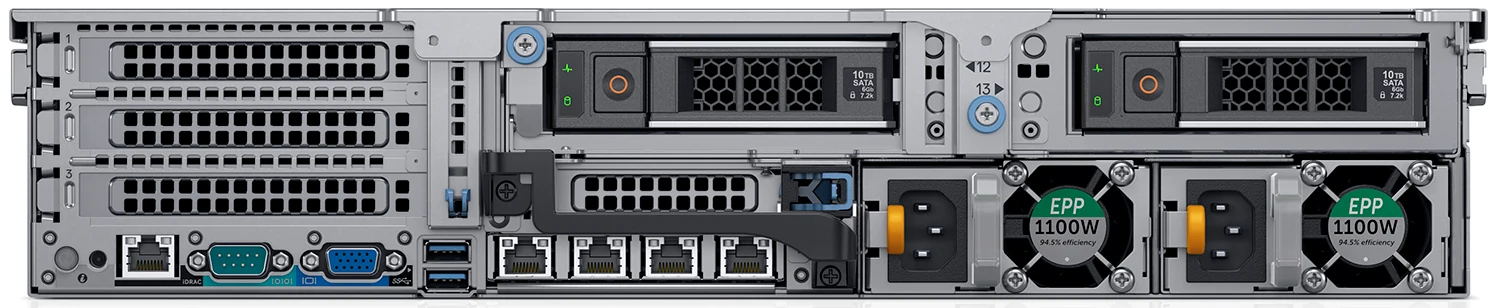
  • Dell EMC PowerEdge R740 and R740xd Technical Guide (Rev. A12, August 2022) — The single document covering both models. Table 2 (R740/R740xd against R730/R730xd), Table 4 (R740xd product specifications), Table 5 (processors), Tables 7 and 8 (memory), Tables 9 and 10 (drives), Tables 11 and 12 (PCIe risers and the rear-storage column), Tables 13 and 14 (power supplies and efficiency), Table 17 (chassis dimensions), Table 18 (weight), plus the storage, thermal and I/O chapters and the rear chassis view used as the photograph above.

Specifications are extracted from Dell’s published documents and independently re-checked line by line. Configurations are quote-based; availability and exact options are confirmed at quotation. Last reviewed 2026-10-01.

Get a quote for the Dell PowerEdge R740xd

Tell us the workload and we’ll spec and price it — or build it in the configurator first.

Business enquiries only — please use your company email. Gmail, Hotmail and other personal addresses are not accepted.

We only ship hardware to the countries in the dropdown. Software and maintenance services are global.

We use these details to reply to your enquiry and prepare any quote. No marketing emails without your consent. Privacy Policy

Enquiring about: Dell PowerEdge R740xd

Response within 4 business hours · No obligation

Quote for
Dell PowerEdge R740xd
0800 987 4111

Talk to a UK specialist

Get expert advice or a no-obligation quote — servers, storage, networking, maintenance, finance and cloud. We reply the same working day.

or call 0800 987 4111