UK’s trusted IT infrastructure partner since 2003
Servnet
FinanceToolsConfiguratorGet in Touch
Technical data sheet · PowerEdge 14G · 2U dual-socket · refurbished

Dell PowerEdge R740Specifications, configurations & comparisons

The R740 is the general-purpose half of Dell’s 14th-generation 2U pair: sixteen 2.5-inch bays at the front, three PCIe risers, and an accelerator allowance the storage-dense R740xd never got. It arrived in 2017, and Servnet supplies it refurbished — re-certified hardware, not a current Dell product. This page works through Dell’s own technical guide for what the chassis still does well, and where its DDR4 ceiling starts to bite.

2U Rack1 or 2 socketsIntel Xeon Processor Scalable FamilyiDRAC9
28cores per CPU56 per server · 2nd Gen Xeon Scalable
3TBDDR4 maximum24 slots · 128 GB LRDIMMs
16front drive bays2.5-inch · or 8 × 3.5-inch · none at the rear
8PCIe 3.0 slotsthree risers · four x16 at most
6accelerators150 W single-width · or 3 × 300 W
111processor SKUsTable 5 · 1st and 2nd Gen Xeon

Every figure checked against the Dell EMC PowerEdge R740 and R740xd Technical Guide (Aug 2022, Rev. A12)

Form factor
2U Rack · 2 sockets
Processors
Intel Xeon Processor Family
Memory
24 × DDR4 RDIMM · up to 3 TB with RDIMM/LRDIMM
Drive bays
Up to 16 · 3 drive-bay layouts
Expansion
8 × PCIe
GPUs
Up to 6 · 5 listed
Boot
M.2 and BOSS and microSD · 2 boot options
Management
iDRAC9
01 — Overview

The R740 at a glance

Our read of Dell’s documentation: where the R740 is strong, and the limits worth knowing before you spec one.

Strengths

  • Keeping every drive at the front is the trade that buys room inside: Dell allows this model three double-width 300 W accelerators or six single-width 150 W ones, plus three double-width or four single-width FPGAs, with no drive-chassis condition attached. The R740xd’s equivalent row stops at two cards and ties them to its 24-bay build.
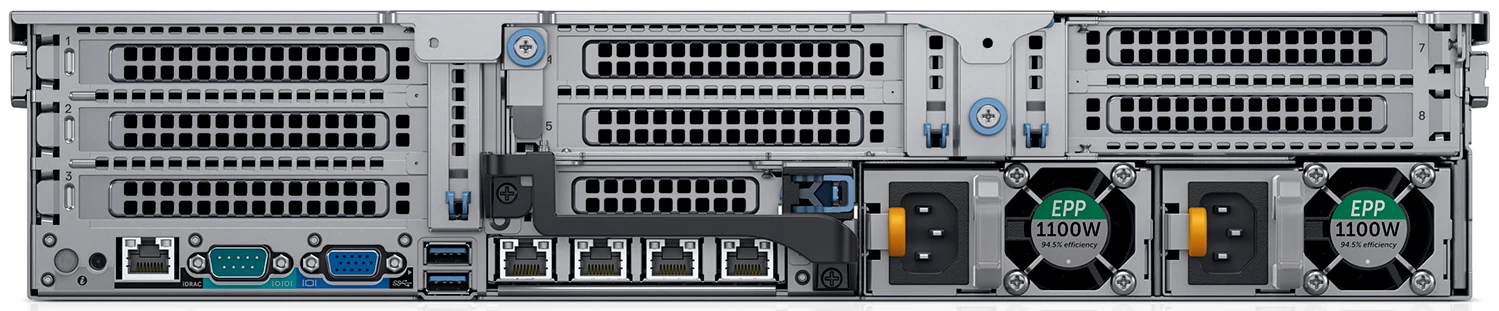
  • Eight PCIe 3.0 slots across three riser positions, as many as four of them x16. The 13G R730 it succeeded reached seven slots, and six in some builds.
  • A one-processor machine is a documented configuration rather than a compromise. Fit CPU1 on its own and a riser 1 card plus riser 2B stay functional, so a half-populated chassis is a legitimate place to start and grow from.
  • Table 5 carries 111 processor SKUs spanning both Xeon Scalable generations, from four cores at 85 W to 28 cores at 205 W — an unusually wide landing zone when you are matching second-hand silicon to a per-core licence count.

Watch-outs

  • Nothing goes behind the front backplane. Sixteen 2.5-inch bays or eight 3.5-inch bays is the whole envelope, with no rear and no mid-bay module, so boot either consumes two front slots or moves onto the BOSS M.2 pair.
  • The headline “up to 24 x NVMe” in the comparison table belongs to the pair, not to this model. The R740’s own specification row stops at sixteen 2.5-inch bays and names SAS and SATA only, so treat a front full of NVMe as the xd’s trick.
  • Three terabytes means twenty-four 128 GB LRDIMMs, and those are 8-rank modules fixed at 2666 MT/s whether you fit one or two per channel. The 2933 MT/s rating needs a second-generation processor at one DIMM per channel — and 64 of the 111 listed parts are rated at 2667 MT/s or lower, so they never see it.
  • Dell claims Titanium supplies at 750 W, 1600 W and 2600 W in its summary tables, yet only the 750 W Titanium reappears in the detailed power and efficiency tables. The 2600 W figure occurs nowhere else in the document at all.
  • Controller availability splits across the pair in ways the guide does not reconcile: the H330 and H350 are listed for this model only, while the Mini Mono HBA350i is marked as belonging to the R740xd in one table and offered to both in another.
Processors111 SKUs
Cores / CPU4–28
DIMM slots24
Drive layouts3
Max bays16
GPUsup to 6
PSU options12 · to 2,600 W
02 — Processors

111 supported processors, mapped

One processor table serves both 2U models, and it is unusually long: 111 rows covering two generations of Xeon Scalable. Skylake-SP parts carry a memory controller rated at 2667, 2400 or 2133 MT/s; Cascade Lake parts reach 2933. The bubble chart below sorts all 111 by core count against thermal design power, but on a refurbished build the column that quietly decides the result is the memory speed — read it next to the memory section.

Processor landscape — cores × TDP

111 SKUs · 1 family
Dell PowerEdge R740: every supported processor by cores and TDP081624320 W50 W100 W150 W200 W250 WCores per processorIntel Xeon Platinum 8280L — 28 cores · 205 W · 2.7 GHz base · 38.5 MB cache · DDR4-2933Intel Xeon Platinum 8280M — 28 cores · 205 W · 2.7 GHz base · 38.5 MB cache · DDR4-2933Intel Xeon Platinum 8280 — 28 cores · 205 W · 2.7 GHz base · 38.5 MB cache · DDR4-2933Intel Xeon Platinum 8180M — 28 cores · 205 W · 2.5 GHz base · 38.5 MB cache · DDR4-2667Intel Xeon Platinum 8180 — 28 cores · 205 W · 2.5 GHz base · 38.5 MB cache · DDR4-2667Intel Xeon Gold 6258R — 28 cores · 205 W · 2.7 GHz base · 38.5 MB cache · DDR4-2933Intel Xeon Platinum 8276L — 28 cores · 165 W · 2.2 GHz base · DDR4-2933Intel Xeon Platinum 8276M — 28 cores · 165 W · 2.2 GHz base · DDR4-2933Intel Xeon Platinum 8276 — 28 cores · 165 W · 2.2 GHz base · DDR4-2933Intel Xeon Platinum 8176M — 28 cores · 165 W · 2.1 GHz base · 38 MB cache · DDR4-2667Intel Xeon Platinum 8176 — 28 cores · 165 W · 2.1 GHz base · 38 MB cache · DDR4-2667Intel Xeon Gold 6238R — 28 cores · 165 W · 2.2 GHz base · 38.5 MB cache · DDR4-2933Intel Xeon Platinum 8270 — 26 cores · 205 W · 2.7 GHz base · DDR4-2933Intel Xeon Platinum 8164 — 26 cores · 205 W · 2.7 GHz base · 33 MB cache · DDR4-2667Intel Xeon Platinum 8170M — 26 cores · 165 W · 2.1 GHz base · 36 MB cache · DDR4-2667Intel Xeon Platinum 8170 — 26 cores · 165 W · 2.1 GHz base · 36 MB cache · DDR4-2667Intel Xeon Gold 6230R — 26 cores · 150 W · 2.1 GHz base · 35.75 MB cache · DDR4-2933Intel Xeon Platinum 8268 — 24 cores · 205 W · 2.9 GHz base · DDR4-2933Intel Xeon Platinum 8168 — 24 cores · 205 W · 2.7 GHz base · 33 MB cache · DDR4-2667Intel Xeon Gold 6248R — 24 cores · 205 W · 3 GHz base · 35.75 MB cache · DDR4-2933Intel Xeon Platinum 8260L — 24 cores · 165 W · 2.4 GHz base · DDR4-2933Intel Xeon Platinum 8260M — 24 cores · 165 W · 2.4 GHz base · DDR4-2933Intel Xeon Platinum 8260Y — 24 cores · 165 W · 2.4 GHz base · DDR4-2933Intel Xeon Platinum 8260 — 24 cores · 165 W · 2.4 GHz base · DDR4-2933Intel Xeon Gold 6240 — 24 cores · 165 W · 2.6 GHz base · DDR4-2933Intel Xeon Gold 6240R — 24 cores · 165 W · 2.4 GHz base · 35.75 MB cache · DDR4-2933Intel Xeon Gold 6212U — 24 cores · 165 W · 2.4 GHz base · DDR4-2933Intel Xeon Platinum 8160M — 24 cores · 150 W · 2.1 GHz base · 33 MB cache · DDR4-2667Intel Xeon Platinum 8160 — 24 cores · 150 W · 2.1 GHz base · 33 MB cache · DDR4-2667Intel Xeon Gold 6252 — 24 cores · 150 W · 2.1 GHz base · DDR4-2933Intel Xeon Gold 6252N — 24 cores · 150 W · 3 GHz base · 35.75 MB cache · DDR4-2933Intel Xeon Gold 5220R — 24 cores · 150 W · 2.2 GHz base · 35.75 MB cache · DDR4-2933Intel Xeon Platinum 6262V — 24 cores · 135 W · 1.9 GHz base · 33 MB cache · DDR4-2400Intel Xeon Gold 6238 — 22 cores · 140 W · 2.1 GHz base · 30.25 MB cache · DDR4-2933Intel Xeon Gold 6238L — 22 cores · 140 W · 2.1 GHz base · 30.25 MB cache · DDR4-2933Intel Xeon Gold 6238M — 22 cores · 140 W · 2.1 GHz base · 30.25 MB cache · DDR4-2933Intel Xeon Gold 6152 — 22 cores · 140 W · 2.1 GHz base · 25 MB cache · DDR4-2667Intel Xeon Gold 6242R — 20 cores · 205 W · 3.1 GHz base · 27.5 MB cache · DDR4-2933Intel Xeon Gold 6248 — 20 cores · 150 W · 2.5 GHz base · DDR4-2933Intel Xeon Gold 6210U — 20 cores · 150 W · 2.5 GHz base · DDR4-2933Intel Xeon Gold 6148 — 20 cores · 150 W · 2.4 GHz base · 27 MB cache · DDR4-2667Intel Xeon Gold 6230N — 20 cores · 125 W · 2.3 GHz base · 27.5 MB cache · DDR4-2933Intel Xeon Gold 6230 — 20 cores · 125 W · 2.1 GHz base · DDR4-2933Intel Xeon Gold 6209U — 20 cores · 125 W · 2.1 GHz base · 27.5 MB cache · DDR4-2933Intel Xeon Gold 6138 — 20 cores · 125 W · 2 GHz base · 27.5 MB cache · DDR4-2667Intel Xeon Gold 5218 — 20 cores · 125 W · 2.3 GHz base · 22 MB cache · DDR4-2667Intel Xeon Gold 5218R — 20 cores · 125 W · 2.1 GHz base · 27.5 MB cache · DDR4-2667Intel Xeon Gold 6222V — 20 cores · 115 W · 1.8 GHz base · 27.5 MB cache · DDR4-2400Intel Xeon Gold 6254 — 18 cores · 200 W · 3.1 GHz base · DDR4-2933Intel Xeon Gold 6154 — 18 cores · 200 W · 3 GHz base · 25 MB cache · DDR4-2667Intel Xeon Gold 6150 — 18 cores · 165 W · 2.7 GHz base · 25 MB cache · DDR4-2667Intel Xeon Gold 6240L — 18 cores · 150 W · 2.6 GHz base · 24.75 MB cache · DDR4-2933Intel Xeon Gold 6240M — 18 cores · 150 W · 2.6 GHz base · 24.75 MB cache · DDR4-2933Intel Xeon Gold 6240Y — 18 cores · 150 W · 2.6 GHz base · DDR4-2933Intel Xeon Gold 6140M — 18 cores · 140 W · 2.3 GHz base · 25 MB cache · DDR4-2667Intel Xeon Gold 6140 — 18 cores · 140 W · 2.3 GHz base · 25 MB cache · DDR4-2667Intel Xeon Gold 5220 — 18 cores · 125 W · 2.2 GHz base · DDR4-2667Intel Xeon Gold 5220S — 18 cores · 125 W · 2.7 GHz base · 24.75 MB cache · DDR4-2667Intel Xeon Gold 6246R — 16 cores · 205 W · 3.4 GHz base · 22 MB cache · DDR4-2933Intel Xeon Gold 6242 — 16 cores · 150 W · 2.8 GHz base · DDR4-2933Intel Xeon Gold 6226R — 16 cores · 150 W · 2.9 GHz base · 22 MB cache · DDR4-2933Intel Xeon Gold 6208U — 16 cores · 150 W · 2.9 GHz base · 22 MB cache · DDR4-2933Intel Xeon Gold 6142M — 16 cores · 150 W · 2.6 GHz base · 22 MB cache · DDR4-2667Intel Xeon Gold 6142 — 16 cores · 150 W · 2.6 GHz base · 22 MB cache · DDR4-2667Intel Xeon Platinum 8253 — 16 cores · 125 W · 2.2 GHz base · DDR4-2933Intel Xeon Platinum 8153 — 16 cores · 125 W · 2 GHz base · 22 MB cache · DDR4-2667Intel Xeon Gold 6130 — 16 cores · 125 W · 2.1 GHz base · 22 MB cache · DDR4-2667Intel Xeon Gold 5218N — 16 cores · 110 W · 2.3 GHz base · 22 MB cache · DDR4-2667Intel Xeon Silver 4216 — 16 cores · 100 W · 2.1 GHz base · DDR4-2667Intel Xeon Gold 6132 — 14 cores · 140 W · 2.6 GHz base · 19.25 MB cache · DDR4-2667Intel Xeon Gold 5120 — 14 cores · 105 W · 2.2 GHz base · 19.25 MB cache · DDR4-2400Intel Xeon Gold 6246 — 12 cores · 165 W · 3.3 GHz base · 24.75 MB cache · DDR4-2933Intel Xeon Gold 6146 — 12 cores · 165 W · 3.2 GHz base · 24.75 MB cache · DDR4-2667Intel Xeon Platinum 8158 — 12 cores · 150 W · 3 GHz base · 24.75 MB cache · DDR4-2667Intel Xeon Gold 6226 — 12 cores · 125 W · 2.7 GHz base · 19.25 MB cache · DDR4-2933Intel Xeon Gold 6136 — 12 cores · 125 W · 3 GHz base · 24.75 MB cache · DDR4-2667Intel Xeon Gold 6126 — 12 cores · 125 W · 2.6 GHz base · 19.25 MB cache · DDR4-2667Intel Xeon Gold 5118 — 12 cores · 105 W · 2.3 GHz base · 16.5 MB cache · DDR4-2400Intel Xeon Silver 4214Y — 12 cores · 105 W · 2.2 GHz base · DDR4-2667Intel Xeon Silver 4214R — 12 cores · 100 W · 2.4 GHz base · 16.5 MB cache · DDR4-2400Intel Xeon Silver 4214 — 12 cores · 85 W · 2.2 GHz base · DDR4-2667Intel Xeon Silver 4116 — 12 cores · 85 W · 2.1 GHz base · 16 MB cache · DDR4-2400Intel Xeon Silver 4210R — 10 cores · 100 W · 2.4 GHz base · 13.75 MB cache · DDR4-2400Intel Xeon Gold 5215 — 10 cores · 85 W · 2.5 GHz base · DDR4-2667Intel Xeon Gold 5215M — 10 cores · 85 W · 2.5 GHz base · DDR4-2667Intel Xeon Gold 5215L — 10 cores · 85 W · 2.5 GHz base · DDR4-2667Intel Xeon Gold 5115 — 10 cores · 85 W · 2.4 GHz base · 13.75 MB cache · DDR4-2400Intel Xeon Silver 4210 — 10 cores · 85 W · 2.2 GHz base · DDR4-2667Intel Xeon Silver 4114 — 10 cores · 85 W · 2.2 GHz base · 14 MB cache · DDR4-2400Intel Xeon Gold 6244 — 8 cores · 150 W · 3.6 GHz base · DDR4-2933Intel Xeon Gold 6144 — 8 cores · 150 W · 3.5 GHz base · 24.75 MB cache · DDR4-2667Intel Xeon Gold 6234 — 8 cores · 130 W · 3.3 GHz base · 24.75 MB cache · DDR4-2933Intel Xeon Gold 6134M — 8 cores · 130 W · 3.2 GHz base · 24.75 MB cache · DDR4-2667Intel Xeon Gold 6134 — 8 cores · 130 W · 3.3 GHz base · 24.75 MB cache · DDR4-2667Intel Xeon Silver 4215R — 8 cores · 130 W · 3.2 GHz base · 11 MB cache · DDR4-2400Intel Xeon Gold 5217 — 8 cores · 125 W · 3 GHz base · DDR4-2667Intel Xeon Silver 4215 — 8 cores · 85 W · 2.5 GHz base · DDR4-2667Intel Xeon Silver 4208 — 8 cores · 85 W · 2.1 GHz base · DDR4-2667Intel Xeon Silver 4110 — 8 cores · 85 W · 2.1 GHz base · 11 MB cache · DDR4-2400Intel Xeon Silver 4108 — 8 cores · 85 W · 1.8 GHz base · 11 MB cache · DDR4-2400Intel Xeon Bronze 3206R — 8 cores · 85 W · 1.9 GHz base · 11 MB cache · DDR4-2400Intel Xeon Bronze 3106 — 8 cores · 85 W · 1.7 GHz base · 11 MB cache · DDR4-2133Intel Xeon Gold 6128 — 6 cores · 115 W · 3.4 GHz base · 19.25 MB cache · DDR4-2667Intel Xeon Bronze 3204 — 6 cores · 85 W · 1.9 GHz base · DDR4-2667Intel Xeon Bronze 3104 — 6 cores · 85 W · 1.7 GHz base · 11 MB cache · DDR4-2133Intel Xeon Platinum 8156 — 4 cores · 105 W · 3.6 GHz base · 16.5 MB cache · DDR4-2667Intel Xeon Gold 5222 — 4 cores · 105 W · 3.8 GHz base · DDR4-2933Intel Xeon Gold 5122 — 4 cores · 105 W · 3.6 GHz base · 16.5 MB cache · DDR4-2400Intel Xeon Silver 4112 — 4 cores · 85 W · 2.6 GHz base · 8.25 MB cache · DDR4-2400Intel Xeon Gold 6256 — null cores · null W · 3.6 GHz base · 33 MB cache · DDR4-2933Intel Xeon Gold 6250 — null cores · null W · 3.9 GHz base · 35.75 MB cache · DDR4-29338280L28 cores — the top SKU6262V5.6 W/core — most efficient
Intel Xeon Processor Scalable Family 111Bubble size = L3 cache · hover a bubble for the full SKU

Processor explorer

filter · sort · compare
ProcessorCores / threadsBaseL3 cacheTDPW / coreMemory
Intel Xeon Platinum 8280L282.7 GHz38.5 MB205 W7.3DDR4-2933
Intel Xeon Platinum 8280M282.7 GHz38.5 MB205 W7.3DDR4-2933
Intel Xeon Platinum 8280282.7 GHz38.5 MB205 W7.3DDR4-2933
Intel Xeon Platinum 8180M282.5 GHz38.5 MB205 W7.3DDR4-2667
Intel Xeon Platinum 8180282.5 GHz38.5 MB205 W7.3DDR4-2667
Intel Xeon Gold 6258R282.7 GHz38.5 MB205 W7.3DDR4-2933
Intel Xeon Platinum 8276L282.2 GHz—165 W5.9DDR4-2933
Intel Xeon Platinum 8276M282.2 GHz—165 W5.9DDR4-2933
Intel Xeon Platinum 8276282.2 GHz—165 W5.9DDR4-2933
Intel Xeon Platinum 8176M282.1 GHz38 MB165 W5.9DDR4-2667
Intel Xeon Platinum 8176282.1 GHz38 MB165 W5.9DDR4-2667
Intel Xeon Gold 6238R282.2 GHz38.5 MB165 W5.9DDR4-2933
Intel Xeon Platinum 8270262.7 GHz—205 W7.9DDR4-2933
Intel Xeon Platinum 8164262.7 GHz33 MB205 W7.9DDR4-2667
Intel Xeon Platinum 8170M262.1 GHz36 MB165 W6.3DDR4-2667
Intel Xeon Platinum 8170262.1 GHz36 MB165 W6.3DDR4-2667
Intel Xeon Gold 6230R262.1 GHz35.75 MB150 W5.8DDR4-2933
Intel Xeon Platinum 8268242.9 GHz—205 W8.5DDR4-2933
Intel Xeon Platinum 8168242.7 GHz33 MB205 W8.5DDR4-2667
Intel Xeon Gold 6248R243 GHz35.75 MB205 W8.5DDR4-2933
Intel Xeon Platinum 8260L242.4 GHz—165 W6.9DDR4-2933
Intel Xeon Platinum 8260M242.4 GHz—165 W6.9DDR4-2933
Intel Xeon Platinum 8260Y242.4 GHz—165 W6.9DDR4-2933
Intel Xeon Platinum 8260242.4 GHz—165 W6.9DDR4-2933
Intel Xeon Gold 6240242.6 GHz—165 W6.9DDR4-2933
Intel Xeon Gold 6240R242.4 GHz35.75 MB165 W6.9DDR4-2933
Intel Xeon Gold 6212U242.4 GHz—165 W6.9DDR4-2933
Intel Xeon Platinum 8160M242.1 GHz33 MB150 W6.3DDR4-2667
Intel Xeon Platinum 8160242.1 GHz33 MB150 W6.3DDR4-2667
Intel Xeon Gold 6252242.1 GHz—150 W6.3DDR4-2933
Intel Xeon Gold 6252N243 GHz35.75 MB150 W6.3DDR4-2933
Intel Xeon Gold 5220R242.2 GHz35.75 MB150 W6.3DDR4-2933
Intel Xeon Platinum 6262V241.9 GHz33 MB135 W5.6DDR4-2400
Intel Xeon Gold 6238222.1 GHz30.25 MB140 W6.4DDR4-2933
Intel Xeon Gold 6238L222.1 GHz30.25 MB140 W6.4DDR4-2933
Intel Xeon Gold 6238M222.1 GHz30.25 MB140 W6.4DDR4-2933
Intel Xeon Gold 6152222.1 GHz25 MB140 W6.4DDR4-2667
Intel Xeon Gold 6242R203.1 GHz27.5 MB205 W10.3DDR4-2933
Intel Xeon Gold 6248202.5 GHz—150 W7.5DDR4-2933
Intel Xeon Gold 6210U202.5 GHz—150 W7.5DDR4-2933
Intel Xeon Gold 6148202.4 GHz27 MB150 W7.5DDR4-2667
Intel Xeon Gold 6230N202.3 GHz27.5 MB125 W6.3DDR4-2933
Intel Xeon Gold 6230202.1 GHz—125 W6.3DDR4-2933
Intel Xeon Gold 6209U202.1 GHz27.5 MB125 W6.3DDR4-2933
Intel Xeon Gold 6138202 GHz27.5 MB125 W6.3DDR4-2667
Intel Xeon Gold 5218202.3 GHz22 MB125 W6.3DDR4-2667
Intel Xeon Gold 5218R202.1 GHz27.5 MB125 W6.3DDR4-2667
Intel Xeon Gold 6222V201.8 GHz27.5 MB115 W5.8DDR4-2400
Intel Xeon Gold 6254183.1 GHz—200 W11.1DDR4-2933
Intel Xeon Gold 6154183 GHz25 MB200 W11.1DDR4-2667
Intel Xeon Gold 6150182.7 GHz25 MB165 W9.2DDR4-2667
Intel Xeon Gold 6240L182.6 GHz24.75 MB150 W8.3DDR4-2933
Intel Xeon Gold 6240M182.6 GHz24.75 MB150 W8.3DDR4-2933
Intel Xeon Gold 6240Y182.6 GHz—150 W8.3DDR4-2933
Intel Xeon Gold 6140M182.3 GHz25 MB140 W7.8DDR4-2667
Intel Xeon Gold 6140182.3 GHz25 MB140 W7.8DDR4-2667
Intel Xeon Gold 5220182.2 GHz—125 W6.9DDR4-2667
Intel Xeon Gold 5220S182.7 GHz24.75 MB125 W6.9DDR4-2667
Intel Xeon Gold 6246R163.4 GHz22 MB205 W12.8DDR4-2933
Intel Xeon Gold 6242162.8 GHz—150 W9.4DDR4-2933
Intel Xeon Gold 6226R162.9 GHz22 MB150 W9.4DDR4-2933
Intel Xeon Gold 6208U162.9 GHz22 MB150 W9.4DDR4-2933
Intel Xeon Gold 6142M162.6 GHz22 MB150 W9.4DDR4-2667
Intel Xeon Gold 6142162.6 GHz22 MB150 W9.4DDR4-2667
Intel Xeon Platinum 8253162.2 GHz—125 W7.8DDR4-2933
Intel Xeon Platinum 8153162 GHz22 MB125 W7.8DDR4-2667
Intel Xeon Gold 6130162.1 GHz22 MB125 W7.8DDR4-2667
Intel Xeon Gold 5218N162.3 GHz22 MB110 W6.9DDR4-2667
Intel Xeon Silver 4216162.1 GHz—100 W6.3DDR4-2667
Intel Xeon Gold 6132142.6 GHz19.25 MB140 W10.0DDR4-2667
Intel Xeon Gold 5120142.2 GHz19.25 MB105 W7.5DDR4-2400
Intel Xeon Gold 6246123.3 GHz24.75 MB165 W13.8DDR4-2933
Intel Xeon Gold 6146123.2 GHz24.75 MB165 W13.8DDR4-2667
Intel Xeon Platinum 8158123 GHz24.75 MB150 W12.5DDR4-2667
Intel Xeon Gold 6226122.7 GHz19.25 MB125 W10.4DDR4-2933
Intel Xeon Gold 6136123 GHz24.75 MB125 W10.4DDR4-2667
Intel Xeon Gold 6126122.6 GHz19.25 MB125 W10.4DDR4-2667
Intel Xeon Gold 5118122.3 GHz16.5 MB105 W8.8DDR4-2400
Intel Xeon Silver 4214Y122.2 GHz—105 W8.8DDR4-2667
Intel Xeon Silver 4214R122.4 GHz16.5 MB100 W8.3DDR4-2400
Intel Xeon Silver 4214122.2 GHz—85 W7.1DDR4-2667
Intel Xeon Silver 4116122.1 GHz16 MB85 W7.1DDR4-2400
Intel Xeon Silver 4210R102.4 GHz13.75 MB100 W10.0DDR4-2400
Intel Xeon Gold 5215102.5 GHz—85 W8.5DDR4-2667
Intel Xeon Gold 5215M102.5 GHz—85 W8.5DDR4-2667
Intel Xeon Gold 5215L102.5 GHz—85 W8.5DDR4-2667
Intel Xeon Gold 5115102.4 GHz13.75 MB85 W8.5DDR4-2400
Intel Xeon Silver 4210102.2 GHz—85 W8.5DDR4-2667
Intel Xeon Silver 4114102.2 GHz14 MB85 W8.5DDR4-2400
Intel Xeon Gold 624483.6 GHz—150 W18.8DDR4-2933
Intel Xeon Gold 614483.5 GHz24.75 MB150 W18.8DDR4-2667
Intel Xeon Gold 623483.3 GHz24.75 MB130 W16.3DDR4-2933
Intel Xeon Gold 6134M83.2 GHz24.75 MB130 W16.3DDR4-2667
Intel Xeon Gold 613483.3 GHz24.75 MB130 W16.3DDR4-2667
Intel Xeon Silver 4215R83.2 GHz11 MB130 W16.3DDR4-2400
Intel Xeon Gold 521783 GHz—125 W15.6DDR4-2667
Intel Xeon Silver 421582.5 GHz—85 W10.6DDR4-2667
Intel Xeon Silver 420882.1 GHz—85 W10.6DDR4-2667
Intel Xeon Silver 411082.1 GHz11 MB85 W10.6DDR4-2400
Intel Xeon Silver 410881.8 GHz11 MB85 W10.6DDR4-2400
Intel Xeon Bronze 3206R81.9 GHz11 MB85 W10.6DDR4-2400
Intel Xeon Bronze 310681.7 GHz11 MB85 W10.6DDR4-2133
Intel Xeon Gold 612863.4 GHz19.25 MB115 W19.2DDR4-2667
Intel Xeon Bronze 320461.9 GHz—85 W14.2DDR4-2667
Intel Xeon Bronze 310461.7 GHz11 MB85 W14.2DDR4-2133
Intel Xeon Platinum 815643.6 GHz16.5 MB105 W26.3DDR4-2667
Intel Xeon Gold 522243.8 GHz—105 W26.3DDR4-2933
Intel Xeon Gold 512243.6 GHz16.5 MB105 W26.3DDR4-2400
Intel Xeon Silver 411242.6 GHz8.25 MB85 W21.3DDR4-2400
Intel Xeon Gold 6256—3.6 GHz33 MB——DDR4-2933
Intel Xeon Gold 6250—3.9 GHz35.75 MB——DDR4-2933
  • Thread counts appear nowhere in this document, and they cannot be inferred: the Bronze 3206R, 3204, 3106 and 3104 have no hyper-threading, and those same four are the only rows whose turbo column records none.
  • That turbo column records support as a yes or a no, never a frequency, so no turbo clocks are shown here.
  • Two rows, the 6256 and the 6250, leave both cores and power blank; another 33 leave cache blank. Those gaps are left as gaps rather than filled in from elsewhere.
  • The four U-suffix parts — 6208U, 6209U, 6210U and 6212U — are single-socket offerings. This guide prints no single-socket table, so that designation is carried across from Dell’s R640 guide, which names the same four.
  • The sixth column of the table is headed QPI, but the platform runs Intel UPI; Dell’s own overview of the machine describes up to three UPI links per processor.
03 — Memory

24 DIMM slots, 12 per processor

Twelve DIMM slots flank each processor, arranged six channels wide and two deep. Dell asks for the channels to be filled evenly — six modules per socket, or twelve — and only the first of those two populations holds the top speed.

Capacity with every slot filled

by DIMM size
8 GB192 GB1-rank · 2666 MT/s only16 GB384 GB32 GB768 GB64 GB1.5 TB128 GB3 TBLRDIMM · 8-rank · 2666 MT/s only256 GB6 TB512 GB12 TB24 slots · 12 per processor · each tick = one DIMM

Operating speed

per Dell memory tables
Processor1 DIMM / channel2 DIMMs / channel
1st Gen Xeon Scalable (Skylake-SP)2666 MT/s2666 MT/s
2nd Gen Xeon Scalable (Cascade Lake)2933 MT/s2666 MT/s
128 GB LRDIMM · either generation2666 MT/s2666 MT/s
  • The 2933 MT/s rating belongs to the 2-rank 16, 32 and 64 GB RDIMMs on a second-generation processor at one module per channel. Choose the 1-rank 8 GB module or the 128 GB LRDIMM instead and the ceiling is 2666 MT/s either way.
  • Dell contradicts itself on the second module per channel: the new-technology table says 2933 MT/s is reachable there with select processors, while the supported-memory table prints 2666 MT/s in that column for every module listed. Plan on 2666 MT/s and confirm the exact pairing.
  • Each processor imposes its own ceiling as well. Every row of the processor table carries a maximum memory speed, and 64 of the 111 sit at 2667 MT/s or below regardless of which module you fit.
  • Persistent memory belonged to this platform too — up to six Intel Optane DCPMM per socket beside one DRAM module per channel, reaching 6.14 TB, or 7.68 TB with LRDIMM behind it, and NVDIMM-N to 192 GB across twelve modules. Those parts are long out of production; the refurbished configurator carries RDIMM and LRDIMM only.
04 — Storage

3 drive-bay layouts, up to 16 bays

Three front backplanes, and nothing behind any of them. Dell offers eight or sixteen 2.5-inch bays, or eight 3.5-inch bays, and states outright that this model has no rear and no mid-bay option — precisely the two things the R740xd exists to add. The ceilings printed against those fronts are 122.88 TB across sixteen small-form-factor bays and 128 TB across eight large ones.

Headline layouts

front panel view

Front panel

The densest front this chassis takes — sixteen hot-plug 2.5-inch SAS or SATA bays, which Dell rates to 122.88 TB.

SAS/SATANVMeSAS/SATA + NVMe

Controllers & boot

  • PERC H330 — RAID. Table 3 internal controller. Table 2 marks H330 as R740 only, both as an adapter and as Mini Mono. Cache size is not stated in this guide.
  • PERC H350 — RAID. Table 3 internal controller. Table 2 marks H350 as R740 only, both as an adapter and as Mini Mono. Cache size is not stated in this guide.
  • PERC H730P — RAID. Table 3 internal controller; Table 2 lists it as adapter and Mini Mono. Cache size is not stated in this guide.
  • PERC H740P — RAID. Table 3 internal controller; Table 2 lists it as adapter and Mini Mono. Cache size is not stated in this guide.
  • PERC H750 — RAID. Table 3 internal controller. Cache size is not stated in this guide. (A claim that PERC 11 parts 'cannot be mixed' with H740P/H730P/H330/HBA330 was recorded here in error and removed 1 Oct 2026. H350, H750 and HBA350i ARE listed in this guide, with Table 2 marking H350 R740-only and HBA350i R740xd-only — but no mixing restriction appears anywhere in the document: 'cannot be mixed', 'mixed with', 'mixing' and 'PERC 11' all return zero matches.)
  • PERC S140 — Software RAID. Table 3: "Software RAID (SWRAID) S140".
  • HBA350i — HBA. Table 3 internal controller. Table 2 lists HBA350i as an adapter for both models but marks the Mini Mono variant "R740xd only" - an unexplained inconsistency with Table 3.
  • HBA330 — HBA. Table 3: "Internal- HBA330 (non-RAID)".
  • BOSS - HW RAID, 2 x M.2 SATA SSD, 240 GB or 480 GB (Table 3) — boot
  • IDSDM (2 x microSD, 16/32/64 GB) and/or vFlash (1 x 16 GB microSD) — boot
All 12 controllers and 2 boot options
  • BOSS — Boot. Boot Optimized Storage Subsystem: HW RAID, 2 x M.2 SATA SSD (240 GB or 480 GB), PCIe Gen 2.0 x2 on a x8 connector.
  • PERC H840 — RAID. Table 3: external PERC (RAID). Cache size is not stated in this guide.
  • HBA355e — HBA. Table 3: external, listed under the external PERC heading.
  • 12 Gbps SAS HBA (external) — HBA. Table 3: "External - 12Gbps SAS HBA (non-RAID)".
  • Boot normally stays out of those bays. The BOSS card runs hardware RAID across two M.2 SATA drives, which Dell sizes at either 240 or 480 GB, reaching them over two PCIe Gen 2 lanes. IDSDM contributes two microSD cards at 16, 32 or 64 GB, plus a third 16 GB card for vFlash.
  • Internal controllers run from the HBA330 passthrough up to the H740P, with the H330 and H350 listed for this model and absent from the R740xd. External attachment goes through the H840, the HBA355e or the 12 Gb/s SAS HBA.
  • Dell’s supported-drive table tops 3.5-inch SAS out at 10 TB while 3.5-inch SATA reaches 16 TB, so the 128 TB ceiling assumes the larger SATA disks rather than nearline SAS.
  • This is the model that takes an internal optical drive — DVD-ROM or DVD+ROM — which the R740xd does not. Neither machine has an internal tape bay; tape attaches externally.

Every documented layout

3 with drive bays
16 x 2.5-inch SAS/SATA front backplane16 x 2.5-inch SAS/SATA front backplane168 x 2.5-inch SAS/SATA front backplane8 x 2.5-inch SAS/SATA front backplane88 x 3.5-inch SAS/SATA front backplane8 x 3.5-inch SAS/SATA front backplane8Bays · solid = front · dashed = rear · brighter = NVMe-only
2.5-inch3.5-inchEDSFF (E1.S / E3.S)
05 — Accelerators & I/O

GPUs, PCIe and networking

Cards sit in the risers, and this is where the R740 is the more capable of the two. Its specification row permits three double-width 300 W accelerators or six single-width 150 W ones, alongside three double-width or four single-width FPGAs, and attaches no drive-chassis condition — where the R740xd is held to two cards on its 24-bay front. Only one accelerator is actually named anywhere in the guide, the NVIDIA M10, and a footnote limits that card to two per system. Up to 3 × double-width 300 W, or 6 × single-width 150 W · FPGAs: 3 double-width or 4 single-width

NVIDIA M10

up to 2

300 W double-width GPU (model not stated in guide)

double-wide
up to 3

150 W single-width GPU (model not stated in guide)

single-wide
up to 6

Double-width FPGA (model not stated in guide)

double-wide
up to 3

Single-width FPGA (model not stated in guide)

single-wide
up to 4

I/O topology

2 sockets
CPU 1PCIe 3.06 ch · 12 DIMMCPU 2PCIe 3.06 ch · 12 DIMMIntel UPI · up to 3 linksUp to 8 × PCIe 3.0four x16 max · risers 1–3No-riser build offeredMini-Mono PERC onlyrNDC network daughter card4 × 1GbE up to 2 × 25GbEiDRAC9 + Quick Sync 2.0dedicated 1GbE iDRAC port

Three riser positions feed as many as eight PCIe 3.0 slots, of which at most four are x16. Which risers you fit is a genuine decision rather than a detail: Dell’s riser table pairs every combination with the processor count it needs, the PERC style it allows, and whether rear storage is possible — a column that only ever means anything on the R740xd.

Network adapters Dell lists

4 options
AdapterPortsForm
4 x 1GbE Network Daughter Card (rNDC)4 × 1GbELOM
2 x 10GbE + 2 x 1GbE Network Daughter Card (rNDC)4 × 10GbE / 1GbELOM
4 x 10GbE Network Daughter Card (rNDC)4 × 10GbELOM
2 x 25GbE Network Daughter Card (rNDC)2 × 25GbELOM
  • Riser 1 presents slots 1 to 3, riser 2 slots 4 to 6 and riser 3 slots 7 and 8. Link widths are x8 or x16 depending on the riser variant, full-height on most positions and low-profile on the 2B and 2C options.
  • Fit one processor and only a riser 1 card and riser 2B remain functional. The machine will not start from the second socket alone, and the processor and memory blanks belonging to the empty socket have to stay in for cooling.
  • OCP 3.0 had not arrived when this generation shipped, so the network card goes in the rNDC bay instead: four 1GbE ports, two 10GbE alongside two 1GbE, four 10GbE, or two 25GbE — and that last is the option the 13G R730 lacked. Not one PCIe network adapter is named in the whole document.
06 — Power & cooling

12 power supplies, 495–2,600 W

Two hot-plug supplies run as a 1+1 pair. Platinum AC units start at 495 W and 750 W for light builds, pass through 1100 W and 1600 W, and finish on 2000 W or 2400 W. Beside them sit a 750 W Titanium, a 1100 W Gold unit for −48 to −60 V DC telco racks, and mixed-mode HVDC versions of the 750 W and 1100 W supplies that Dell restricted to China and Japan.

050010001500200025003000495 W Platinum — Table 13: 50/60 Hz, 100-240 Vac / 6.5-3 A, 1908 BTU/hr. Table 14 efficiency 82/90/94/91% at 10/20/50/100% load.495Platinum750 W Platinum — Table 13: 50/60 Hz, 100-240 Vac / 10-5 A, 2891 BTU/hr. Table 14 efficiency 82/90/94/91%.750Platinum750 W Platinum — Table 13 "750W Mix Mode/HVDC (China Only)": 50/60 Hz 100-240 Vac / 10-5 A, or 240 Vdc / 4.5 A, 2891 BTU/hr. Table 14 lists 750W HVDC Platinum at 82/90/94/91%.750Platinum750 W Titanium — Table 13 lists this as "750WT": 50/60 Hz, 200-240 Vac / 5 A, 2843 BTU/hr. Table 14 efficiency 90/94/96/91%.750Titanium1100 W Gold — Table 13 "1100W DC": -48 V DC to -60 V DC, 32 A, 4416 BTU/hr (printed verbatim as "-48--60Vdc/32A"). Table 14 efficiency 80/88/91/88%. Tables 2/3/4 call it "Gold 1100W -48VDC".1100DC1100 W Platinum — Table 13: 50/60 Hz, 100-240 Vac / 12-6.5 A, 4100 BTU/hr. Table 14 efficiency 89/93/94.5/92%.1100Platinum1100 W Platinum — Table 13 "1100W Mix Mode/HVDC (China and Japan Only)": 50/60 Hz 100-240 Vac / 12-6.5 A, or 200-380 Vdc / 6.4-3.2 A, 4100 BTU/hr.1100Platinum1600 W Platinum — Table 13: 50/60 Hz, 100-240 Vac / 10 A, 6000 BTU/hr. Table 14 efficiency 87/90/94/91%.1600Platinum1600 W Titanium — Listed only in the summary tables - Table 2 "AC (Titanium): 750W, 1600W, 2600W" and Table 3 "Titanium 750W, 1600W, and 2600W". The detailed Table 13 (PSU specification) and Table 14 (PSU efficiency) list 1600 W as Platinum only and contain no Titanium 1600 W row.1600Titanium2000 W Platinum — Table 13: 50/60 Hz, 100-240 Vac / 11.5 A, 7500 BTU/hr. Table 14 efficiency 89/93/94/91%.2000Platinum2400 W Platinum — Table 13: 50/60 Hz, 100-240 Vac / 16 A, 9000 BTU/hr. Table 14 efficiency 89/93/94/91.5%.2400Platinum2600 W Titanium — Listed only in the summary tables - Table 2 and Table 3. No 2600 W entry of any class appears in the detailed Table 13 or Table 14, and 2600 W appears nowhere else in the guide. Treat as unconfirmed by this document.2600TitaniumWatts · dashed line = output at 100–120 V low line
AC−48 V DC
  • The summary tables also promise Titanium units at 1600 W and 2600 W. Neither turns up in the detailed specification or efficiency tables, and 2600 W is absent from the rest of the document, so both should be treated as unconfirmed until a quote names a part number.
  • Heat output is published per supply — 1,908 BTU/hr at 495 W, 2,891 at 750 W, 4,100 at 1100 W, 6,000 at 1600 W, 7,500 at 2000 W and 9,000 at 2400 W — which is what you need when the question is rack cooling rather than server power.
  • The 750 W Titanium is the efficiency outlier at 96% under half load, against 94% for the Platinum units, and it is high-line only: 200–240 V AC.
  • Cooling carries N+1 fan redundancy. The documented operating range is 10°C to 35°C inlet, with Dell naming 30°C as the recommendation for this pair of machines.
07 — Management, security & OS

Run it, secure it, choose the OS

Management

  • iDRAC9 with Lifecycle Controller 3.x
  • iDRAC Direct — dedicated micro-USB port
  • Quick Sync 2.0 wireless at-the-box management
  • OpenManage
  • OpenManage Power Center 3
  • Digital License Key
  • Easy Restore
  • vFlash — 1 × 16 GB microSD
  • IDSDM — 2 × microSD, 16/32/64 GB

Security

  • TPM 1.2 and TPM 2.0
  • Optional TCM 2.0
  • Cryptographically signed firmware
  • Secure Boot
  • System Lockdown (requires OpenManage Enterprise)
  • Secure erase

Operating systems

  • Canonical Ubuntu Server LTS
  • Citrix Hypervisor
  • Microsoft Windows Server LTSC with Hyper-V
  • Oracle Linux
  • Red Hat Enterprise Linux
  • SUSE Linux Enterprise Server
  • VMware ESXi
08 — Compare

R730 / R730xd → R740

The one generational comparison this document draws looks backwards, to the 13G R730 and R730xd. For a refurbished buyer that is the more useful direction: both generations are on the second-hand market at once, and the gaps between them are concrete rather than promotional.

13GPowerEdge R730 / R730xd
14GPowerEdge R740
Processors
Intel Xeon E5-2600 product family
2 × Intel Xeon Scalable, 1st and 2nd Gen · up to 28 cores
Interconnect
Intel QuickPath Interconnect (QPI)
Intel Ultra Path Interconnect (UPI)
Memory
24 × DDR4 RDIMM / LRDIMM
24 × DDR4 RDIMM / LRDIMM · plus 12 × NVDIMM-N or 12 × Optane DCPMM
Drives
3.5", 2.5" or 1.8" 12 Gb SAS / 6 Gb SATA · 4 × PCIe SSD
3.5" or 2.5" 12 Gb SAS / 6 Gb SATA · up to 24 × NVMe across the pair
Storage controllers
HBA330, H330, H730, H730P, H830 · S130 software RAID
HBA330, HBA350i, H330, H350, H730P, H740P, H750, H840, HBA355e · S140
PCIe slots
Max 7 × PCIe 3.0, or 6 in some builds
Max 8 × PCIe 3.0
Networking
rNDC: 4 × 1GbE, 4 × 10GbE, or 2 × 10GbE + 2 × 1GbE
rNDC: the same three, plus 2 × 25GbE
Management
iDRAC8 · Quick Sync 1.0 · Lifecycle Controller
iDRAC9 · Quick Sync 2.0 · Lifecycle Controller 3.x
Rack height
2U
2U

Source: Dell EMC PowerEdge R740 and R740xd Technical Guide, Table 2 (R740/R740xd set against R730/R730xd).

The R740 family side by side

Three 14th-generation PowerEdge rack servers sit in our verified catalogue, and the bars show where each one stops: this machine, the storage-heavy R740xd that shares its processor list and most of its chassis, and the 1U R640 that gives up bays and riser space to halve the rack height.

R740R740xdR640Cores / CPUR740: 2828R740xd: 2828R640: 2828DIMM slotsR740: 2424R740xd: 2424R640: 2424Max memoryR740: 3 TB3R740xd: 3 TB3R640: 1.53 TB1.53Max drive baysR740: 1616R740xd: 2424R640: 1818Max GPUsR740: 66R740xd: 66R640: 33Largest PSUR740: 2,600 W2,600R740xd: 2,400 W2,400R640: 1,600 W1,600
This modelSiblings and successorEach value from that model’s own verified spec file · bars scale per column

Head-to-head comparisons

Every figure on this page, set against the machines buyers weigh it up with.

09 — Use cases

Five builds that suit the R740

Five builds, each assembled only from parts the refurbished configurator will accept on this model and each one inside what Dell’s guide documents. Open any of them and the configurator arrives already filled in.

Virtualisation

Sixteen-bay VM host

The population that holds 2933 MT/s is one module per channel, which across two sockets means twelve of them — so 64 GB parts reach 768 GB without paying the speed penalty. Eight SAS SSDs leave half the front free for later, and boot sits on the M.2 pair instead of eating two bays.

  • 2 × Xeon Gold 6230 — 20 cores @ 2.1 GHz, 125 W each
  • 12 × 64 GB DDR4 RDIMM — 768 GB, one per channel
  • 8 × 1.92 TB SAS read-intensive SSD in a sixteen-bay front
  • PERC H740P, with BOSS mirrored M.2 boot
  • Mellanox ConnectX-4 Lx 2 × 25GbE rNDC
  • 2 × 1100 W Platinum hot-plug
Open this build in the configurator →
Databases

Licence-frugal SQL host

Twelve cores a socket at a 2.7 GHz base is the shape per-core licensing rewards, and it is one of the parts rated for the full 2933 MT/s. Eight bays hold a mirrored log pair and a six-disk data array behind the premium PERC, which is as much spindle as most mid-sized estates need.

  • 2 × Xeon Gold 6226 — 12 cores @ 2.7 GHz, 125 W each
  • 12 × 32 GB DDR4 RDIMM — 384 GB at the top rating
  • 8 × 3.84 TB SAS SSD behind the H740P
  • Intel X710 4 × 10GbE rNDC
  • Windows Server 2022 — the newest version in Dell’s 14G matrix
  • 2 × 750 W Platinum

Dell’s Windows Server matrix for this generation has no 2025 column, and the supported-operating-system page for the model stops at 2022, although the release notes for BIOS 2.22.2 do claim 2025 support for the R740 and R640 specifically. We track that conflict on our end-of-life pages; ask us before you plan a 2025 estate around it.

Open this build in the configurator →
Capacity

Eight-bay nearline store

The large-form-factor front is where this chassis turns bay count into bulk capacity. Eight nearline disks presented raw through a passthrough adapter suit ZFS, Ceph or a backup appliance that wants the devices rather than a RAID set, and a twelve-core part at 85 W is ample to drive them.

  • 2 × Xeon Silver 4214 — 12 cores @ 2.2 GHz, 85 W each
  • 8 × 10 TB nearline SAS — 80 TB raw
  • HBA330 passthrough for software-defined storage
  • 12 × 16 GB DDR4 RDIMM — 192 GB
  • Intel X520 2 × 10GbE
  • 2 × 750 W Platinum

Ten terabytes is where Dell’s table stops for 3.5-inch SAS; the 128 TB ceiling printed against this front assumes 16 TB SATA disks instead. Tell us which of the two you want and we fit accordingly.

Open this build in the configurator →
Entry

One-socket starter

Dell documents the single-processor build rather than tolerating it: CPU1 populated, blanks in the second socket and its memory, riser 1 and riser 2B live. Six modules fill that processor’s channels properly, and the empty socket is headroom you can buy into later.

  • 1 × Xeon Silver 4216 — 16 cores @ 2.1 GHz, 100 W
  • 6 × 32 GB DDR4 RDIMM — 192 GB on one socket
  • 4 × 1.92 TB SATA SSD in an eight-bay front
  • PERC H730P with BOSS M.2 boot
  • Broadcom 5720 4 × 1GbE rNDC
  • 2 × 495 W Platinum

This processor is rated at 2667 MT/s in the processor table, so the faster modules run at the chip’s speed rather than their own. The chassis also will not start if the first socket is left empty.

Open this build in the configurator →
Consolidation

Maximum-memory consolidation

Twenty-eight cores a socket with every slot filled is the far end of this platform: 1.5 TB from 64 GB modules, or 3 TB if you move to 128 GB LRDIMMs. Either population gives up the top memory rating, which is the clearest demonstration of where DDR4 stops being generous on a 2017 design.

  • 2 × Xeon Platinum 8280 — 28 cores @ 2.7 GHz, 205 W each
  • 24 × 64 GB DDR4 RDIMM — 1.5 TB, two per channel
  • 16 × 3.84 TB SAS SSD — the front filled
  • PERC H740P plus BOSS M.2 boot
  • Mellanox ConnectX-4 Lx 2 × 25GbE rNDC
  • 2 × 1600 W Platinum

Putting a second module in each channel drops the rating from 2933 MT/s to 2666 MT/s. A pair of 205 W processors also sits at the top of the thermal envelope, so the fans will work harder than they do in a 125 W build.

Open this build in the configurator →
10 — Refurbished alternatives

Other refurbished PowerEdge options

This machine is already a re-certified buy, so the usual question is not new against used but which chassis in the same range fits the job. These three are its immediate neighbours in the refurbished configurator.

14G · re-certified

PowerEdge R740xd

  • Up to 24 × 2.5-inch or 12 × 3.5-inch front
  • Rear and mid-bay drive modules
  • Same 24 DDR4 slots and processor list
  • No internal optical drive

Storage-led roles — backup targets, object and file stores, anything that runs out of front bays on this chassis.

Configure a refurbished R740xd →
14G · re-certified

PowerEdge R640

  • 1U · the same two-socket Xeon Scalable
  • 24 DDR4 slots
  • Up to 10 × 2.5-inch, NVMe-capable
  • iDRAC9

When rack height is worth more than drive bays and ten small-form-factor devices will do.

Configure a refurbished R640 →
13G · re-certified

PowerEdge R730

  • 2U · Intel Xeon E5-2600 v3 / v4
  • 24 DDR4 slots · up to 1.5 TB
  • Up to 16 × 2.5-inch or 8 × 3.5-inch
  • iDRAC8

Development, test and disaster-recovery standby, where Broadwell-era cores and iDRAC8 are no obstacle.

Configure a refurbished R730 →
11 — Full specifications

Dell PowerEdge R740 specifications

Chassis & cooling

Form factor2U rack server · 14th-generation PowerEdge
Height86.8 mm
Width434.0 mm (Xb) · 482.0 mm including the rack ears (Xa)
Depth737.5 mm excluding bezel (Table 3). Table 17 instead gives Zb 678.8 mm and Zc 715.5 mm, with Za 22.0 mm without the bezel and 35.84 mm with it — the guide does not reconcile the two
Weight26.3 kg in the 2.5-inch build · 28.6 kg in the 3.5-inch build
CoolingHot-plug fans, N+1 redundant · 10°C to 35°C inlet, 30°C recommended
ChipsetIntel C620 series Platform Controller Hub

Processor

SocketsOne or two
FamiliesIntel Xeon Scalable, 1st Gen (Skylake-SP) and 2nd Gen (Cascade Lake)
Cores per processorUp to 28
Thermal design power85 W to 205 W across the listed parts
InterconnectIntel UPI · up to three links per processor
Single-processor ruleCPU1 only; blanks required in the CPU2 socket and its DIMM slots; riser 1 and riser 2B functional

Memory

Slots24 DDR4 · 12 per processor · 6 channels × 2 DIMMs
Module typesRDIMM 2666 and 2933 · LRDIMM 2666 · NVDIMM-N 2666 · Intel Optane DCPMM 2666
Capacities8, 16, 32, 64 and 128 GB DRAM · 128, 256 and 512 GB DCPMM
Maximum3 TB with 24 × 128 GB LRDIMM · 6.14 TB with DCPMM · 7.68 TB with DCPMM plus LRDIMM · NVDIMM-N to 192 GB
Speed2933 MT/s at 1 DIMM per channel with 2nd Gen and 2-rank modules · 2666 MT/s otherwise

Storage

Front8 × 2.5-inch, 16 × 2.5-inch, or 8 × 3.5-inch SAS/SATA
Rear / mid-bayNone on this model
Ceilings122.88 TB across 16 × 2.5-inch · 128 TB across 8 × 3.5-inch
Internal controllersHBA330 · HBA350i · PERC H330 and H350 (this model only) · H730P · H740P · H750 · S140 software RAID
External controllersPERC H840 · HBA355e · 12 Gb/s SAS HBA
BootBOSS — hardware RAID over 2 × M.2 SATA SSD, 240 or 480 GB · IDSDM 2 × microSD · vFlash 16 GB microSD
OpticalOne internal DVD-ROM or DVD+ROM — offered on this model and not the R740xd
TapeNo internal bay; external tape supported

Expansion & networking

PCIeUp to 8 × PCIe 3.0 slots, a maximum of four at x16
Risers1A / 1B / 1D · 2A / 2B / 2C / 2D / 2E / 2F · 3A / 3B · and a no-riser option
Network daughter card4 × 1GbE · 2 × 10GbE + 2 × 1GbE · 4 × 10GbE · 2 × 25GbE
OCPNot on this generation — the rNDC bay takes its place

Accelerators

GPU envelopeUp to 3 × double-width 300 W, or 6 × single-width 150 W
FPGA envelopeUp to 3 double-width, or 4 single-width
Named cardsNVIDIA M10 only, limited to two per system

Power

SuppliesTwo hot-plug, 1+1 redundant
AC Platinum495 W · 750 W · 1100 W · 1600 W · 2000 W · 2400 W
AC Titanium750 W confirmed in the detailed tables · 1600 W and 2600 W claimed only in the summary tables
Mixed mode / HVDC750 W (China only) · 1100 W (China and Japan)
DC1100 W Gold · −48 V to −60 V

Ports, video & management

Front2 × USB 2.0 · 1 × USB 3.0 (optional, and offered only on this model) · 1 × iDRAC Direct micro-USB · 1 × video
Rear2 × USB 3.0 · 1 × serial · 1 × dedicated iDRAC Ethernet · 1 × VGA
VideoMatrox G200eW3
ManagementiDRAC9 with Lifecycle Controller 3.x · Quick Sync 2.0 · OpenManage
SecurityTPM 1.2 / 2.0 · optional TCM 2.0 · signed firmware · Secure Boot · System Lockdown · Secure erase
12 — FAQ

R740 questions, answered from the documentation

What are the specifications of the Dell PowerEdge R740?

A 2U rack server from Dell’s 14th generation: one or two Intel Xeon Scalable processors of up to 28 cores each, 24 DDR4 slots reaching 3 TB, eight or sixteen 2.5-inch front bays or eight 3.5-inch ones, up to eight PCIe 3.0 slots over three risers, an rNDC network bay and iDRAC9 management. Two hot-plug supplies run 1+1 redundant, from 495 W up to 2400 W.

How much memory can a PowerEdge R740 take?

Three terabytes, using all 24 slots with 128 GB LRDIMMs. Those modules are 8-rank and fixed at 2666 MT/s, so the maximum capacity and the maximum speed are different builds: 2933 MT/s requires a 2nd Gen processor, a 2-rank 16, 32 or 64 GB RDIMM, and one module per channel — twelve across two sockets, which caps you at 768 GB. Optane DCPMM raised the ceiling to 6.14 TB, or 7.68 TB alongside LRDIMMs, but those modules are out of production.

How many drives does the R740 hold?

Sixteen 2.5-inch bays or eight 3.5-inch bays, all at the front. There is no rear and no mid-bay option on this model — that is what separates it from the R740xd, which adds a 24-bay 2.5-inch and a 12-bay 3.5-inch front plus rear and mid-bay modules. Dell rates the sixteen-bay front to 122.88 TB and the eight-bay 3.5-inch front to 128 TB.

Does the Dell R740 support NVMe drives?

Not in the way the comparison table suggests. That table gives "up to 24 x NVMe" for the R740 and R740xd together, but the R740’s own specification row stops at sixteen 2.5-inch bays and names SAS and SATA only — the 24-drive NVMe figure matches the xd’s front. Our refurbished configurator reflects that: this model is offered with SAS and SATA backplanes.

How many PCIe slots and GPUs does the R740 take?

Up to eight PCIe 3.0 slots across three risers, with at most four of them running at x16. For accelerators the envelope is three double-width cards at 300 W or six single-width at 150 W, plus three double-width or four single-width FPGAs — and unlike the R740xd, no drive chassis is named as a condition. The only card the guide identifies is the NVIDIA M10, capped at two.

Which processors does the PowerEdge R740 support?

The guide prints 111 SKUs in a single table covering 1st Gen (Skylake-SP) and 2nd Gen (Cascade Lake) Xeon Scalable, from four cores at 85 W up to 28 cores at 205 W. The practical filter is the memory column: 47 of the 111 are rated at 2933 MT/s, while the remaining 64 top out at 2667, 2400 or 2133 MT/s whatever modules you fit.

Can the R740 run with only one processor?

Yes, and Dell documents how. The processor goes in the CPU1 socket, blanks are needed in the CPU2 socket and its memory slots so that airflow still works, and only a riser 1 card and riser 2B remain functional. A machine with the second socket populated and the first one empty will not boot.

Is the Dell PowerEdge R740 end of life?

There is no model-level end-of-life or end-of-service-life date published for the standalone R740 — the date that matters is the support expiry recorded against each unit’s service tag. Dell was still issuing BIOS and iDRAC9 updates for the 14G platform through 2026, while Intel’s servicing updates for 1st Gen Xeon Scalable ended on 31 December 2023 and for 2nd Gen on 30 June 2025. Our end-of-life checker records dates as the vendors publish them.

What is the difference between the R740 and the R740xd?

Storage, mostly. The xd adds 24-bay 2.5-inch and 12-bay 3.5-inch fronts and gains rear and mid-bay modules; the R740 keeps everything at the front and stops at sixteen bays. In exchange the R740 is allowed more accelerators with no chassis condition, takes an internal optical drive the xd does not, is offered the optional extra front USB 3.0 port, lists the H330 and H350 controllers the xd does not, and is the lighter of the two at 26.3 kg against 28.1 kg in the 2.5-inch build.

Does Servnet sell the R740 new or refurbished?

Refurbished. The R740 is a 2017 platform and Dell no longer sells it new, so every unit we supply is re-certified hardware configured in our refurbished PowerEdge configurator, with a choice of Servnet hardware warranty or third-party maintenance cover. Talk to us about the exact configuration you need and we will quote it.

Sources & verification

Where these figures come from

Specifications are extracted from Dell’s published documents and independently re-checked line by line. Configurations are quote-based; availability and exact options are confirmed at quotation. Last reviewed 2026-10-01.

Get a quote for the Dell PowerEdge R740

Tell us the workload and we’ll spec and price it — or build it in the configurator first.

Business enquiries only — please use your company email. Gmail, Hotmail and other personal addresses are not accepted.

We only ship hardware to the countries in the dropdown. Software and maintenance services are global.

We use these details to reply to your enquiry and prepare any quote. No marketing emails without your consent. Privacy Policy

Enquiring about: Dell PowerEdge R740

Response within 4 business hours · No obligation

Quote for
Dell PowerEdge R740
0800 987 4111

Talk to a UK specialist

Get expert advice or a no-obligation quote — servers, storage, networking, maintenance, finance and cloud. We reply the same working day.

or call 0800 987 4111