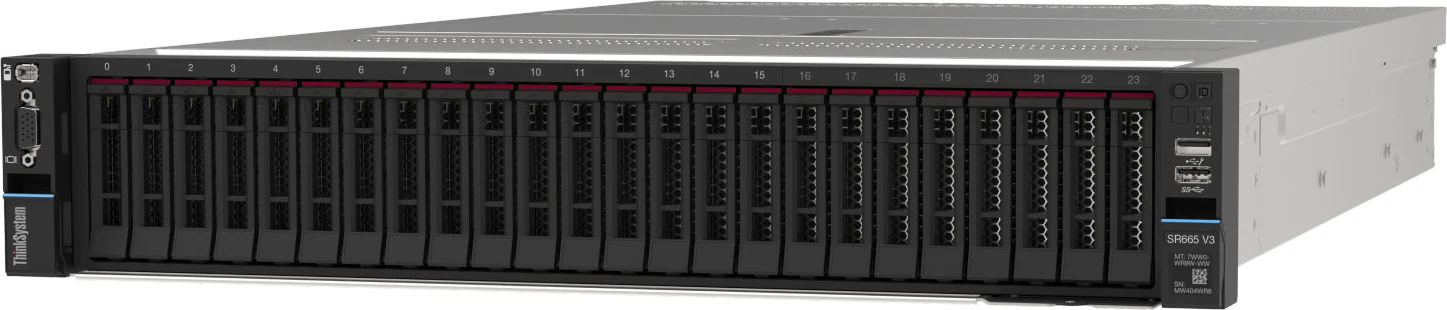
The ThinkSystem SR665 V3 is Lenovo’s two-socket 2U rack server for 4th and 5th Gen AMD EPYC processors, pitched at virtualisation, HCI, VDI, inference and HPC. This data sheet maps its option range and the rules behind it — 24 DIMMs and 6 TB over two sockets, three drive zones, the GPU envelope, and the slots, memory and cooling that only arrive with the second processor.
Our read of Lenovo’s documentation: where the SR665 V3 is strong, and the limits worth knowing before you spec one.
Strengths
+Lenovo lists 48 processors across two EPYC generations in one chassis, spanning 8 cores (EPYC 9015) to 160 (EPYC 9845) at up to 400 W.
+Twelve DDR5 channels per socket, one DIMM each, give 24 slots and 6 TB; 5th Gen processors run memory at 6400 MHz when fitted with the qualifying DIMMs and current firmware.
+Three drive zones — front, mid-chassis, rear — add up to forty 2.5-inch or twenty 3.5-inch bays; as many as 32 NVMe drives (24 front, 8 mid) each keep a full x4 link.
+Up to 12 PCIe slots plus OCP 3.0, and by default one of the four xGMI links is given over to two extra PCIe 5.0 x16 connections for adapters and NVMe drives.
+Three double-wide GPUs or up to seven single-wide L4s, and an optional Processor Neptune Core Module that moves the CPUs’ entire heat load into facility water.
Watch-outs
!Much of the range hangs on the second processor: Riser 2, Riser 4, full-height slot 7 and both front slots connect to CPU 2, and the Neptune module needs two CPUs.
!Reaching 6 TB takes 256 GB 3DS RDIMMs, listed for 5th Gen EPYC only; a 4th Gen server’s biggest option is 128 GB, which caps its 24 slots at 3 TB.
!GPU builds give up the mid and rear bays, and three GPUs of 300 W or more alongside processors of 320 W or more must move to the water-cooled module.
!Standard fans are allowed only when every CPU is under 240 W and the build has no GPUs, 3DS RDIMMs, ConnectX-6 or ConnectX-7 cards, Broadcom 57454 OCP adapter, 12 × 3.5-inch front, or mid or rear bays; many GPU and dense-storage builds also cap inlet air at 30 °C or 25 °C.
!The V3 holds less memory than the SR665 it replaced — 24 DIMMs and 6 TB against 32 and 8 TB — and supports neither memory mirroring nor rank sparing.
Processors48 SKUs
Cores / CPU8–160
DIMM slots24
Backplanes19
Max bays40
GPUsup to 7
PSU options10 · to 2,600 W
02 — Processors
48 supported processors, mapped
Lenovo lists 48 EPYC processors for the SR665 V3: 25 from the 5th Gen 9005 family (“Turin”, in Zen 5 and Zen 5c versions) and 23 from the 4th Gen 9004 family, which spans “Genoa”, the 3D V-Cache “Genoa-X” parts and the Zen 4c “Bergamo” parts. Core counts span 8 to 160 and TDPs 125 W to 400 W. Whatever the model, a socket brings 12 DDR5 channels plus 128 PCIe 5.0 lanes, though only 64 of those are left for adapters and NVMe drives.
Processor landscape — cores × TDP
48 SKUs · 2 families
AMD EPYC 9005 25AMD EPYC 9004 23Bubble size = L3 cache · hover a bubble for the full SKU
Processor explorer
filter · sort · compare
Processor
Cores / threads
Base
L3 cache
TDP
W / core
Memory
AMD EPYC 9845
160 / 320
2.1 GHz
320 MB
390 W
2.4
DDR5-6400
AMD EPYC 9825
144 / 288
2.2 GHz
384 MB
390 W
2.7
DDR5-6400
AMD EPYC 9745
128 / 256
2.4 GHz
256 MB
400 W
3.1
DDR5-6400
AMD EPYC 9754
128 / 256
2.25 GHz
256 MB
360 W
2.8
DDR5-4800
AMD EPYC 9734
112 / 224
2.2 GHz
256 MB
340 W
3.0
DDR5-4800
AMD EPYC 9655
96 / 192
2.6 GHz
384 MB
400 W
4.2
DDR5-6400
AMD EPYC 9655P
96 / 192
2.6 GHz
384 MB
400 W
4.2
DDR5-6400
AMD EPYC 9645
96 / 192
2.3 GHz
256 MB
320 W
3.3
DDR5-6400
AMD EPYC 9684X
96 / 192
2.55 GHz
1150 MB
400 W
4.2
DDR5-4800
AMD EPYC 9654
96 / 192
2.4 GHz
384 MB
360 W
3.8
DDR5-4800
AMD EPYC 9654P
96 / 192
2.4 GHz
384 MB
360 W
3.8
DDR5-4800
AMD EPYC 9634
84 / 168
2.25 GHz
384 MB
290 W
3.5
DDR5-4800
AMD EPYC 9565
72 / 144
3.15 GHz
384 MB
400 W
5.6
DDR5-6400
AMD EPYC 9575F
64 / 128
3.3 GHz
256 MB
400 W
6.3
DDR5-6400
AMD EPYC 9555
64 / 128
3.2 GHz
256 MB
360 W
5.6
DDR5-6400
AMD EPYC 9555P
64 / 128
3.2 GHz
256 MB
360 W
5.6
DDR5-6400
AMD EPYC 9535
64 / 128
2.4 GHz
256 MB
300 W
4.7
DDR5-6400
AMD EPYC 9554
64 / 128
3.1 GHz
256 MB
360 W
5.6
DDR5-4800
AMD EPYC 9554P
64 / 128
3.1 GHz
256 MB
360 W
5.6
DDR5-4800
AMD EPYC 9534
64 / 128
2.45 GHz
256 MB
280 W
4.4
DDR5-4800
AMD EPYC 9475F
48 / 96
3.65 GHz
256 MB
400 W
8.3
DDR5-6400
AMD EPYC 9455
48 / 96
3.15 GHz
256 MB
300 W
6.3
DDR5-6400
AMD EPYC 9455P
48 / 96
3.15 GHz
256 MB
300 W
6.3
DDR5-6400
AMD EPYC 9474F
48 / 96
3.6 GHz
256 MB
360 W
7.5
DDR5-4800
AMD EPYC 9454
48 / 96
2.75 GHz
256 MB
290 W
6.0
DDR5-4800
AMD EPYC 9454P
48 / 96
2.75 GHz
256 MB
290 W
6.0
DDR5-4800
AMD EPYC 9365
36 / 72
3.4 GHz
192 MB
300 W
8.3
DDR5-6400
AMD EPYC 9375F
32 / 64
3.8 GHz
256 MB
320 W
10.0
DDR5-6400
AMD EPYC 9355
32 / 64
3.55 GHz
256 MB
280 W
8.8
DDR5-6400
AMD EPYC 9355P
32 / 64
3.55 GHz
256 MB
280 W
8.8
DDR5-6400
AMD EPYC 9335
32 / 64
3 GHz
128 MB
210 W
6.6
DDR5-6400
AMD EPYC 9374F
32 / 64
3.85 GHz
256 MB
320 W
10.0
DDR5-4800
AMD EPYC 9384X
32 / 64
3.1 GHz
768 MB
320 W
10.0
DDR5-4800
AMD EPYC 9354
32 / 64
3.25 GHz
256 MB
280 W
8.8
DDR5-4800
AMD EPYC 9354P
32 / 64
3.25 GHz
256 MB
280 W
8.8
DDR5-4800
AMD EPYC 9334
32 / 64
2.7 GHz
128 MB
210 W
6.6
DDR5-4800
AMD EPYC 9275F
24 / 48
4.1 GHz
256 MB
320 W
13.3
DDR5-6400
AMD EPYC 9255
24 / 48
3.25 GHz
128 MB
200 W
8.3
DDR5-6400
AMD EPYC 9274F
24 / 48
4.05 GHz
256 MB
320 W
13.3
DDR5-4800
AMD EPYC 9224
24 / 48
2.5 GHz
64 MB
200 W
8.3
DDR5-4800
AMD EPYC 9254
24 / 48
2.9 GHz
128 MB
200 W
8.3
DDR5-4800
AMD EPYC 9175F
16 / 32
4.2 GHz
512 MB
320 W
20.0
DDR5-6400
AMD EPYC 9135
16 / 32
3.65 GHz
64 MB
200 W
12.5
DDR5-6400
AMD EPYC 9115
16 / 32
2.6 GHz
64 MB
125 W
7.8
DDR5-6400
AMD EPYC 9174F
16 / 32
4.1 GHz
256 MB
320 W
20.0
DDR5-4800
AMD EPYC 9184X
16 / 32
3.55 GHz
768 MB
320 W
20.0
DDR5-4800
AMD EPYC 9124
16 / 32
3 GHz
64 MB
200 W
12.5
DDR5-4800
AMD EPYC 9015
8 / 16
3.6 GHz
64 MB
125 W
15.6
DDR5-6400
P-suffix models (9355P, 9455P, 9555P, 9655P, 9354P, 9454P, 9554P and 9654P) are single-socket processors, supplied only in factory-built (CTO) or preconfigured servers rather than as option kits.
Three frequency-optimised 5th Gen parts — the 9175F, 9275F and 9375F — are CTO-only and are listed for two-processor builds only.
The X-suffix Genoa-X chips carry up to 1,150 MB of L3 cache (9684X); Lenovo aims them at engineering codes such as EDA and CFD.
The memory bus runs at 6400 MHz on every 5th Gen part (with qualifying DIMMs and the latest firmware; 6000 MHz otherwise) and at 4800 MHz on every 4th Gen part.
High-TDP parts bring their own inlet limits: with performance heatsinks the 9274F, 9374F, 9474F and 9575F hold an air-cooled 8- or 16-bay 2.5-inch or 8-bay 3.5-inch build to 25 °C, and parts such as the 9654, 9655 and 9684X hold the same layouts to 30 °C.
Platform Secure Boot is on by default: once powered up, a processor — including a second one added later — is cryptographically tied to that server, and Lenovo advises against moving it yourself.
03 — Memory
24 DIMM slots, 12 per processor
Each EPYC processor drives 12 DDR5 channels with one DIMM per channel, so the SR665 V3 has 12 slots per socket and 24 in all. Per processor, the permitted DIMM counts are 1, 2, 4, 6, 8, 10 and 12; for peak bandwidth Lenovo advises matching DIMMs in every one of the 12 channels.
Capacity with every slot filled
by DIMM size
Rated memory speed
from the processor table
Processor family
Up to
AMD EPYC 9005
6400 MT/s
AMD EPYC 9004
4800 MT/s
Two DIMM lists apply: 6400 MHz parts from 16 GB to 256 GB for 5th Gen processors, and parts running at up to 4800 MHz from 16 GB to 128 GB for 4th Gen. Lenovo does not support the 4800 MHz-rated DIMMs with 5th Gen or the 6400 MHz DIMMs with 4th Gen.
A 4th Gen server therefore reaches 3 TB at most (24 × 128 GB), and a single processor of either generation has 12 slots — 3 TB when filled with 256 GB 3DS RDIMMs on 5th Gen.
DIMM types (9x4, 10x4, x8 and 3DS) cannot be mixed, nor can x4 and x8 parts or DRAM densities; each processor takes at most two capacities, and 128 GB and 256 GB 3DS RDIMMs cannot share a server.
Protection includes ECC, SDDC on x4 DIMMs (not 9x4), Bounded Fault, patrol and demand scrubbing and Post Package Repair; memory mirroring and rank sparing are not offered.
Lenovo names 9x4 RDIMMs as a supported type, but neither of its current memory tables lists one.
When a GPU or another high-heat component is added in the field, every empty DIMM slot needs a filler for airflow.
04 — Storage
19 backplane options, up to 40 bays
Drives sit in three zones: up to 24 × 2.5-inch or 12 × 3.5-inch hot-swap bays at the front, a mid-chassis cage of 8 × 2.5-inch or 4 × 3.5-inch bays reached by lifting the top cover, and up to 8 × 2.5-inch or 4 × 3.5-inch bays at the rear. Lenovo counts 30 drive-bay configurations; the layouts below are its headline ceilings, and the chart after them plots the 19 backplanes those layouts are assembled from.
Headline layouts
front panel view
Front panel
Rear module
Config 33: three 8-bay SAS/SATA backplanes at the front, two 4-bay SAS/SATA backplanes in the mid cage (not drawn) and an 8-bay rear backplane. Lenovo lists it with one or two processors, run by 16-port RAID or HBA adapters with internal SAS expanders.
SAS/SATANVMeSAS/SATA + NVMe
Controllers & boot
On Board SATA AHCI Mode — Onboard (no RAID). Onboard controllers; RAID levels: None
Non RAID NVMe — Onboard (no RAID). Onboard controllers; RAID levels: None
RAID 540-8i PCIe Gen4 12Gb Adapter — RAID. 12Gb SAS/6Gb SATA RAID adapters - Broadcom PCIe Gen 4 (RAID 940 adapters support Tri-Mode); RAID levels: 0, 1, 10
RAID 540-16i PCIe Gen4 12Gb Adapter — RAID. 12Gb SAS/6Gb SATA RAID adapters - Broadcom PCIe Gen 4 (RAID 940 adapters support Tri-Mode); RAID levels: 0, 1, 10
Tri-Mode lets RAID 940-8i and 940-16i adapters run U.3 NVMe drives alongside SAS and SATA on AnyBay backplanes, each NVMe drive linked over a single lane; U.3 is mandatory, so U.2 drives will not work, and new CTO orders enable it with feature CH5Z.
Onboard ports connect up to 20 SATA and 20 NVMe drives without an adapter (no RAID); with one processor that falls to 16 SATA and 8 NVMe connections.
Riser 3 cannot be combined with the onboard NVMe ports except in configs 13-1, 13-2 and 12D-1.
Mid bays need Riser 1, which powers their backplanes, and exclude full-length adapters and all GPUs; 2.5-inch mid backplanes are fitted in pairs with no NVMe/SAS mixing.
For boot, choose either a rear pair of 7mm drives, which occupies slot 3 or slot 6, or an internal M.2 adapter with one or two drives; a server cannot have both.
Lenovo excludes both SAS-expander backplanes (12 × 3.5-inch BQ2S and 24 × 2.5-inch BQ2T) from cluster use; if BQ2T ships inside a rack cabinet, only six of its drives may be installed at the factory.
A 3.5-inch front rules out the internal cabled RAID/HBA bay, because the adapter and the drives occupy the same space.
Every documented backplane
19 with drive bays
2.5-inch3.5-inchEDSFF (E1.S / E3.S)
05 — Accelerators & I/O
GPUs, PCIe and networking
Every GPU slot in Lenovo’s GPU table is at the rear (slots 1–8). A double-wide card occupies slot 2, 5 or 7 and makes the slot beside it (1, 4 or 8) unusable; mixing GPU models in one server is not allowed, and GPU builds exclude flash storage adapters and mid or rear drive bays. Controlled GPUs such as the L40S, RTX PRO 6000 Blackwell Max-Q, A30 and L4 are ordered only on the “for AI” base models, while the non-controlled A16 and RTX 4500 Ada go on the general-purpose models. Up to 3 × double-wide (slots 2, 5, 7) or 7 × single-wide L4.
NVIDIA L40S 48GB PCIe Gen4 Passive GPU
double-wide
48GB · up to 3
NVIDIA RTX PRO 6000 Blackwell Max-Q Workstation Edition 96GB PCIe Gen5 Active GPU
double-wide
96GB · up to 3
NVIDIA A16 64GB Gen4 PCIe Passive GPU
double-wide
64GB · up to 3
NVIDIA RTX PRO 4500 Blackwell Workstation Edition 32GB PCIe Gen5 Active GPU
double-wide
32GB · up to 3
NVIDIA RTX 4500 Ada 24GB PCIe Active GPU
double-wide
24GB · up to 3
NVIDIA A30 24GB PCIe Gen4 Passive GPU
double-wide
24GB · up to 3
NVIDIA RTX PRO 4500 Blackwell Server Edition 32GB PCIe Gen5 Passive GPU
single-wide
32GB · up to 4
NVIDIA L4 24GB PCIe Gen4 Passive GPU
single-wide
24GB · up to 7
I/O topology
64 lanes per CPU
Each EPYC socket has 12 DDR5 channels; of its 128 PCIe 5.0 lanes, 64 remain for slots and NVMe drives. The two processors share four xGMI links: by default three carry inter-processor traffic and the fourth is split into two PCIe x16 connections for extra NVMe and PCIe devices, unless an optional cable rejoins it to maximise CPU-to-CPU bandwidth.
A one-processor server keeps slots 1–3 and, with the low-profile Riser 3 layout, slots 7 and 8 — five slots at most; slots 4–6, 9 and 10 are unavailable.
The low-profile Riser 3/4 pair (BQ2W with BTMS) supplies PCIe 4.0 slots in this server, even though its feature names say Gen5.
Once front slots are fitted, the rear OCP position goes offline, the lockable bezel cannot be used and the serial port cannot go in those slots.
The xGMI cable kit is not supported with 16 or more onboard NVMe connections, with front slots plus front OCP and front onboard NVMe, or with the 12-slot layout.
Every x8 slot is open-ended, and an optional RS-232 port bracket can take slot 3 or slot 6.
2.5-inch-front builds have a separate internal bay where a RAID adapter or HBA is cabled to an x8 connector, so it does not consume a slot.
06 — Power & cooling
10 power supplies, 750–2,600 W
Ten hot-swap supplies are listed: Titanium AC units of 750 W (two versions), 1100 W, 1800 W and 2600 W; Platinum AC units of 750 W, 1100 W, 1800 W and 2400 W; plus a single −48 V DC model rated at 1100 W. Up to two can be installed, and a pair must be identical.
AC−48 V DC
Low-line 110 V input is limited to two Platinum models, the 750 W and the 1100 W; every other supply in the table is a 220 V AC part.
Inlets: C14 on supplies of 1800 W or less; the two largest supplies (2400 W Platinum, 2600 W Titanium) take C20.
Behind the rack flange, the PSU handle sits at 732 mm for supplies up to 1100 W, 755 mm for the 1800 W units and 781 mm for 2400 W.
At 200 V the 2600 W Titanium unit draws up to 13.2 A and the 2400 W Platinum unit 14 A.
The DC model runs from a −48 to −60 V feed at up to 26 A through a Weidmuller terminal; Chinese installations can also feed any of the AC supplies with 240 V DC.
Cooling uses five 60 mm hot-swap fans with one processor and six with two, N+1, in Standard (single-rotor 17K RPM) or Performance (dual-rotor 21K RPM) form, plus fans inside the supplies.
The Processor Neptune Core Module (CTO only) needs 0.5, 1.0 or 1.5 litres per minute per server for inlet water at up to 40, 45 or 50 °C; it takes over slot 6, limits 7mm drives to slot 3 and rules out a cable management arm.
07 — Management, security & OS
Run it, secure it, choose the OS
Management
XClarity Controller 2 (XCC2) on an ASPEED AST2600 BMC
Rear 10/100/1000 RJ45 management port · optional second XCC2 port in the rear OCP slot
XCC2 Platinum: remote console, virtual media, System Guard, Neighbor Group, CNSA 1.0 strict mode — no power capping on this model
IPMI 2.0 (IPMI-over-LAN off by default), SNMPv3, CIM-XML, Redfish
XClarity Provisioning Manager (UEFI, F1 at boot)
XClarity One cloud management · XClarity Integrator plug-ins · XClarity Energy Manager
XClarity Mobile via the service USB port · optional External Diagnostics Handset
Optional Integrated Diagnostics Panel on 8- and 16-bay 2.5-inch fronts
Security
Platform Firmware Resiliency hardware Root of Trust (NIST SP 800-193)
AMD Platform Secure Boot, enabled by default
Integrated TPM 2.0 · Nationz TPM 2.0 in China (CTO only)
UEFI Secure Boot — enabled at the factory or left for the customer
AMD SEV, SEV-ES, SEV-SNP and TSME memory encryption
System Guard component-change detection (XCC2 Platinum)
Self-encrypting drives with KMIP key managers (IBM SKLM, Thales KeySecure)
NIST SP 800-147B compliant
Optional intrusion switch and lockable front bezel (bezel not with front slots)
Operating systems
Microsoft Windows Server 2019, 2022 and 2025
Windows 10 and 11 (Workstation base models; subset of adapters)
Red Hat Enterprise Linux 8.10, 9.4–9.8 and 10.0–10.2 (5th Gen); from 8.6 on 4th Gen
SUSE Linux Enterprise Server 15 SP6, SP7 and 16 (5th Gen); from 15 SP4 on 4th Gen
Ubuntu 22.04, 24.04 and 26.04 LTS; 20.04 on 4th Gen only
VMware ESXi 8.0 U3, 9.0 and 9.1 (5th Gen); from 7.0 U3 on 4th Gen · no factory preload with NVIDIA GPUs
08 — Compare
SR665 → SR665 V3
Lenovo’s guide sets the V3 against the SR665 it replaced. The newer model moves to DDR5 and PCIe 5.0 and more than doubles the core ceiling, but has fewer DIMM slots and a lower memory maximum, because it runs one DIMM on each of 12 channels rather than two on each of 8.
Previous generationThinkSystem SR665
This modelThinkSystem SR665 V3
Processors
2 × 2nd or 3rd Gen EPYC · up to 64 cores · 280 W
2 × 4th or 5th Gen EPYC · up to 160 cores · 400 W
PCIe lanes per CPU
64 × PCIe 4.0
64 × PCIe 5.0
xGMI
4 dedicated x16 links
4 x16 links, 1 convertible to PCIe 5.0
Memory
DDR4 to 2933 MHz · 8 channels · 2 DPC
DDR5 to 6400 MHz · 12 channels · 1 DPC
DIMM slots · maximum
32 · 8 TB
24 · 6 TB
Drive bays
20 × 3.5" or 40 × 2.5"
20 × 3.5" or 40 × 2.5"
Onboard NVMe ports
16
20
PCIe slots
Up to 8, all full-height
Up to 12 (10 rear + 2 front)
OCP 3.0
Rear · PCIe 4.0 x16
Rear or front · PCIe 5.0 x16
GPUs
8 single-wide or 3 double-wide
3 double-wide; single-wide 8 in this table, 7 in the GPU table
Management
XClarity Controller
XClarity Controller 2
Largest AC supply
1800 W
2600 W
Source: Lenovo Press LP1608 (SR665 V3 product guide), Table 2 — Comparing the SR665 V3 to the SR665; single-wide GPU maximum from Table 82.
The SR665 V3 family side by side
The SR665 V3 is the two-socket 2U member of Lenovo’s V3 AMD rack family: the SR655 V3 is the one-socket 2U model, the SR645 V3 and SR635 V3 are the 1U two- and one-socket models, and the SR675 V3 is a 3U machine. The SR650 V3 is its Intel Xeon counterpart. Each bar reflects that model’s verified spec file.
This modelSiblings and successorEach value from that model’s own verified spec file · bars scale per column
Head-to-head comparisons
Every figure on this page, set against the machines buyers weigh it up with.
Four builds that lean on the SR665 V3’s two-socket breadth, all assembled from parts our configurator permits for this server. Treat them as starting points: we check Lenovo’s storage-configuration tables, fan rules and inlet-temperature limits for the exact parts at quotation.
Virtualisation
High-density consolidation host
Two 64-core 9555 processors give 128 cores, and filling all 12 channels per socket with 64 GB DIMMs gives 1.5 TB at 6400 MHz. Eight NVMe drives hold local VM storage, and the hypervisor boots from a mirrored M.2 pair.
2 × AMD EPYC 9555 — 64 cores @ 3.2 GHz, 360 W each
This is Lenovo config 12-1 (one 8-bay NVMe backplane on onboard ports, two processors), which lists only RAID M.2 options — the mirrored M.2 pair here is one. The 360 W 9555 needs Performance fans, and with performance heatsinks in an 8-bay 2.5-inch front it limits air-cooled inlet to 30 °C.
Three double-wide NVIDIA L40S cards (48 GB each) fill slots 2, 5 and 7. Keeping the processors under 320 W — here two 32-core, 280 W 9355s — is what lets three 350 W GPUs stay on air instead of needing the Neptune water module.
2 × AMD EPYC 9355 — 32 cores @ 3.55 GHz, 280 W each
3 × NVIDIA L40S 48 GB, double-wide, in slots 2, 5 and 7
The L40S is a Controlled GPU, so it is ordered on a “for AI” base model such as 7D9ACTOAWW. With 5th Gen processors it needs PCIe Gen5 slots, the build cannot use mid or rear bays, config 15 requires both processors, and air-cooled GPU servers are held to 30 °C inlet.
Lenovo positions the 3D V-Cache Genoa-X parts for engineering codes such as EDA and CFD, and two 96-core 9684X processors bring 1,150 MB of L3 each. As a 4th Gen part it runs memory at 4800 MHz, so all 24 slots take 96 GB 4800 MHz RDIMMs for 2.25 TB, with a 200 Gb/s HDR InfiniBand adapter for the cluster fabric.
2 × AMD EPYC 9684X — 96 cores @ 2.55 GHz, 400 W each
24 × 96 GB TruDDR5 4800 MHz — 2.25 TB
4 × 3.84 TB NVMe U.3 scratch on an 8-bay NVMe backplane
The 400 W 9684X and the ConnectX-6 adapter both call for Performance fans, and with performance heatsinks in an 8-bay 2.5-inch front Lenovo limits air-cooled inlet to 30 °C.
The LFF maximum — 12 front, 4 mid and 4 rear 3.5-inch bays — filled with 20 TB drives gives 400 TB raw behind one 16-port RAID 940. Lenovo lists this layout only with two processors, so a pair of 16-core 9135s fills the sockets without adding cores the workload will not use.
2 × AMD EPYC 9135 — 16 cores @ 3.65 GHz, 200 W each
Windows is ruled out here: Lenovo does not support the 12-bay expander backplane with Windows once mid or rear 3.5-inch backplanes are fitted, or in cluster applications. 3.5-inch front, mid and rear bays all need Performance fans, this layout holds inlet air to 30 °C, and swapping a mid-bay drive means taking the top cover off.
Lenovo is not part of our refurbished range, which covers Dell and HPE; the closest re-certified matches to the SR665 V3 are therefore two-socket 2U AMD EPYC machines from the DDR4 generation. They offer far fewer cores than a V3, but suit projects where an earlier EPYC platform does the job.
Gen10 Plus · re-certified
HPE ProLiant DL385 Gen10 Plus
2U · two sockets
2 × EPYC 7002/7003 · up to 128 cores
32 DIMM slots · up to 8 TB DDR4-3200
Up to 24 × SFF or 12 × LFF · iLO 5
The most memory of the three — 32 slots and 8 TB — for VM and VDI hosts where capacity matters more than DDR5 bandwidth.
128 × PCIe 5.0 per processor · 64 available for PCIe and NVMe
Memory
Slots
24 DDR5 · 12 per processor · 12 channels × 1 DIMM
Types
TruDDR5 RDIMM, 3DS RDIMM and 9x4 RDIMM (no UDIMM or LRDIMM)
DIMM sizes
16, 32, 64, 96, 128 and 256 GB
Speed
5th Gen: 6400 MHz with qualifying DIMMs, otherwise 6000 MHz · 4th Gen: 4800 MHz
Maximum
6 TB (24 × 256 GB 3DS RDIMM)
Protection
ECC, SDDC (x4), Bounded Fault, patrol/demand scrubbing, Post Package Repair · no mirroring or sparing
Persistent memory
Not supported
Storage
Front
3.5": 8 or 12 bays · 2.5": 8, 16 or 24 bays · SAS/SATA, AnyBay or NVMe (Gen4 or Gen5)
Mid-chassis
4 × 3.5" SAS/SATA or 8 × 2.5" SAS/SATA or NVMe, reached under the top cover
Rear
2 or 4 × 3.5" SAS/SATA · 4 or 8 × 2.5" SAS/SATA, or 4 × 2.5" AnyBay
Maximum
20 × 3.5" or 40 × 2.5" · 32 NVMe without oversubscription
Boot
2 × rear 7mm (slot 3 or 6) or internal M.2 with 1–2 drives, not both
Onboard
Up to 20 SATA and 20 NVMe ports (non-RAID)
Adapters
RAID 540 / 940 (8, 16 or 32 ports, up to 8 GB flash) · 440 HBAs · Gen4 and Gen5 NVMe retimers
Expansion & networking
PCIe slots
Up to 12: 10 rear on four risers + 2 front FHHL x16
OCP
1 × OCP 3.0 SFF, PCIe 5.0 x16 — rear or front, not both
Internal
Cabled RAID/HBA bay on 2.5-inch-front builds
Serial
Optional RS-232 COM bracket in slot 3 or 6
CXL
CXL 1.1 ready
Accelerators
Double-wide GPUs
Up to 3 · slots 2, 5 and 7
Single-wide GPUs
Up to 7 NVIDIA L4 · up to 4 RTX PRO 4500 Blackwell Server Edition
Rules
Identical GPUs only · no mid or rear bays · Controlled GPUs on “for AI” models
Power
Supplies
Up to two hot-swap, redundant, identical
AC Titanium
750, 1100, 1800 and 2600 W
AC Platinum
750 and 1100 W (also 110 V) · 1800 and 2400 W
DC
1100 W, −48 to −60 V
Ports & video
Front
USB 3.2 Gen 1 · USB 2.0 (also XCC) · external diagnostics port · optional VGA
Rear
3 × USB 3.2 Gen 1 · VGA · 1GbE XCC management · optional DB-9 serial
Internal
1 × USB 3.2 Gen 1
Video
16 MB, integrated in XCC2 · up to 1920 × 1200 at 60 Hz
Environment & warranty
ASHRAE
Class A2 in most configurations; A3, A4 or H1 depending on the build
Operating temperature
10–35 °C (A2) · shuts down above its supported maximum (A4: 45 °C)
Maximum altitude
3,050 m
Sound power (operating)
8.1 Bel typical · 8.7 Bel GPU-rich
Warranty
3 or 1 year by machine type · CRU and onsite, 9 × 5 next business day
12 — FAQ
SR665 V3 questions, answered from the documentation
What is the maximum memory of the Lenovo ThinkSystem SR665 V3?
Six terabytes, with all 24 slots holding 256 GB 3DS RDIMMs across two processors. That DIMM appears only in Lenovo’s 5th Gen EPYC memory table, so with 4th Gen processors the ceiling is 3 TB (24 × 128 GB), and a one-processor server has just 12 slots.
Which AMD EPYC processors does the SR665 V3 support?
Lenovo lists 48: 25 5th Gen EPYC 9005 and 23 4th Gen EPYC 9004 models, ranging from 8 cores (9015) to 160 (9845), with TDPs between 125 W and 400 W. The 4th Gen list includes Genoa-X parts with up to 1,150 MB of L3 and the Zen 4c Bergamo parts. Eight P-suffix models are single-socket only.
How many drives does the SR665 V3 hold?
Forty 2.5-inch drives split 24/8/8 across front, mid-chassis and rear, or twenty 3.5-inch drives split 12/4/4, plus two rear 7mm or up to two M.2 boot drives. As many as 32 bays can be NVMe with a dedicated x4 link each — 24 at the front and 8 mid-chassis — and that layout needs both processors.
How many GPUs fit in the SR665 V3?
Three double-wide GPUs in slots 2, 5 and 7, or up to seven single-wide NVIDIA L4 cards. Lenovo’s summary tables say eight single-wide, but no single-wide GPU in its GPU table is listed above seven. GPU servers cannot use mid or rear bays, and three GPUs of 300 W or more with processors of 320 W or more require the water-cooled Neptune module.
How many PCIe slots does the SR665 V3 have?
Up to 12 plus one OCP 3.0 slot: ten at the rear on four risers, and two full-height half-length x16 slots at the front in layouts with 16 or fewer front bays. The riser chosen sets each rear slot to PCIe 5.0 or 4.0, while Riser 2, Riser 4 and both front slots are wired to the second processor.
What does a one-processor SR665 V3 give up?
Half the memory slots (12 remain), all but five PCIe slots — slots 1–3, plus 7 and 8 with the low-profile riser — and onboard connections beyond 16 SATA and 8 NVMe drives. The Neptune liquid-cooling module is unavailable, and several storage layouts, including the 32-NVMe and 20 × 3.5-inch maximums, are listed for two processors only.
Should I choose the SR665 V3 or the single-socket SR655 V3?
Both are 2U EPYC servers with the same 40 × 2.5-inch or 20 × 3.5-inch bay ceilings. The SR655 V3 takes one processor, 12 DIMM slots and up to 3 TB, with up to 10 PCIe slots and a PCIe 4.0 OCP slot; the SR665 V3 doubles sockets and memory to 24 DIMMs and 6 TB and reaches 12 slots. Pick the SR665 V3 when one socket’s memory or I/O runs out.
How does the SR665 V3 compare with the SR645 V3 and the Intel SR650 V3?
The SR645 V3 matches the 24-DIMM, 6 TB memory ceiling in a 1U two-socket chassis, but stops at 12 × 2.5-inch bays, 5 PCIe slots and five single-width GPUs of up to 75 W. The SR650 V3 is the Intel Xeon 2U alternative, with 32 DIMM slots and 8 TB but up to 64 cores per processor against the SR665 V3’s 160.
What changed from the original SR665?
According to Lenovo’s comparison table, the V3 moves from DDR4-2933 and PCIe 4.0 to DDR5-6400 and PCIe 5.0, raises the core ceiling from 64 to 160 and TDP from 280 W to 400 W, and adds front slots, a front OCP option and 20 onboard NVMe ports instead of 16. Memory falls from 32 DIMMs and 8 TB to 24 DIMMs and 6 TB, as each channel now carries one DIMM.
Is the Lenovo ThinkSystem SR665 V3 end of life?
Not per Lenovo’s current product guide: it still lists orderable processors and options, some flagged as new in July 2026, and publishes no end-of-service date for the SR665 V3. Coverage follows each unit’s warranty or service contract, and our end-of-life checker will record official dates when they appear.
Specifications are extracted from Lenovo’s published documents and independently re-checked line by line. Configurations are quote-based; availability and exact options are confirmed at quotation. Last reviewed 2026-09-11.