UK’s trusted IT infrastructure partner since 2003
Servnet
FinanceToolsConfiguratorGet in Touch
Technical data sheet · ThinkSystem V3 · 3U one- or two-socket AMD EPYC GPU server

Lenovo ThinkSystem SR675 V3Specifications, configurations & comparisons

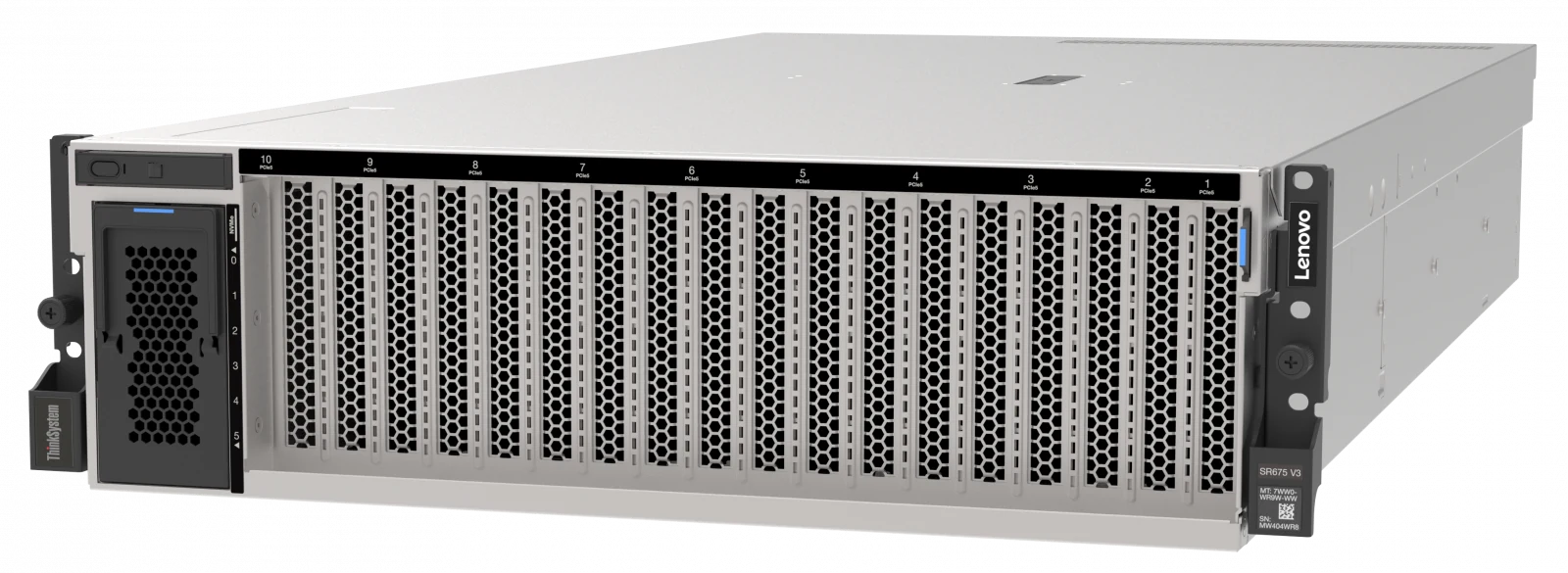
The ThinkSystem SR675 V3 is Lenovo’s 3U AMD EPYC server for PCIe accelerators, built on one of two front GPU bases: four double-wide cards beside eight 2.5-inch bays, or eight double-wide cards over EDSFF storage. This data sheet maps what each base allows — GPU risers, drives, slots, supply counts and the fan and processor rules — and where the fixed SR675i V3 inference build fits.

3U Rack1 or 2 socketsAMD EPYC 9005AMD EPYC 9004XClarity Controller 2
8double-wide GPUs8-DW base · 4 on the 4-DW base
160cores per processorEPYC 9845 · one or two sockets
6TBDDR5 maximum24 × 256 GB · Table 2 says 3 TB
8front drive bays2.5" AnyBay · 4-DW base only
14PCIe slots + OCP8 GPU · 2 front I/O · 4 rear
4hot-swap PSUs1800, 2400 or 2600 W · two minimum

Every figure checked against the Lenovo ThinkSystem SR675 V3 and SR675i V3 Servers Product Guide (August 25, 2026)

Form factor
3U Rack · 2 sockets
Processors
AMD EPYC 9005 · AMD EPYC 9004
Memory
24 × DDR5 RDIMM · up to 6 TB
Drive bays
Up to 8 · 3 backplane options
Expansion
6 × PCIe · 1 × OCP 3.0
GPUs
Up to 8 · 6 listed
Boot
M.2 · 3 boot options
Management
XClarity Controller 2
01 — Overview

The SR675 V3 at a glance

Our read of Lenovo’s documentation: where the SR675 V3 is strong, and the limits worth knowing before you spec one.

Strengths

  • Eight double-wide or single-wide PCIe GPUs fit in 3U on the 8-DW base, fed either by two direct x8 risers at 1:1 or by two switched x16 risers that share each host link between two cards.
  • The GPU table spans the single-wide L4 to the 141 GB H200 NVL and 96 GB RTX PRO 6000 Blackwell cards, with NVLink bridges for double-wide pairs and a 4-way bridge for sets of four H200 NVL cards.
  • One chassis takes both EPYC generations: 40 processors from 8 to 160 cores and up to 400 W, each socket with 12 DDR5 channels, and memory at up to 6400 MHz on 5th Gen parts.
  • Network adapters get their own slots rather than competing with GPUs: up to two front and four rear x16 positions take cards up to 400 Gb (ConnectX-8, BlueField-3 B3140H, CN5000), plus an OCP 3.0 slot.
  • Every drive bay is at the front and hot-swap, NVMe bays get four lanes each, and the two to four supplies come as 1800 W, 2400 W or 2600 W units.

Watch-outs

  • Local storage is deliberately small: eight 2.5-inch bays on the 4-DW base, and on the 8-DW base six E1.S or four E3.S NVMe bays with no SAS or SATA option.
  • Lenovo marks all six GPUs in its table as Controlled, so any GPU server starts from a “for AI” base model, which is export-classified and has limited availability.
  • H200 NVL and RTX PRO 6000 builds, and any configuration with 600 W GPUs, need 5th Gen EPYC and the High Performance fans — and those fans are not offered with 4th Gen processors.
  • The 8-DW base cannot run N+N power: four 2400 W or 2600 W supplies give N+1 at best, and with 1800 W units all four are needed just to run the server.
  • Lenovo’s onsite response targets (next business day, 4-hour) do not apply to GPU-related faults on this model; they are handled on a commercially reasonable endeavours basis, and on-site spares are the suggested remedy.
Processors40 SKUs
Cores / CPU8–160
DIMM slots24
Backplanes3
Max bays8
GPUsup to 8
PSU options4 · to 2,600 W
02 — Processors

40 supported processors, mapped

Lenovo lists 40 EPYC processors: 21 Turin-generation 9005 parts split between Zen 5 and Zen 5c cores, and 19 from the 9004 generation — Genoa, the 3D V-Cache Genoa-X chips and Zen 4c Bergamo. Every SKU is listed for one or two sockets, yet the configuration tables show only two single-processor builds, both on the 4-DW base. A socket supplies 12 DDR5 memory channels plus 128 lanes of PCIe 5.0, of which 64 reach GPUs, adapters and NVMe drives.

Processor landscape — cores × TDP

40 SKUs · 2 families
Lenovo ThinkSystem SR675 V3: every supported processor by cores and TDP081624324048566472808896104112120128136144152160100 W150 W200 W250 W300 W350 W400 WCores per processorAMD EPYC 9845 — 160 cores / 320 threads · 390 W · 2.1 GHz base · 320 MB cache · DDR5-6400AMD EPYC 9825 — 144 cores / 288 threads · 390 W · 2.2 GHz base · 384 MB cache · DDR5-6400AMD EPYC 9745 — 128 cores / 256 threads · 400 W · 2.4 GHz base · 256 MB cache · DDR5-6400AMD EPYC 9655 — 96 cores / 192 threads · 400 W · 2.6 GHz base · 384 MB cache · DDR5-6400AMD EPYC 9645 — 96 cores / 192 threads · 320 W · 2.3 GHz base · 256 MB cache · DDR5-6400AMD EPYC 9565 — 72 cores / 144 threads · 400 W · 3.15 GHz base · 384 MB cache · DDR5-6400AMD EPYC 9575F — 64 cores / 128 threads · 400 W · 3.3 GHz base · 256 MB cache · DDR5-6400AMD EPYC 9555 — 64 cores / 128 threads · 360 W · 3.2 GHz base · 256 MB cache · DDR5-6400AMD EPYC 9535 — 64 cores / 128 threads · 300 W · 2.4 GHz base · 256 MB cache · DDR5-6400AMD EPYC 9475F — 48 cores / 96 threads · 400 W · 3.65 GHz base · 256 MB cache · DDR5-6400AMD EPYC 9455 — 48 cores / 96 threads · 300 W · 3.15 GHz base · 256 MB cache · DDR5-6400AMD EPYC 9365 — 36 cores / 72 threads · 300 W · 3.4 GHz base · 192 MB cache · DDR5-6400AMD EPYC 9375F — 32 cores / 64 threads · 320 W · 3.8 GHz base · 256 MB cache · DDR5-6400AMD EPYC 9355 — 32 cores / 64 threads · 280 W · 3.55 GHz base · 256 MB cache · DDR5-6400AMD EPYC 9335 — 32 cores / 64 threads · 210 W · 3 GHz base · 128 MB cache · DDR5-6400AMD EPYC 9275F — 24 cores / 48 threads · 320 W · 4.1 GHz base · 256 MB cache · DDR5-6400AMD EPYC 9255 — 24 cores / 48 threads · 200 W · 3.25 GHz base · 128 MB cache · DDR5-6400AMD EPYC 9175F — 16 cores / 32 threads · 320 W · 4.2 GHz base · 512 MB cache · DDR5-6400AMD EPYC 9135 — 16 cores / 32 threads · 200 W · 3.65 GHz base · 64 MB cache · DDR5-6400AMD EPYC 9115 — 16 cores / 32 threads · 125 W · 2.6 GHz base · 64 MB cache · DDR5-6400AMD EPYC 9015 — 8 cores / 16 threads · 125 W · 3.6 GHz base · 64 MB cache · DDR5-6400AMD EPYC 9754 — 128 cores / 256 threads · 360 W · 2.25 GHz base · 256 MB cache · DDR5-4800AMD EPYC 9734 — 112 cores / 224 threads · 340 W · 2.2 GHz base · 256 MB cache · DDR5-4800AMD EPYC 9684X — 96 cores / 192 threads · 400 W · 2.55 GHz base · 1150 MB cache · DDR5-4800AMD EPYC 9654 — 96 cores / 192 threads · 360 W · 2.4 GHz base · 384 MB cache · DDR5-4800AMD EPYC 9634 — 84 cores / 168 threads · 290 W · 2.25 GHz base · 384 MB cache · DDR5-4800AMD EPYC 9554 — 64 cores / 128 threads · 360 W · 3.1 GHz base · 256 MB cache · DDR5-4800AMD EPYC 9534 — 64 cores / 128 threads · 280 W · 2.45 GHz base · 256 MB cache · DDR5-4800AMD EPYC 9474F — 48 cores / 96 threads · 360 W · 3.6 GHz base · 256 MB cache · DDR5-4800AMD EPYC 9454 — 48 cores / 96 threads · 290 W · 2.75 GHz base · 256 MB cache · DDR5-4800AMD EPYC 9374F — 32 cores / 64 threads · 320 W · 3.85 GHz base · 256 MB cache · DDR5-4800AMD EPYC 9384X — 32 cores / 64 threads · 320 W · 3.1 GHz base · 768 MB cache · DDR5-4800AMD EPYC 9354 — 32 cores / 64 threads · 280 W · 3.25 GHz base · 256 MB cache · DDR5-4800AMD EPYC 9334 — 32 cores / 64 threads · 210 W · 2.7 GHz base · 128 MB cache · DDR5-4800AMD EPYC 9274F — 24 cores / 48 threads · 320 W · 4.05 GHz base · 256 MB cache · DDR5-4800AMD EPYC 9224 — 24 cores / 48 threads · 200 W · 2.5 GHz base · 64 MB cache · DDR5-4800AMD EPYC 9254 — 24 cores / 48 threads · 200 W · 2.9 GHz base · 128 MB cache · DDR5-4800AMD EPYC 9174F — 16 cores / 32 threads · 320 W · 4.1 GHz base · 256 MB cache · DDR5-4800AMD EPYC 9184X — 16 cores / 32 threads · 320 W · 3.55 GHz base · 768 MB cache · DDR5-4800AMD EPYC 9124 — 16 cores / 32 threads · 200 W · 3 GHz base · 64 MB cache · DDR5-4800EPYC 9845160 cores · 2.4 W/core — top SKU and most efficient
AMD EPYC 9005 21AMD EPYC 9004 19Bubble size = L3 cache · hover a bubble for the full SKU

Processor explorer

filter · sort · compare
ProcessorCores / threadsBaseL3 cacheTDPW / coreMemory
AMD EPYC 9845160 / 3202.1 GHz320 MB390 W2.4DDR5-6400
AMD EPYC 9825144 / 2882.2 GHz384 MB390 W2.7DDR5-6400
AMD EPYC 9745128 / 2562.4 GHz256 MB400 W3.1DDR5-6400
AMD EPYC 9754128 / 2562.25 GHz256 MB360 W2.8DDR5-4800
AMD EPYC 9734112 / 2242.2 GHz256 MB340 W3.0DDR5-4800
AMD EPYC 965596 / 1922.6 GHz384 MB400 W4.2DDR5-6400
AMD EPYC 964596 / 1922.3 GHz256 MB320 W3.3DDR5-6400
AMD EPYC 9684X96 / 1922.55 GHz1150 MB400 W4.2DDR5-4800
AMD EPYC 965496 / 1922.4 GHz384 MB360 W3.8DDR5-4800
AMD EPYC 963484 / 1682.25 GHz384 MB290 W3.5DDR5-4800
AMD EPYC 956572 / 1443.15 GHz384 MB400 W5.6DDR5-6400
AMD EPYC 9575F64 / 1283.3 GHz256 MB400 W6.3DDR5-6400
AMD EPYC 955564 / 1283.2 GHz256 MB360 W5.6DDR5-6400
AMD EPYC 953564 / 1282.4 GHz256 MB300 W4.7DDR5-6400
AMD EPYC 955464 / 1283.1 GHz256 MB360 W5.6DDR5-4800
AMD EPYC 953464 / 1282.45 GHz256 MB280 W4.4DDR5-4800
AMD EPYC 9475F48 / 963.65 GHz256 MB400 W8.3DDR5-6400
AMD EPYC 945548 / 963.15 GHz256 MB300 W6.3DDR5-6400
AMD EPYC 9474F48 / 963.6 GHz256 MB360 W7.5DDR5-4800
AMD EPYC 945448 / 962.75 GHz256 MB290 W6.0DDR5-4800
AMD EPYC 936536 / 723.4 GHz192 MB300 W8.3DDR5-6400
AMD EPYC 9375F32 / 643.8 GHz256 MB320 W10.0DDR5-6400
AMD EPYC 935532 / 643.55 GHz256 MB280 W8.8DDR5-6400
AMD EPYC 933532 / 643 GHz128 MB210 W6.6DDR5-6400
AMD EPYC 9374F32 / 643.85 GHz256 MB320 W10.0DDR5-4800
AMD EPYC 9384X32 / 643.1 GHz768 MB320 W10.0DDR5-4800
AMD EPYC 935432 / 643.25 GHz256 MB280 W8.8DDR5-4800
AMD EPYC 933432 / 642.7 GHz128 MB210 W6.6DDR5-4800
AMD EPYC 9275F24 / 484.1 GHz256 MB320 W13.3DDR5-6400
AMD EPYC 925524 / 483.25 GHz128 MB200 W8.3DDR5-6400
AMD EPYC 9274F24 / 484.05 GHz256 MB320 W13.3DDR5-4800
AMD EPYC 922424 / 482.5 GHz64 MB200 W8.3DDR5-4800
AMD EPYC 925424 / 482.9 GHz128 MB200 W8.3DDR5-4800
AMD EPYC 9175F16 / 324.2 GHz512 MB320 W20.0DDR5-6400
AMD EPYC 913516 / 323.65 GHz64 MB200 W12.5DDR5-6400
AMD EPYC 911516 / 322.6 GHz64 MB125 W7.8DDR5-6400
AMD EPYC 9174F16 / 324.1 GHz256 MB320 W20.0DDR5-4800
AMD EPYC 9184X16 / 323.55 GHz768 MB320 W20.0DDR5-4800
AMD EPYC 912416 / 323 GHz64 MB200 W12.5DDR5-4800
AMD EPYC 90158 / 163.6 GHz64 MB125 W15.6DDR5-6400
  • GPU choice can fix the processor generation: the H200 NVL and RTX PRO 6000 Blackwell are sold only on 5th Gen (Turin) servers, and so is every 600 W GPU configuration.
  • The highest boost clocks are the 9175F and 9575F at 5 GHz; the 9175F pairs just 16 cores with 512 MB of L3.
  • Genoa-X parts (9184X, 9384X and 9684X) carry 768 MB to 1,150 MB of L3, and Lenovo pitches them at EDA and CFD work.
  • With 5th Gen processors, memory runs at 6400 MHz only with the listed DIMMs and current firmware, and at 6000 MHz otherwise; 4th Gen parts run at 4800 MHz.
  • For UK and EU orders Lenovo advises the Maximum Efficiency operating mode (BFYA) for ErP Lot 9 compliance; the SR675i V3 ships in Maximum Performance mode (BFYB).
  • Lenovo’s processor tables give feature codes only, with no option-kit part numbers.
03 — Memory

24 DIMM slots, 12 per processor

There are 12 DIMM slots per processor, one per channel: 24 in a two-socket server and 12 with a single CPU. Each processor takes a single DIMM or any even number up to 12, every DIMM must carry the same part number, and Lenovo recommends filling all 12 channels for best performance.

Capacity with every slot filled

by DIMM size
16 GB384 GB32 GB768 GB64 GB1.5 TB96 GB2.3 TB128 GB3 TB256 GB6 TB5th Gen only24 slots · 12 per processor · each tick = one DIMM

Rated memory speed

from the processor table
Processor familyUp to
AMD EPYC 90056400 MT/s
AMD EPYC 90044800 MT/s
  • The guide states two ceilings. Its key features and memory section give 6 TB using 24 × 256 GB 3DS RDIMMs; the standard-specifications table gives 3 TB using 24 × 128 GB 3DS RDIMMs, although no 128 GB 3DS part appears in either memory table.
  • By generation, the only 256 GB module is in the 5th Gen list, so 6 TB (24 × 256 GB) is a 5th Gen figure; the largest 4th Gen option is a 128 GB RDIMM, which makes 3 TB across 24 slots.
  • 6400 MHz DIMMs work only with 5th Gen and 4800 MHz DIMMs only with 4th Gen; the 128 GB 5600 MHz module in the 4th Gen list runs at 4800 MHz here.
  • RDIMMs and 3DS RDIMMs are supported (x4, 9x4, 10x4 and x8 types); UDIMMs, LRDIMMs and persistent memory are not, and neither memory mirroring nor rank sparing is offered.
  • Error handling includes ECC, Bounded Fault, SDDC for x4 DIMMs (not 9x4), patrol and demand scrubbing, on-die ECC, ECS and Post Package Repair.
  • Adding 256 GB 3DS RDIMMs in the field follows Lenovo support tip TT3220, and H200 builds have their own population rules in Lenovo’s online documentation.
04 — Storage

3 backplane options, up to 8 bays

The GPU base fixes the drive options. The 4-DW base has one 8-bay 2.5-inch AnyBay backplane for SAS, SATA or NVMe drives; the 8-DW base takes either a 6-bay E1.S backplane (PCIe 4.0) or a 4-bay E3.S 1T backplane (PCIe 5.0), all NVMe. Every bay is at the front and hot-swap, and one or two boot drives can go on an internal M.2 adapter. The bay map draws three complete layouts from Lenovo’s configuration tables; the six-bay E1.S front is covered in the notes.

Headline layouts

front panel view

Front panel

Configs 1 and 2 (4-DW base): two processors, the direct x16 GPU riser (BR7Q) and the BLL2 AnyBay backplane with SAS, SATA or PCIe 5.0 NVMe drives, plus two front x16 slots. Config 1 keeps the OCP slot and one rear x16 slot for the RAID adapter or HBA; config 2 drops the OCP slot for a second rear x16 slot.

SAS/SATANVMeSAS/SATA + NVMe

Controllers & boot

  • RAID 540-8i PCIe Gen4 12Gb Adapter — RAID. RAID Adapter - PCIe 4.0 (RAID 940 adapters support Tri-Mode); RAID levels: 0, 1, 10
  • RAID 940-8i 4GB Flash PCIe Gen4 12Gb Adapter — RAID, 4GB cache. RAID Adapter - PCIe 4.0 (RAID 940 adapters support Tri-Mode); RAID levels: 0, 1, 10, 5, 50, 6, 60
  • RAID 940-8i 8GB Flash PCIe Gen4 12Gb Adapter — RAID, 8GB cache. RAID Adapter - PCIe 4.0 (RAID 940 adapters support Tri-Mode); RAID levels: 0, 1, 10, 5, 50, 6, 60
  • RAID 940-16i 8GB Flash PCIe Gen4 12Gb Adapter for U.2 — RAID, 8GB cache. RAID Adapter - PCIe 4.0 (RAID 940 adapters support Tri-Mode); RAID levels: 0, 1, 10, 5, 6
  • 440-8i SAS/SATA PCIe Gen4 12Gb HBA — HBA. SAS/SATA HBA; RAID levels: None
  • RAID 940-8i 4GB Flash PCIe Gen4 12Gb Adapter for U.3 — RAID, 4GB cache. Tri-Mode (U.3 NVMe) variant; RAID levels: 0, 1, 10, 5, 50, 6, 60
  • RAID 940-8i 8GB Flash PCIe Gen4 12Gb Adapter for U.3 — RAID, 8GB cache. Tri-Mode (U.3 NVMe) variant; RAID levels: 0, 1, 10, 5, 50, 6, 60
  • ThinkSystem 440-16e SAS/SATA PCIe Gen4 12Gb HBA — HBA. External SAS HBA (JBOD to external enclosures/tape), part 4Y37A09724 feature B8P7 - lp1611 L1981
  • M.2 SATA/NVMe 2-Bay Enablement Kit (4Y37A09738) — boot
  • M.2 SATA/x4 NVMe 2-Bay Enablement Kit (4Y37A79663) — boot
  • M.2 NVMe 2-Bay RAID Enablement Kit (4Y37A09750) — boot
  • E1.S front (8-DW base only, configs 3, 4, 6 and 38): six 5.9 mm bays on the BFTQ backplane at PCIe 4.0 x4. The drive table lists 3.84 TB and 7.68 TB models, so six drives reach 46.08 TB.
  • Lenovo’s summary quotes 245.76 TB (8 × 30.72 TB SAS) and 491.52 TB (8 × 61.44 TB NVMe) for the 4-DW base and 61.44 TB for four E3.S drives; the drive tables also list a 122.88 TB U.2 drive and 30.72 TB and 61.44 TB E3.S drives, which those totals do not reflect.
  • NVMe bays each get four PCIe lanes, so nothing is oversubscribed. Tri-Mode is the exception: a RAID 940 runs U.3 drives (not U.2) over x1 links, enabled with feature CH5Z on new CTO orders.
  • RAID adapters and HBAs go only in rear slots 16 and 20, never the front risers. The guide is inconsistent on flash-backed RAID: its supercap section allows two holders (the serial port is then disabled), while the controller and external-storage notes allow a single supercap.
  • Boot drives are M.2 NVMe only, because the motherboard has no SATA. Three two-bay kits connect to CPU 1; the RAID kit uses a Marvell 88NR2241 controller, and another relies on a separate RAID adapter for RAID.
  • The drive tables list no hard-disk drives: the 2.5-inch choices are 24 Gb SAS, 6 Gb SATA and PCIe 4.0 or 5.0 NVMe SSDs.
  • An encryption-ready CTO build (feature CES1) requires SED drives and XCC2 Platinum and removes the M.2 RAID kit and 440 HBAs; Lenovo says not to use it for vSAN or Nutanix.

Every documented backplane

3 with drive bays
SR675 V3 8x2.5" AnyBay Backplane Option KitSR675 V3 8x2.5" AnyBay Backplane Option Kit8SR675 V3 6xEDSFF Backplane Option KitSR675 V3 6xEDSFF Backplane Option Kit6SR675 V3 1x4 E3.S Backplane for 8DW PCIe GPU Base …SR675 V3 1x4 E3.S Backplane for 8DW PCIe GPU Base Option Kit4Bays · solid = front · dashed = rear · brighter = NVMe-only
2.5-inch3.5-inchEDSFF (E1.S / E3.S)
05 — Accelerators & I/O

GPUs, PCIe and networking

The chassis base sets the GPU count: BR7G takes four double-wide or single-wide cards, BR7F eight. Lenovo lists six NVIDIA PCIe GPUs for both bases — the H200 NVL 141 GB, RTX PRO 6000 Blackwell Server Edition 96 GB, A100 80 GB, A30 24 GB and L40S 48 GB, all double-wide, plus the single-wide L4 24 GB — and all cards in a server must match. Adjacent double-wide pairs can be joined with NVLink bridges; H200 NVL uses a 2-way bridge per pair or a 4-way bridge per four cards. Host links come from three riser types: a direct x16 riser for four GPUs at 1:1, a direct x8 riser fitted in pairs for eight GPUs at 1:1, and a switched x16 riser with GPUDirect RDMA that shares each uplink between two GPUs. This guide documents no SXM/HGX base or liquid cooling for the SR675 V3, and although its overview mentions AMD Instinct accelerators, none appears in the GPU table. 4 × double- or single-wide GPUs (4-DW base) or 8 × (8-DW base) · double-wide cards rated up to 600 W each

NVIDIA H200 NVL 141GB PCIe GPU Gen5 Passive GPU

double-wide
141GB · up to 4 (4-DW GPU model) / up to 8 (8-DW GPU model)

NVIDIA RTX PRO 6000 Blackwell Server Edition 96GB PCIe Gen5 Passive GPU

double-wide
96GB · up to 4 (4-DW GPU model) / up to 8 (8-DW GPU model)

NVIDIA A100 80GB PCIe Gen4 Passive GPU w/o CEC

double-wide
80GB · up to 4 (4-DW GPU model) / up to 8 (8-DW GPU model)

NVIDIA A30 24GB PCIe Gen4 Passive GPU w/o CEC

double-wide
24GB · up to 4 (4-DW GPU model) / up to 8 (8-DW GPU model)

NVIDIA L40S 48GB PCIe Gen4 Passive GPU

double-wide
48GB · up to 4 (4-DW GPU model) / up to 8 (8-DW GPU model)

NVIDIA L4 24GB PCIe Gen4 Passive GPU

single-wide
24GB · up to 4 (4-DW GPU model) / up to 8 (8-DW GPU model)

I/O topology

64 lanes per CPU
CPU 164 × PCIe 5.012 ch · 12 DIMMCPU 264 × PCIe 5.012 ch · 12 DIMMGPU: 4 or 8 × x16 slotsdirect x16/x8 or switched risersI/O: 2 front + 4 rear x16slots 1–2, 15–16 and 20–21OCP 3.0 SFF · PCIe 4.0x8 or x16 · slot 27 · rear onlyXCC2 on AST26001GbE RJ45 · Redfish · IPMI 2.0

Each EPYC processor has 12 DDR5 channels and 128 PCIe 5.0 lanes, and half of those lanes are usable by GPUs, adapters and NVMe drives. Lenovo counts up to 14 slots plus OCP, but that total includes the eight GPU positions; the others are two front x16 I/O slots and up to four rear slots on two risers, and which of them are present depends on the configuration.

Network adapters Lenovo lists

25 options
AdapterPortsForm
Intel I350 1GbE RJ45 4-port OCP Ethernet Adapter4 × 1GbEOCP 3.0
Intel I350 1GbE RJ45 4-Port OCP Ethernet Adapter V24 × 1GbEOCP 3.0
Intel X710-T2L 10GBASE-T 2-port OCP Ethernet Adapter2 × 10GBASE-TOCP 3.0
Intel X710-T4L 10GBase-T 4-Port OCP Ethernet Adapter4 × 10GBase-TOCP 3.0
Broadcom 57412 10GBase-T 4-Port OCP Ethernet Adapter4 × 10GBase-TOCP 3.0
Broadcom 57504 10/25GbE SFP28 4-Port OCP Ethernet Adapter4 × 10/25GbEOCP 3.0
Intel E810-DA2 10/25GbE SFP28 2-Port OCP Ethernet Adapter2 × 10/25GbEOCP 3.0
Intel E810-DA4 10/25GbE SFP28 4-Port OCP Ethernet Adapter4 × 10/25GbEOCP 3.0
Mellanox ConnectX-6 Lx 10/25GbE SFP28 2-port OCP Ethernet Adapter2 × 10/25GbEOCP 3.0
Broadcom 57508 100GbE QSFP56 2-Port OCP Ethernet Adapter2 × 100GbEOCP 3.0
I350-T4 PCIe 1Gb 4-Port RJ45 Ethernet Adapter4 × 1GbPCIe
Broadcom 57412 10GBase-T 4-Port PCIe Ethernet Adapter4 × 10GBase-TPCIe
Broadcom 57504 10/25GbE SFP28 4-port PCIe Ethernet Adapter4 × 10/25GbEPCIe
Intel E810-DA2 10/25GbE SFP28 2-Port PCIe Ethernet Adapter2 × 10/25GbEPCIe
Intel E810-DA4 10/25GbE SFP28 4-Port PCIe Ethernet Adapter4 × 10/25GbEPCIe
Mellanox ConnectX-6 Lx 10/25GbE SFP28 2-port PCIe Ethernet Adapter2 × 10/25GbEPCIe
Broadcom 57508 100GbE QSFP56 2-Port PCIe 4 Ethernet Adapter2 × 100GbEPCIe
Mellanox ConnectX-6 Dx 100GbE QSFP56 2-port PCIe Ethernet Adapter2 × 100GbEPCIe
NVIDIA BlueField-3 B3220 VPI QSFP112 2P 200G PCIe Gen5 x16 with Tin Plating Connector2 × 200GbEPCIe
Mellanox ConnectX-6 HDR/200GbE QSFP56 1-port PCIe 4 VPI Adapter1 × HDR/200GbEPCIe
NVIDIA ConnectX-7 NDR200/200GbE QSFP112 2-port PCIe Gen5 x16 InfiniBand Adapter2 × NDR200/200GbEPCIe
NVIDIA ConnectX-7 NDR400 OSFP 1-port PCIe Gen5 VPI Adapter1 × NDR400PCIe
NVIDIA ConnectX-8 8240 400GbE / 400Gb/s IB QSFP112 2-port PCIe Gen6 x16 (Generic FW)2 × 400GbEPCIe
NVIDIA BlueField-3 B3140H VPI QSFP112 1P 400G PCIe Gen5 x16 Adapter1 × 400GbEPCIe
Cornelis CN5000 Omni-Path 1-Port QSFP112 HFI SuperNIC (Generic FW)1 × 400Gb Omni-PathPCIe
  • Slot 21 is held to PCIe 4.0 in ten of Lenovo’s configurations; in configs 3, 4, 22 and 23 the x16/x8 riser BR7M supplies it as an x8 slot.
  • Front slots 1 and 2 are full-height, full-length x16 positions intended for network adapters, and RAID adapters are not supported there. On the 8-DW base, fitting them removes the front USB, VGA and diagnostics ports.
  • Network cards install only in non-GPU slots (1, 2, 15, 16, 20, 21). The ConnectX-8 is limited to three (slots 1, 15 and 20) and the BlueField-3 B3220 to two, in the front slots, with an auxiliary power cable.
  • NVIDIA network adapters and the Cornelis CN5000 Omni-Path card cannot share a server, and the BlueField-3 B3140H cannot use active optical cables in the rear slots.
  • The OCP slot is not present in every build — configs 2, 4 and 23 list rear risers but no OCP. An optional serial port uses the top position of a rear riser cage, so it exists only on builds with rear slots.
  • Configs 38 and 39 combine the switched GPU riser with eight 400 W GPUs, a BlueField-3 in front slot 1 and two switch-cabled rear risers (C2RK), each holding two ConnectX-7 or two BlueField-3 cards.
06 — Power & cooling

4 power supplies, 1,800–2,600 W

Two to four 1U hot-swap CFFv4 supplies, for 200–240 V AC (240 V DC in China only): 1800 W in Titanium or Platinum, 2400 W Platinum and 2600 W Titanium. Lenovo specifies how many each base needs, and the redundancy policy follows from the number fitted rather than being a setting.

0500100015002000250030001800 W Platinum — input 230V; max quantity 4; 2-4 PSUs depending on model/redundancy (Table 44)1800Platinum1800 W Titanium — input 230V; max quantity 4; 2-4 PSUs depending on model/redundancy (Table 44)1800Titanium2400 W Platinum — input 230V; max quantity 2-4; 2-4 PSUs depending on model/redundancy (Table 44)2400Platinum2600 W Titanium — input 230V; max quantity 2-4; 2-4 PSUs depending on model/redundancy (Table 44)2600TitaniumWatts · dashed line = output at 100–120 V low line
AC
  • 4-DW base: three 1800 W supplies run N+0 and four N+1; with 2400 W or 2600 W units, two give N+0, three N+1 and four N+N.
  • 8-DW base: four 1800 W supplies with no redundancy, or three 2400 W or 2600 W units for N+0 and four for N+1 — N+N is not offered.
  • Inlets are C14 on the 1800 W units and C20 on the 2400 W and 2600 W units, which draw 14 A and 13.2 A respectively (10 A for 1800 W). There is no 110 V AC option.
  • Rated heat output with four supplies: 21,313 BTU/hr (6,250 W) for 2600 W units, 17,609 BTU/hr for 2400 W and 16,327 BTU/hr for 1800 W.
  • Power capping and zero-output mode are not supported, and XClarity Energy Manager’s capping and policy functions do not apply to this model.
  • Cooling is five 80 mm dual-rotor simple-swap fans (N+1 by rotor) plus fans in each supply. Standard fans cover single-wide cards and lower-power double-wide cards; 600 W double-wide builds need the High Performance fans (C5WW), which require 5th Gen EPYC.
  • Supply handles set the rack depth: 884 mm behind the rack flange with 1800 W supplies and 912 mm with 2400 W or 2600 W units.
07 — Management, security & OS

Run it, secure it, choose the OS

Management

  • XClarity Controller 2 (XCC2) on an ASPEED AST2600 BMC, with Platinum features built in
  • Rear 10/100/1000 RJ45 management port · connector for a redundant management port adapter
  • Remote console, virtual media, System Guard, Neighbor Group and CNSA 1.0 strict security mode
  • IPMI 2.0 (IPMI-over-LAN off by default), SNMPv3, CIM-XML and Redfish
  • XClarity Provisioning Manager (F1) · XClarity Administrator, Integrator and Energy Manager (licence included)
  • Front operator panel · External Diagnostics Handset port on the 4-DW base only
  • XClarity One Mobile over the front USB 2.0 port · MicroSD slot for up to 4 GB of RDOC storage
  • Lenovo EveryScale HPC & AI Software Stack (Confluent, Slurm, Energy Aware Runtime)

Security

  • Platform Firmware Resiliency hardware root of trust (NIST SP 800-193)
  • TPM 2.0 · Nationz TPM 2.0 in China (CTO only)
  • UEFI Secure Boot, factory-enabled with feature BPKQ
  • AMD Platform Secure Boot, SEV, SEV-ES, SEV-SNP and TSME
  • System Guard component-change detection (XCC2 Platinum)
  • Self-encrypting drives with KMIP key managers (IBM SKLM, Thales KeySecure)
  • NIST SP 800-147B compliant
  • Chassis intrusion switch · administrator and power-on passwords

Operating systems

  • Microsoft Windows Server 2019, 2022 and 2025
  • Red Hat Enterprise Linux 8.10, 9.4, 9.5, 9.6, 9.8, 10.0 and 10.2 (5th Gen); from 8.6 on 4th Gen
  • SUSE Linux Enterprise Server 15 SP6, SP7 and 16 (5th Gen); from 15 SP4 on 4th Gen
  • Ubuntu 22.04, 24.04 and 26.04 LTS; 20.04 on 4th Gen only
  • VMware ESXi 8.0 U3, 9.0 and 9.1 (5th Gen); from 7.0 U3 on 4th Gen · no ESXi preload with an NVIDIA GPU
  • Also tested with Rocky Linux and AlmaLinux
08 — Compare

How the SR675 V3 compares with its family

The SR675 V3 sits between Lenovo’s general-purpose 2U servers and its larger GPU systems. The bars set it against the 2U SR665 V3 (same EPYC families), the Intel-based 2U SR650a V4, the 8U SR685a V3 and SR680a V3, and the 5U SR780a V3, each drawn from that model’s verified spec file.

SR675 V3SR665 V3SR650a V4SR685a V3SR680a V3 with B200SR780a V3Cores / CPUSR675 V3: 160160SR665 V3: 160160SR650a V4: 8686SR685a V3: 128128SR680a V3 with B200: 6464SR780a V3: 6464DIMM slotsSR675 V3: 2424SR665 V3: 2424SR650a V4: 3232SR685a V3: 2424SR680a V3 with B200: 3232SR780a V3: 3232Max memorySR675 V3: 6 TB6SR665 V3: 6 TB6SR650a V4: 8 TB8SR685a V3: 3 TB3SR680a V3 with B200: 4 TB4SR780a V3: 4 TB4Max drive baysSR675 V3: 88SR665 V3: 4040SR650a V4: 88SR685a V3: 1616SR680a V3 with B200: 1616SR780a V3: 1212Max GPUsSR675 V3: 88SR665 V3: 77SR650a V4: 88SR685a V3: 88SR680a V3 with B200: 88SR780a V3: 88Largest PSUSR675 V3: 2,600 W2,600SR665 V3: 2,600 W2,600SR650a V4: 3,200 W3,200SR685a V3: 2,600 W2,600SR680a V3 with B200: 3,200 W3,200SR780a V3: 3,200 W3,200
This modelSiblings and successorEach value from that model’s own verified spec file · bars scale per column

Head-to-head comparisons

Every figure on this page, set against the machines buyers weigh it up with.

09 — Use cases

Four builds that suit the SR675 V3

Four starting points assembled only from parts our configurator allows on the SR675 V3, each matched to a configuration in Lenovo’s tables. Because every GPU on the list is Controlled, each build is quoted on a “for AI” base model, and we confirm the supply count and fan type for the exact parts at quotation.

AI training & fine-tuning

Eight-GPU H200 NVL node

Eight H200 NVL cards with 141 GB each put 1,128 GB of GPU memory in one server, and Lenovo’s 4-way bridge links each set of four over NVLink. Two 64-core 9555 processors satisfy the 5th Gen requirement, 24 × 96 GB DIMMs give 2.25 TB at 6400 MHz, and four PCIe 5.0 E3.S drives hold 61.44 TB of local data.

  • 2 × AMD EPYC 9555 — 64 cores @ 3.2 GHz, 360 W each
  • 8 × NVIDIA H200 NVL 141 GB, double-wide, on switched x16 GPU risers (8-DW base, config 24)
  • 24 × 96 GB TruDDR5 6400 MHz — 2.25 TB
  • 4 × 15.36 TB E3.S 1T PCIe 5.0 NVMe on the 4-bay E3.S backplane
  • 2 × 480 GB M.2 NVMe boot
  • NVIDIA ConnectX-8 8240 2 × 400 Gb in rear slot 15 or 20
  • 4 × 2600 W Titanium (N+1)
  • Ubuntu Server 24.04 LTS

H200 NVL is sold only with 5th Gen EPYC and High Performance fans, and the NVLink bridges (two 4-way bridges here) are ordered separately. Four 2600 W supplies give N+1, the best the 8-DW base offers. GPU faults fall outside Lenovo’s onsite response targets on this model, so budget for on-site spares if uptime matters.

Open this build in the configurator →
AI inference

SR675i-style RTX PRO 6000 server

Lenovo’s SR675i V3 inference model fixes eight RTX PRO 6000 Blackwell Server Edition cards (96 GB each), two 64-core 9535 processors and 1.5 TB of memory on the 8-DW base. This build starts from the same core parts in a configurable SR675 V3, so drives, boot devices and networking stay open to change.

  • 2 × AMD EPYC 9535 — 64 cores @ 2.4 GHz, 300 W each
  • 8 × NVIDIA RTX PRO 6000 Blackwell Server Edition 96 GB, double-wide
  • 24 × 64 GB TruDDR5 6400 MHz — 1.5 TB, as in the SR675i V3
  • 2 × 3.84 TB E3.S 1T NVMe on the 4-bay E3.S backplane
  • 2 × 480 GB M.2 NVMe boot (the SR675i V3 fits 960 GB)
  • NVIDIA BlueField-3 B3140H 1 × 400G (the SR675i V3 has four plus a B3220)
  • 4 × 2600 W Titanium, as in the SR675i V3
  • Ubuntu Server 24.04 LTS

The SR675i V3 itself is ordered as feature CF3F on 7D9RCTO1WW, and its processors, GPUs, memory, drives and adapters cannot be changed — choose it when that bill of materials fits. The RTX PRO 6000 needs 5th Gen EPYC and High Performance fans, and the B3140H must use copper cables, not active optical, in the rear slots.

Open this build in the configurator →
Rendering & visualisation

Single-socket four-GPU render node

The 4-DW base is the only one Lenovo lists with a single processor. In config 5 the four double-wide cards — L40S here — sit on the switched riser, and Lenovo runs the eight AnyBay bays in Tri-Mode, so U.3 NVMe scratch and SAS or SATA drives can share one RAID 940. A 32-core 9375F boosts to 4.8 GHz, and 12 × 128 GB fills all of its channels with 1.5 TB.

  • 1 × AMD EPYC 9375F — 32 cores @ 3.8 GHz, 320 W
  • 4 × NVIDIA L40S 48 GB, double-wide (4-DW base, config 5)
  • 12 × 128 GB TruDDR5 6400 MHz — 1.5 TB, one DIMM per channel
  • 8 × 7.68 TB U.3 NVMe in the AnyBay bays, Tri-Mode
  • RAID 940-8i with 8 GB flash in rear slot 16
  • 2 × 480 GB M.2 NVMe boot
  • Broadcom 57508 2 × 100GbE OCP 3.0
  • 3 × 2400 W Platinum (N+1)
  • Windows Server 2025

Tri-Mode gives each NVMe drive an x1 link through the RAID adapter instead of four direct lanes, and needs U.3 drives plus feature CH5Z. One processor means 12 DIMM slots, and the L40S is still a Controlled GPU, so this too is a “for AI” base model.

Open this build in the configurator →
HPC & simulation

Eight-A100 cluster node on NDR200

Eight A100 80 GB cards on the direct x8 risers each keep their own host link with no switch sharing, and Ampere NVLink bridges can pair neighbouring cards. Two 96-core 9655 processors supply 192 cores, the six E1.S bays hold 46.08 TB of scratch, and a ConnectX-7 NDR200 adapter joins the cluster fabric.

  • 2 × AMD EPYC 9655 — 96 cores @ 2.6 GHz, 400 W each
  • 8 × NVIDIA A100 80 GB PCIe (w/o CEC), double-wide, on direct x8 GPU risers (8-DW base, config 3)
  • 24 × 64 GB TruDDR5 6400 MHz — 1.5 TB
  • 6 × 7.68 TB E1.S NVMe — 46.08 TB scratch
  • 2 × 480 GB M.2 NVMe boot
  • NVIDIA ConnectX-7 NDR200 2-port in rear slot 20
  • 4 × 2400 W Platinum (N+1)
  • Red Hat Enterprise Linux 9

With active optical cables on a ConnectX-7 in slot 15, 16, 20 or 21, Lenovo caps room temperature at 30 °C. In config 3 slot 21 is a PCIe 4.0 x8 slot, and NVIDIA adapters cannot be combined with a Cornelis CN5000 in the same server.

Open this build in the configurator →
10 — Full specifications

Lenovo ThinkSystem SR675 V3 specifications

Chassis & cooling

Form factor3U rack server on a 4-DW or 8-DW PCIe GPU base
Machine types7D9Q (1-year warranty) · 7D9R (3-year warranty)
Chassis basesBR7G: 4 GPUs + 8 × 2.5" bays · BR7F: 8 GPUs + EDSFF bays
Dimensions (W × H × D)448 × 131 × 892 mm · 483 mm across the EIA flanges
Depth to PSU handles884 mm (1800 W) · 912 mm (2400 W / 2600 W) from the rack flange
WeightAbout 36.7 kg (4-DW) · 39 kg (8-DW)
Fans5 × 80 mm dual-rotor simple-swap, N+1 by rotor · Standard or High Performance (5th Gen only)
RailsToolless Slide Rail (4M17A69408) · Heavy Systems rail kit (CTO) · 920 mm travel

Processor

SocketsOne or two (one-processor builds: configs 5 and 14)
Families5th Gen EPYC 9005 (Zen 5, Zen 5c) · 4th Gen EPYC 9004 (Genoa, Genoa-X, Bergamo)
SKUs40: 21 5th Gen and 19 4th Gen
Cores and TDP8 to 160 cores · 125 W to 400 W
PCIe lanes128 × PCIe 5.0 per processor · 64 for PCIe and NVMe devices
ChipsetNot applicable

Memory

Slots24 DDR5 · 12 per processor · 1 DIMM per channel
TypesTruDDR5 RDIMM (x4, 9x4, 10x4, x8) and 3DS RDIMM · no UDIMM, LRDIMM or persistent memory
Speed6400 MHz (5th Gen, qualifying DIMMs) or 6000 MHz · 4800 MHz (4th Gen)
Maximum6 TB (24 × 256 GB 3DS, 5th Gen) per the memory section · 3 TB per Table 2
ProtectionECC, SDDC (x4), Bounded Fault, scrubbing, Post Package Repair · no mirroring or sparing

Storage

4-DW base8 × 2.5" hot-swap AnyBay (SAS, SATA or NVMe)
8-DW base6 × E1.S 5.9 mm (PCIe 4.0) or 4 × E3.S 1T (PCIe 5.0) NVMe
BootInternal M.2 NVMe, one or two drives, optional RAID
ControllersRAID 540-8i · RAID 940-8i (4 or 8 GB) · RAID 940-16i 8 GB · 440-8i HBA · rear slots 16 and 20
Optical / tapeNone internal · external USB DVD-RW

Expansion & networking

GPU slots4 or 8 × PCIe 5.0 x16 (x8 links on direct x8 risers)
I/O slotsFront 1–2 (FHFL x16) · rear 15, 16, 20, 21 (FHHL; slot 21 Gen4 in some configs)
OCP1 × OCP 3.0 SFF, PCIe 4.0 x8 or x16 (slot 27), configuration dependent
400 Gb adaptersConnectX-8 8240, ConnectX-7 NDR400, BlueField-3 B3140H, Cornelis CN5000
Fibre ChannelEmulex LPe35002 32Gb 2-port

Accelerators

GPUsH200 NVL 141 GB · RTX PRO 6000 Blackwell SE 96 GB · A100 80 GB · A30 24 GB · L40S 48 GB · L4 24 GB (single-wide)
Maximum4 on the 4-DW base, 8 on the 8-DW base · identical GPUs only
NVLinkAmpere 2-slot bridge · H200 NVL 2-way or 4-way bridge
OrderingAll listed GPUs Controlled · “for AI” base models only

Power

Supplies2 to 4 hot-swap CFFv4 · N+0, N+1 or N+N set by the count fitted
Options1800 W Titanium or Platinum (C14) · 2400 W Platinum · 2600 W Titanium (C20)
Input200–240 V AC · 180–300 V DC in China only
Power cappingNot supported

Ports & video

FrontUSB 3.1 G1, USB 2.0 (XCC), diagnostics port, VGA — absent on 8-DW builds with front I/O slots
Rear3 × USB 3.1 G1 · VGA · 1GbE XCC port · NMI · optional DB-9 serial
VideoG200e graphics in the AST2600 BMC, 16 MB · 1920 × 1200 at 60 Hz

Environment & warranty

ASHRAEA2 (10–35 °C) · H1 (5–25 °C) in some configurations
Restriction30 °C with ConnectX-7 NDR200/NDR400 on active optical cable in slots 15, 16, 20, 21
AltitudeUp to 3,050 m
Sound power (operating)8.4 Bel GPU-typical · 8.6 Bel GPU-maximum
Warranty1 or 3 years by machine type · CRU and onsite, 9 × 5 NBD · GPU faults outside onsite targets
11 — FAQ

SR675 V3 questions, answered from the documentation

How many GPUs does the Lenovo ThinkSystem SR675 V3 hold?

Four or eight, depending on the base it is built on. The 4-DW base takes four double-wide or single-wide PCIe GPUs next to eight 2.5-inch bays; the 8-DW base takes eight above EDSFF drives. Lenovo’s summary rates double-wide cards at up to 600 W each, and every GPU in one server must be the same model.

Which GPUs can the SR675 V3 use?

Six NVIDIA PCIe cards: the double-wide H200 NVL 141 GB, RTX PRO 6000 Blackwell Server Edition 96 GB, A100 80 GB, A30 24 GB and L40S 48 GB, and the single-wide L4 24 GB. All six are Controlled GPUs, ordered only on “for AI” base models. The H200 NVL and RTX PRO 6000 also require 5th Gen EPYC and High Performance fans.

Is there an SXM or HGX version of the SR675 V3?

Not in Lenovo’s current SR675 V3 product guide, which documents only the two PCIe GPU bases, cooled by the system fans, with NVLink bridges between double-wide pairs. The overview mentions AMD Instinct accelerators, but the GPU table lists only NVIDIA cards; combinations beyond the configuration tables are left to Lenovo’s special-bid process.

What is the SR675i V3?

A fixed inference configuration of the SR675 V3, ordered as feature CF3F on base model 7D9RCTO1WW. It uses the 8-DW base with two EPYC 9535 processors, eight RTX PRO 6000 Blackwell Server Edition GPUs, 1.5 TB of memory, two 3.84 TB E3.S drives, two 960 GB M.2 drives, five BlueField-3 adapters and four 2600 W Titanium supplies. Its main components cannot be changed.

What is the maximum memory of the SR675 V3?

Lenovo’s guide gives two figures: 6 TB with 24 × 256 GB 3DS RDIMMs in its key features and memory section, and 3 TB with 24 × 128 GB 3DS RDIMMs in its specifications table. The 256 GB module is listed only for 5th Gen EPYC, so 4th Gen servers top out at 3 TB with 128 GB RDIMMs, and a one-processor server has 12 slots.

How many drive bays does the SR675 V3 have?

Eight 2.5-inch hot-swap AnyBay bays on the 4-DW base, or six E1.S or four E3.S NVMe bays on the 8-DW base. The chassis has no 3.5-inch, mid-chassis or rear drive positions and no hard-disk options, and the operating system boots from one or two internal M.2 NVMe drives.

How many power supplies does the SR675 V3 need?

Two to four hot-swap supplies of 1800 W (Titanium or Platinum), 2400 W Platinum or 2600 W Titanium, all on 200–240 V AC. The count sets the redundancy: the 4-DW base reaches N+N with four 2400 W or 2600 W units, while the 8-DW base stops at N+1 with four of them and needs all four 1800 W units simply to run.

How many PCIe slots are left for networking?

Lenovo quotes up to 14 slots plus OCP, but eight of those are GPU positions. What remains is two front x16 slots and up to four rear x16 slots on two risers, plus a PCIe 4.0 OCP 3.0 slot, and which are present depends on the configuration. Adapters up to 400 Gb, including ConnectX-8 and BlueField-3, go in those non-GPU slots.

How does the SR675 V3 differ from the SR665 V3?

Both are AMD EPYC servers with 24 DIMM slots that reach 6 TB with 256 GB 3DS RDIMMs, although the SR675 V3’s specification table quotes 3 TB. The 2U SR665 V3 has room for forty 2.5-inch or twenty 3.5-inch drives but only three double-wide GPUs; the 3U SR675 V3 trades that storage for four or eight double-wide GPU positions and at most eight 2.5-inch or six EDSFF bays.

Is the Lenovo ThinkSystem SR675 V3 end of life?

Lenovo’s guide, last updated on 25 August 2026, gives no end-of-service date for the SR675 V3 and still lists orderable options, some marked new as of July 2026. Support follows each unit’s one- or three-year warranty or its service contract, and our end-of-life checker is updated when Lenovo announces official dates.

Sources & verification

Where these figures come from

  • Lenovo ThinkSystem SR675 V3 and SR675i V3 Servers Product Guide (August 25, 2026) — Standard specifications (Table 2), base CTO models and chassis bases (Tables 3–4), SR675i V3 bill of materials (Table 6), supported configurations (Tables 7–8), processors (Tables 10–13), memory (Tables 15–16), storage (Tables 17–30), riser cards (Table 32), GPUs and NVLink bridges (Tables 35–37), network and storage adapters (Tables 38–42), fans (Table 43), power supplies (Tables 44–45), management, security, OS support, dimensions (Table 57), operating environment and warranty.
  • Lenovo ThinkSystem SR665 V3 Server Product Guide — SR665 V3 drive-bay, GPU and memory limits quoted in the FAQ.

Specifications are extracted from Lenovo’s published documents and independently re-checked line by line. Configurations are quote-based; availability and exact options are confirmed at quotation. Last reviewed 2026-09-11.

Get a quote for the Lenovo ThinkSystem SR675 V3

Tell us the workload and we’ll spec and price it — or build it in the configurator first.

Business enquiries only — please use your company email. Gmail, Hotmail and other personal addresses are not accepted.

We only ship hardware to the countries in the dropdown. Software and maintenance services are global.

We use these details to reply to your enquiry and prepare any quote. No marketing emails without your consent. Privacy Policy

Enquiring about: Lenovo ThinkSystem SR675 V3

Response within 4 business hours · No obligation

Quote for
Lenovo ThinkSystem SR675 V3
0800 987 4111

Talk to a UK specialist

Get expert advice or a no-obligation quote — servers, storage, networking, maintenance, finance and cloud. We reply the same working day.

or call 0800 987 4111