UK’s trusted IT infrastructure partner since 2003
Servnet
FinanceToolsConfiguratorGet in Touch
Technical data sheet · ThinkSystem V3 · 8U dual-socket with 8 × NVIDIA B200

Lenovo ThinkSystem SR680a V3Specifications, configurations & comparisons

The ThinkSystem SR680a V3 with B200 is an 8U Lenovo GPU server: two 5th Gen Xeon Platinum processors paired with an NVIDIA HGX B200 board carrying eight 1000 W SXM6 GPUs, built for AI modelling, training and simulation in air-cooled data centres. This data sheet maps the few choices Lenovo leaves open — processor, memory, fabric adapters, drives — and the power, rack and service rules that come fixed.

8U Rack2 sockets5th Gen Xeon ScalableXClarity Controller 2
8NVIDIA B200 GPUsone HGX board · SXM6 · 1000 W each
180GBHBM per GPU8 TB/s each · 1,440 GB on the board
4TBDDR5 ceiling32 × 128 GB RDIMM at 2 DPC
10front PCIe 5.0 x16 slots8 GPU Direct + 2 upper · no OCP
162.5" NVMe baysboth 8-bay backplanes mandatory
83200 W suppliesTitanium · N+N · 200–240 V AC

Every figure checked against the Lenovo ThinkSystem SR680a V3 with B200 Product Guide (July 15, 2026)

Form factor
8U Rack · 2 sockets
Processors
5th Gen Xeon
Memory
32 × DDR5 RDIMM · up to 4 TB
Drive bays
Up to 16 · 1 backplane option
Expansion
10 × PCIe
GPUs
Up to 8 · 1 listed
Boot
2 x M.2 22110 NVMe in onboard connector
Management
XClarity Controller 2
01 — Overview

The SR680a V3 at a glance

Our read of Lenovo’s documentation: where the SR680a V3 is strong, and the limits worth knowing before you spec one.

Strengths

  • Eight B200 SXM6 GPUs on one HGX board; Lenovo’s GPU table gives each 180 GB of HBM3e at 8 TB/s, a 1000 W power rating and NVLink at 900 GB/s — 1,440 GB of GPU memory across the eight.
  • Built for air-cooled data centres: 15 rear fans for the GPU complex, 2 front fans for the CPU shuttle and 2 auxiliary fans move up to 1835 CFM front to back.
  • Ten PCIe 5.0 x16 slots, all front-accessible: eight lower slots switched to both GPUs and CPUs for GPU Direct fabrics at up to 400 Gb/s, and two upper slots for BlueField-3 DPUs or management NICs.
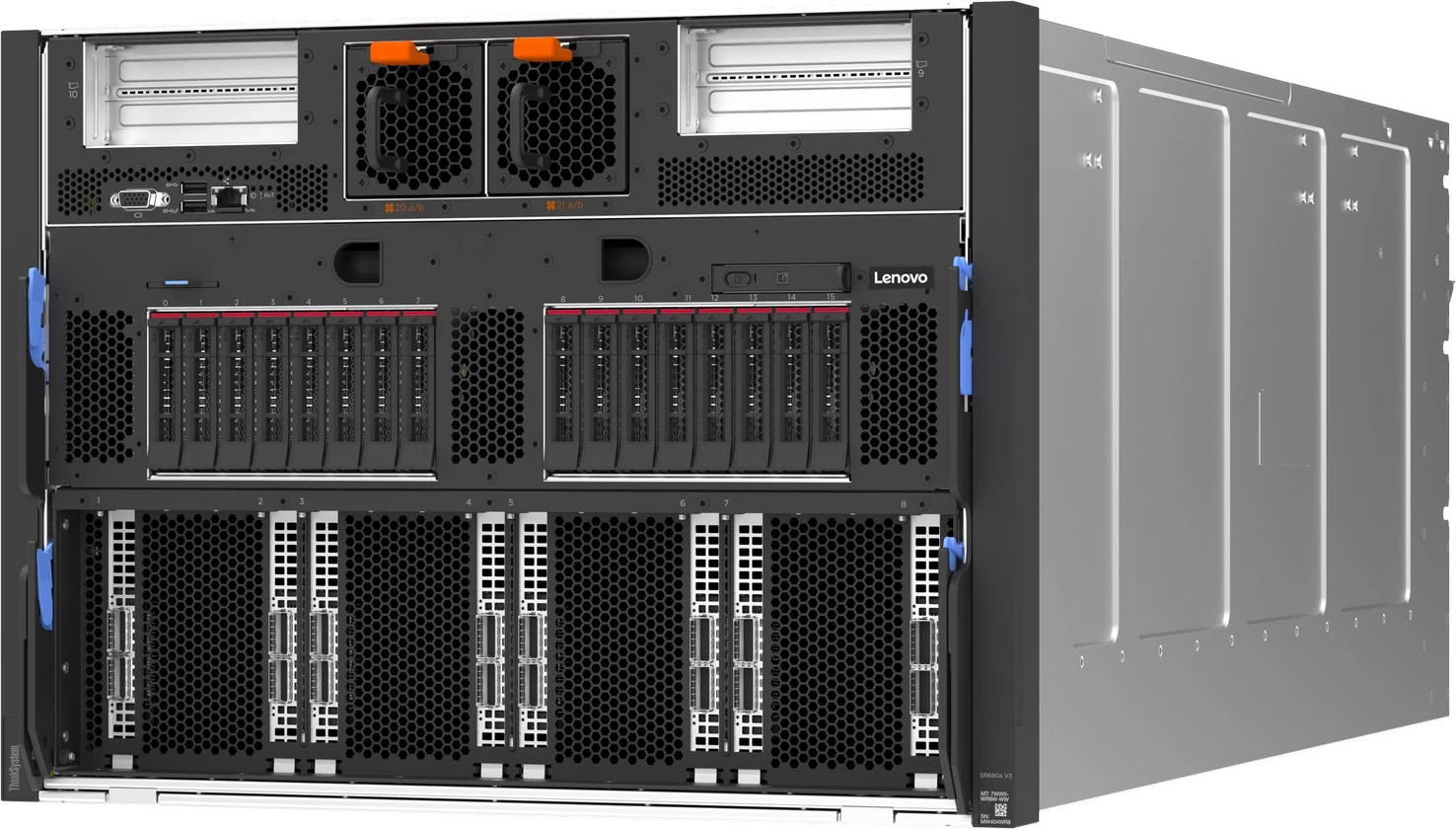
  • Lenovo’s spec table and rear view put every port, drive and adapter at the front, leaving the rear to the eight supplies and the fans; drives, supplies and fans are all hot-swap.
  • Lenovo’s guide lists two MLPerf Inference v5.1 Llama 2 70B results it ranks first among available 8-GPU configurations, current as of 1 September 2026.

Watch-outs

  • Almost nothing scales down: one GPU board option, six CTO-only processors with both sockets filled, both drive backplanes and all eight supplies are mandatory.
  • At up to 116 kg and 943 mm deep it sits on a static L-shaped shelf rail with no slide, no cable arm and no in-rack servicing; a material lift is needed for one-person service and Lenovo supports at most five per 42U or 48U cabinet.
  • Eight 3200 W supplies on C19 inlets need 200–240 V AC — no 110 V — and the C0UD unit draws up to 16 A at 200 V; the guide publishes no maximum system power figure.
  • The 16 bays are NVMe JBOD only: no RAID and no VROC on the 2.5-inch drives, no SAS or SATA despite the AnyBay backplane name, and no field upgrades.
  • Lenovo excludes GPU-related requests from its onsite service-level targets on this model, and the supported OS list is short: RHEL 9.5 and 9.6, Ubuntu 22.04 and 24.04.
Processors6 SKUs
Cores / CPU48–64
DIMM slots32
Backplanes1
Max bays16
GPUsup to 8
PSU options2 · to 3,200 W
02 — Processors

6 supported processors, mapped

Both sockets must be filled — Lenovo does not support a one-processor SR680a V3 with B200 — from a short list of six CTO-only 5th Gen Xeon Platinum parts with 48, 56 or 64 cores at 330 W or 350 W. Every one offers as many as 80 lanes of PCIe 5.0 and an eight-channel DDR5 controller running two DIMMs per channel; the sockets talk over three or four UPI 2.0 links at 20 GT/s, depending on the SKU.

Processor landscape — cores × TDP

6 SKUs · 1 family
Lenovo ThinkSystem SR680a V3: every supported processor by cores and TDP0816243240485664300 W350 WCores per processorIntel Xeon Platinum 8592+ — 64 cores / 128 threads · 350 W · 1.9 GHz base · 320 MB cache · DDR5-5600Intel Xeon Platinum 8592V — 64 cores / 128 threads · 330 W · 2 GHz base · 320 MB cache · DDR5-4800Intel Xeon Platinum 8570 — 56 cores / 112 threads · 350 W · 2.1 GHz base · 300 MB cache · DDR5-5600Intel Xeon Platinum 8558P — 48 cores / 96 threads · 350 W · 2.7 GHz base · 260 MB cache · DDR5-5600Intel Xeon Platinum 8568Y+ — 48 cores / 96 threads · 350 W · 2.3 GHz base · 300 MB cache · DDR5-5600Intel Xeon Platinum 8558 — 48 cores / 96 threads · 330 W · 2.1 GHz base · 260 MB cache · DDR5-52008592+64 cores — the top SKU8592V5.2 W/core — most efficient
5th Gen Xeon Scalable 6Bubble size = L3 cache · hover a bubble for the full SKU

Processor explorer

filter · sort · compare
ProcessorCores / threadsBaseL3 cacheTDPW / coreMemory
Intel Xeon Platinum 8592+64 / 1281.9 GHz320 MB350 W5.5DDR5-5600
Intel Xeon Platinum 8592V64 / 1282 GHz320 MB330 W5.2DDR5-4800
Intel Xeon Platinum 857056 / 1122.1 GHz300 MB350 W6.3DDR5-5600
Intel Xeon Platinum 8558P48 / 962.7 GHz260 MB350 W7.3DDR5-5600
Intel Xeon Platinum 8568Y+48 / 962.3 GHz300 MB350 W7.3DDR5-5600
Intel Xeon Platinum 855848 / 962.1 GHz260 MB330 W6.9DDR5-5200
  • The two 330 W parts trade memory speed: the 48-core 8558 runs its memory bus at 5200 MHz and the 64-core 8592V at 4800 MHz, while the four 350 W parts run at 5600 MHz.
  • The 8558P and 8592V have three UPI links; the 8558, 8568Y+, 8570 and 8592+ have four.
  • QAT, DLB and IAA engines are missing from the 8558 and 8570; DSA is present on all six, and every part supports a 512 GB SGX enclave.
  • Lenovo’s summary sections quote a core speed of up to 2.3 GHz, but its processor table lists the 8558P at 2.7 GHz base, 4.0 GHz turbo.
  • UK and EU orders should carry the “Efficiency – Favoring Performance” UEFI preset (feature BFYE), which Lenovo specifies for ErP Lot 9 compliance.
03 — Memory

32 DIMM slots, 16 per processor

Sixteen DIMM sockets per processor over eight channels give 32 in total. Lenovo lists just three TruDDR5 RDIMMs for this server, all 5600 MHz: 64 GB and 96 GB 10x4 modules and a 128 GB 2Rx4 module. One DIMM per channel runs at up to 5600 MHz and two at up to 4400 MHz, and 32 × 128 GB reaches the 4 TB maximum.

Capacity with every slot filled

by DIMM size
64 GB2 TB96 GB3 TB128 GB4 TB32 slots · 16 per processor · each tick = one DIMM

Rated memory speed

from the processor table
Processor familyUp to
5th Gen Xeon Scalable5600 MT/s
  • With three sizes the capacity steps are simple multiplication: 16 DIMMs (one per channel) give 1 TB, 1.5 TB or 2 TB at the faster rate; 32 DIMMs give 2 TB, 3 TB or 4 TB at 4400 MHz.
  • Lenovo advises filling all eight channels on each processor and fitting DIMMs at least as fast as the processor’s memory bus.
  • Lenovo lists ECC and Bounded Fault correction, SDDC for x4 modules, ADDDC (which needs Gold or Platinum processors — all six options here are Platinum) and memory mirroring, fitted in identical pairs with half the capacity left to the OS.
  • Rank sparing is done through ADDDC; persistent memory is not supported.
04 — Storage

1 backplane option, up to 16 bays

Storage is fixed at sixteen 2.5-inch hot-swap bays across the front on two 8-bay backplanes, and both backplanes are required. Lenovo reuses the SR850 V3/SR860 V3 AnyBay backplane here, yet this server takes NVMe drives only, each on a PCIe 5.0 x4 link from the processors’ onboard ports.

Headline layouts

front panel view

Front panel

Two BT3B 8-bay backplanes, both mandatory, cabled to onboard NVMe ports as JBOD. There is no other drive layout, no rear or mid bays and no field upgrade path; boot uses one or two internal M.2 drives instead.

SAS/SATANVMeSAS/SATA + NVMe

Controllers & boot

  • Onboard PCIe 5.0 x4 NVMe ports - JBOD, no RAID (no VROC on 2.5-inch drives) — HBA. onboard
  • Intel VROC (VMD NVMe RAID) Standard for M.2 (BS7M) - RAID 0/1 — Software RAID. M.2 only
  • Intel VROC RAID1 Only for M.2 (BZ4X) — Software RAID. M.2 only
  • 2 x M.2 22110 NVMe in onboard connector (stacked); optional Intel VROC Standard for M.2 (BS7M, RAID 0/1) or VROC RAID1 Only for M.2 (BZ4X) — boot
  • No RAID on the front bays: the onboard NVMe ports run JBOD and Lenovo does not support VROC on the 2.5-inch drives, so redundancy belongs in the file system or application.
  • Drive options are PCIe 5.0 U.3 SSDs — PM1745 Mixed Use from 1.6 TB to 12.8 TB and PM1743 Read Intensive from 1.92 TB to 15.36 TB — or PCIe 4.0 U.2 and U.3 models; every listed drive supports SED encryption.
  • The largest internal capacity Lenovo quotes is 245.76 TB, from sixteen 15.36 TB NVMe SSDs.
  • Boot is one or two M.2 22110 NVMe drives stacked on a system-board connector. SATA M.2 and other lengths are excluded, the listed drives are 960 GB and 1.92 TB PM9A3 units, and RAID is optional through VROC: BS7M (RAID 0 or 1) or BZ4X (RAID 1 only).
05 — Accelerators & I/O

GPUs, PCIe and networking

The GPU complex fills the lower half of the chassis: a single NVIDIA HGX B200 8-GPU board (feature C519, CTO only, maximum one) with eight SXM6 GPUs. Lenovo rates each GPU at 1000 W, and its GPU table lists 180 GB of HBM3e at 8 TB/s (the summary sections write HBM3), NVLink at 900 GB/s plus a PCIe Gen5 link of 128 GB/s, and up to seven 23 GB MIG instances. Per GPU it quotes 40 teraFLOPS of FP64 and 4.5 petaFLOPS of FP8 (9 with sparsity). The eight lower adapter slots reach the GPUs and CPUs through PCIe switching for GPU Direct traffic, though the guide stops short of a fixed adapter-to-GPU pairing. The server is air-cooled; no liquid-cooled option appears for this model. 1 × HGX B200 board = 8 × B200 SXM6, 1000 W and 180 GB each; no other GPU option.

NVIDIA HGX B200 180GB 1000W 8-GPU Board (SXM6)

180GB HBM3e · 8

I/O topology

80 lanes per CPU
CPU 180 × PCIe 5.08 ch · 16 DIMMCPU 280 × PCIe 5.08 ch · 16 DIMMUPI 2.0 · 3 or 4 links · 20 GT/s8 × lower x16 GPU Directslots 1–8 · via PCIe switching2 × upper x16 FHHL slotsslot 9 → CPU 2 · slot 10 → CPU 1No OCP 3.0 slotevery NIC is a PCIe cardXCC2 · 1GbE RJ45 portAST2600 · front panel, no rear I/O

All ten slots are PCIe 5.0 x16 full-height half-length and face the front. Slots 1–4 hang off CPU 1 and slots 5–8 off CPU 2, each routed through PCIe switching that also reaches the GPUs; upper slot 9 belongs to CPU 2 and slot 10 to CPU 1. A processor supplies at most 80 lanes of PCIe 5.0, and the chassis has no OCP slot at all.

Network adapters Lenovo lists

9 options
AdapterPortsForm
ThinkSystem Broadcom 57508 100GbE QSFP56 2-Port PCIe 4 Ethernet Adapter (GPU Direct, lower slots 1-8)2 × 100GbEPCIe
ThinkSystem Mellanox ConnectX-6 Dx 100GbE QSFP56 2-port PCIe Ethernet Adapter (lower 8 / upper 2)2 × 100GbEPCIe
ThinkSystem Broadcom 57608 2x200/1x400GbE QSFP112 PCIe Ethernet Adapter (GPU Direct)2 × 200/400GbEPCIe
ThinkSystem NVIDIA ConnectX-7 NDR200/200GbE QSFP112 2-port PCIe Gen5 x16 InfiniBand Adapter (lower 8 / upper 2)2 × 200GbE/NDR200PCIe
ThinkSystem NVIDIA BlueField-3 B3140H VPI QSFP112 1P 400G PCIe Gen5 x16 Adapter (lower 8 / upper 2)1 × 400GbE/NDRPCIe
ThinkSystem NVIDIA ConnectX-7 NDR400 OSFP 1-port PCIe Gen5 VPI Adapter (GPU Direct)1 × 400GbE/NDRPCIe
ThinkSystem NVIDIA BlueField-3 B3220 VPI QSFP112 2P 200G PCIe Gen5 x16 with Tin Plating Connector (User/Control plane, upper 9/10, max 2)2 × 200GbE/NDR200PCIe
ThinkSystem Intel X710-T2L 10GBase-T 2-Port PCIe Ethernet Adapter (Management, upper 9/10, max 2)2 × 10GbEPCIe
ThinkSystem Mellanox ConnectX-6 Lx 10/25GbE SFP28 2-port PCIe Ethernet Adapter (Management, upper 9/10, max 2)2 × 25GbEPCIe
  • Lower-slot adapters can number anything from one to eight, but they must all be the same model.
  • Both upper slots are compulsory, each enabled by a C1F3 riser; they take a BlueField-3 B3220 or ConnectX-7 NDR200 or B3140H for the user/control plane, or an X710-T2L, ConnectX-6 Lx or ConnectX-6 Dx for management.
  • The ConnectX-6 Dx, ConnectX-7 NDR200 and BlueField-3 B3140H can fill all ten slots — eight lower and two upper.
  • Fibre Channel HBAs are available only by special bid.
  • Lenovo’s spec table puts the 1GbE XCC port on the front and lists no rear ports; other passages in the same guide still describe the management port and the System I/O Board connectors as rear-facing.
  • Internally the GPUs occupy slot numbers 17–24 and the M.2 drives 33 and 34.
06 — Power & cooling

2 power supplies, 3,200 W

All eight supplies ship as standard and must match: 3200 W 80 PLUS Titanium CRPS Premium hot-swap units with C19 inlets, configured N+N. Lenovo lists two options, feature codes C0UD (230 V) and CBAF (230 V/115 V), and marks both as 220 V AC only, with no 110 V support.

05001000150020002500300035003200 W Titanium — ThinkSystem 3200W 230V Titanium CRPS Premium (C0UD); qty 8, N+N; C19; 220V only3200Titanium3200 W Titanium — ThinkSystem 3200W 230V/115V Titanium CRPS Premium (CBAF); qty 8; C19; table lists 220V AC only3200TitaniumWatts · dashed line = output at 100–120 V low line
AC
  • The supplies take 200 to 240 V AC (50/60 Hz); a 180–300 V DC input is permitted only in China.
  • Maximum inlet current for the C0UD supply is 16 A at 200 V AC and 14.5 A at 240 V DC; it has no 100 V rating.
  • Supply options do not include cords, and whether a server configuration ships with them depends on the model. Lenovo lists 16 A C19-to-C20 rack jumpers from 0.5 m to 4.3 m and a 4.3 m C19 line cord for the UK.
  • Fans: two front 80 mm dual-rotor units for the CPU shuttle (peak 16.3K RPM) and fifteen rear 80 mm dual-rotor units for the GPUs, drive bays and PCIe switches (peak 19.5K RPM), each group N+1 by rotor, plus two 40 mm auxiliary fans and a dual-rotor fan in every supply.
  • There is no system maximum-power figure in the guide; for rack power, current, BTU and VA planning Lenovo points to its Capacity Planner tool.
07 — Management, security & OS

Run it, secure it, choose the OS

Management

  • XClarity Controller 2 (XCC2) on an ASPEED AST2600 BMC, carried on a separate DC-SCM System I/O Board
  • Front 1GbE RJ45 XCC port · IPMI-over-LAN disabled by default
  • Integrated diagnostics panel with pull-out LCD · light path LEDs for each DIMM, drive bay and supply
  • XCC2 Platinum: remote console, virtual media, power capping, System Guard, Neighbor Group, CNSA 1.0 strict mode
  • IPMI 2.0, SNMPv3 (no SET), CIM-XML, Redfish, HTML5 web interface
  • MicroSD slot for XCC2 remote-disc storage (up to 4 GB) and N-1 firmware history
  • XClarity One, Provisioning Manager (F1), Essentials, Energy Manager and Capacity Planner
  • XClarity One Mobile over USB tethering

Security

  • Platform Firmware Resiliency hardware Root of Trust (NIST SP 800-193)
  • Integrated TPM 2.0
  • UEFI Secure Boot, factory-enabled (BPKQ) or left off (BPKR) — once on, it cannot be turned off
  • System Guard component-change detection (XCC2 Platinum)
  • Self-encrypting drives with enterprise key managers
  • NIST SP 800-147B compliant
  • Intel TXT, Execute Disable Bit, AES-NI and SGX

Operating systems

  • Red Hat Enterprise Linux 9.5 and 9.6
  • Ubuntu 22.04 LTS and 24.04 LTS (64-bit)
  • The spec table names Ubuntu Server alone; Windows Server and VMware ESXi are not listed
08 — Compare

SR680a V3 → SR680a V4

Lenovo’s SR680a V4 guide sets its new model against this one. The chassis stays 8U and air-cooled with the same 4 TB memory ceiling, but the V4 moves to Xeon 6 with up to 86 cores and B300 GPUs, swaps the eight GPU Direct slots for OSFP ports on integrated ConnectX-8 switches, and halves the front drive bays.

This model (B200 version)ThinkSystem SR680a V3
Chassis
8U 19-inch rack
8U 19-inch rack
Processors
2 × 5th Gen Xeon Scalable · up to 64 cores · 350 W
2 × Xeon 6700-series P-core · up to 86 cores · 350 W
Memory
DDR5 to 5600 MHz · 8 channels · 32 DIMMs · 4 TB
DDR5 to 6400 MHz · 8 channels · 32 DIMMs · 4 TB
GPUs
8 × HGX B200 SXM (the V3 column also lists H200 and H100)
8 × HGX B300 SXM
Drive bays
16 × 2.5" NVMe · PCIe 4.0 and 5.0 drives
8 × 2.5" NVMe · PCIe 5.0 drives
Boot
2 × internal M.2, VROC RAID 1, not hot-swap
2 × front hot-swap M.2, integrated RAID 1
Networking
8 × x16 GPU Direct slots + 2 × x16 slots
8 × OSFP on ConnectX-8 switches + 4 × x16 slots + OCP
Management
XClarity Controller 2
XClarity Controller 3
Power
8 × 3200 W Titanium · N+N
8 × 3200 W AC (N+1) or 3800 W HVAC/HVDC (N+N)

Source: Lenovo Press LP2264 (SR680a V4 product guide), Table 1 — Comparing the SR680a V4 to the previous generation SR680a V3.

The SR680a V3 family side by side

The bars set four Lenovo 8-GPU baseboard systems side by side: this air-cooled 8U Xeon machine; the SR685a V3, an air-cooled 8U AMD EPYC server with eight MI300X or H200 GPUs; the SR780a V3, a 5U Xeon design that water-cools its CPUs, GPUs and NVLink switches and also offers the B200; and the SR680a V4 successor with HGX B300. The 3U SR675 V3 and 2U SR650a V4 take PCIe GPUs instead. Each bar reflects that model’s verified spec file.

SR680a V3 with B200SR680a V4SR685a V3SR780a V3SR675 V3SR650a V4Cores / CPUSR680a V3 with B200: 6464SR680a V4: 8686SR685a V3: 128128SR780a V3: 6464SR675 V3: 160160SR650a V4: 8686DIMM slotsSR680a V3 with B200: 3232SR680a V4: 3232SR685a V3: 2424SR780a V3: 3232SR675 V3: 2424SR650a V4: 3232Max memorySR680a V3 with B200: 4 TB4SR680a V4: 4 TB4SR685a V3: 3 TB3SR780a V3: 4 TB4SR675 V3: 6 TB6SR650a V4: 8 TB8Max drive baysSR680a V3 with B200: 1616SR680a V4: 88SR685a V3: 1616SR780a V3: 1212SR675 V3: 88SR650a V4: 88Max GPUsSR680a V3 with B200: 88SR680a V4: 88SR685a V3: 88SR780a V3: 88SR675 V3: 88SR650a V4: 88Largest PSUSR680a V3 with B200: 3,200 W3,200SR680a V4: 3,800 W3,800SR685a V3: 2,600 W2,600SR780a V3: 3,200 W3,200SR675 V3: 2,600 W2,600SR650a V4: 3,200 W3,200
This modelSiblings and successorEach value from that model’s own verified spec file · bars scale per column

Head-to-head comparisons

Every figure on this page, set against the machines buyers weigh it up with.

09 — Use cases

Four builds that suit the SR680a V3

Four builds, each assembled from parts our configurator permits for this server around the items Lenovo fixes — the single B200 GPU board, both NVMe backplanes and all eight standard supplies. The configurator link loads one lower-slot adapter and two supplies, so the adapter quantity and the full set of eight supplies are set on the quote, together with the M.2 boot pair (Lenovo lists 960 GB and 1.92 TB NVMe drives) and the adapters for upper slots 9 and 10, whose risers are mandatory.

AI training

Multi-node foundation-model training node

Lenovo positions the lower slots for eight NDR 400 Gb/s InfiniBand adapters with GPU Direct connections, the fabric this build uses to spread training across several servers. Two 64-core 8592+ processors keep four UPI links and a 5600 MHz memory bus, and all 32 slots take 128 GB modules for the 4 TB ceiling, enough host memory to stage large data sets.

  • 2 × Xeon Platinum 8592+ — 64 cores @ 1.9 GHz, 350 W each
  • 1 × NVIDIA HGX B200 8-GPU board — eight B200 SXM6 GPUs, 180 GB HBM3e each
  • 32 × 128 GB TruDDR5 RDIMM — 4 TB, two per channel at 4400 MHz
  • 16 × 7.68 TB PCIe 4.0 U.3 NVMe across both 8-bay backplanes — 122.88 TB raw
  • Onboard NVMe ports, JBOD
  • 8 × ConnectX-7 NDR400 OSFP 1-port adapters, one in each lower slot
  • 8 × 3200 W Titanium CRPS Premium supplies, N+N
  • Ubuntu 24.04 LTS
  • Lenovo Premier Support, 5 years

Two DIMMs per channel hold memory at 4400 MHz rather than 5600. GPU-related onsite requests fall outside Lenovo’s service-level targets on this model, so onsite spares are worth pricing; single-person service needs a material lift, and Lenovo supports no more than five of these servers in a cabinet. Our configurator’s entry for this adapter carries a water-cooled (DWC) part name; the quote uses the ConnectX-7 NDR400 OSFP 1-port adapter Lenovo lists for this server (feature C51C).

Open this build in the configurator →
LLM inference

Large-model inference serving node

The guide’s MLPerf Inference v5.1 entries — Llama 2 70B, offline, closed datacenter division — are the results Lenovo ranks first among available 8-GPU configurations. For serving, one DIMM in each of the 16 channels keeps memory at full speed with 1.5 TB, the 48-core 8568Y+ keeps a 5600 MHz bus, four UPI links and every QAT, DLB, DSA and IAA engine, and Broadcom 57608 adapters put the GPU Direct fabric on Ethernet.

  • 2 × Xeon Platinum 8568Y+ — 48 cores @ 2.3 GHz, 350 W each
  • 1 × NVIDIA HGX B200 8-GPU board — eight B200 SXM6 GPUs
  • 16 × 96 GB TruDDR5 RDIMM — 1.5 TB, one per channel at up to 5600 MHz
  • 16 × 3.84 TB PCIe 4.0 U.3 NVMe on both backplanes — 61.44 TB raw for model weights
  • Onboard NVMe ports, JBOD
  • 8 × Broadcom 57608 2 × 200/1 × 400GbE QSFP112 adapters in slots 1–8
  • 8 × 3200 W Titanium CRPS Premium supplies, N+N
  • Red Hat Enterprise Linux 9 (Lenovo lists 9.5 and 9.6)
  • Lenovo Premier Support, 3 years

Adding a second DIMM to each channel later drops memory to 4400 MHz. Windows Server and VMware ESXi are not in Lenovo’s OS list for this server, so the serving stack has to run on RHEL or Ubuntu.

Open this build in the configurator →
Fine-tuning & shared GPUs

Partitioned GPU node for fine-tuning teams

Each B200 can be carved into as many as seven 23 GB MIG instances, so one board can host many smaller fine-tuning, evaluation or notebook jobs side by side. BlueField-3 B3140H 400 Gb adapters, one of the GPU Direct options Lenovo lists, fill all eight lower slots; the 8558P has the highest base clock of the six processors (2.7 GHz), and 32 × 64 GB is the 2 TB configuration Lenovo quotes in its key features.

  • 2 × Xeon Platinum 8558P — 48 cores @ 2.7 GHz, 350 W each
  • 1 × NVIDIA HGX B200 8-GPU board — up to 7 MIG instances per GPU
  • 32 × 64 GB TruDDR5 RDIMM — 2 TB at 4400 MHz
  • 8 × 1.92 TB PCIe 4.0 U.3 NVMe, eight bays left free for growth
  • Onboard NVMe ports, JBOD
  • 8 × BlueField-3 B3140H 1 × 400G QSFP112 adapters in slots 1–8
  • 8 × 3200 W Titanium CRPS Premium supplies, N+N
  • Ubuntu 22.04 LTS
  • Lenovo Premier Support Plus, 3 years

The 8558P has three UPI links rather than four. Both 8-bay backplanes are compulsory even with only eight drives fitted, and every adapter in the lower slots must be the same model.

Open this build in the configurator →
HPC & simulation

Double-precision simulation node

Lenovo’s GPU table credits each B200 with 40 teraFLOPS of both FP64 and FP64 Tensor Core throughput, and simulation is among the uses Lenovo suggests for this server. Two 56-core 8570s keep four UPI links and a 5600 MHz bus but lack the QAT, DLB and IAA engines; 32 × 96 GB gives 3 TB, and ConnectX-7 NDR200 adapters connect to an InfiniBand fabric.

  • 2 × Xeon Platinum 8570 — 56 cores @ 2.1 GHz, 350 W each
  • 1 × NVIDIA HGX B200 8-GPU board — 40 TFLOPS FP64 per GPU
  • 32 × 96 GB TruDDR5 RDIMM — 3 TB at 4400 MHz
  • 16 × 7.68 TB PCIe 4.0 U.3 NVMe scratch — 122.88 TB raw
  • Onboard NVMe ports, JBOD
  • 8 × ConnectX-7 NDR200/200GbE QSFP112 2-port adapters in slots 1–8
  • 8 × 3200 W Titanium CRPS Premium supplies, N+N
  • Red Hat Enterprise Linux 9
  • Lenovo Foundation Service, 4-hour 24x7, 5 years

For the full 5600 MHz, stop at 16 DIMMs (1.5 TB with 96 GB modules). Lenovo’s onsite service-level targets do not cover GPU faults on this model, and the static rail means the server comes out of the rack for any internal work.

Open this build in the configurator →
10 — Full specifications

Lenovo ThinkSystem SR680a V3 specifications

Chassis & cooling

Form factor8U rack · machine type 7DM9 (3-year warranty) · CTO model 7DM9CTO1WW
Dimensions (W × H × D)447 × 351 × 943 mm · 483 mm across the EIA flanges
WeightUp to 116 kg
Shipping carton600 × 740 × 1200 mm
Fans2 front + 15 rear 80 mm dual-rotor, N+1 · 2 × 40 mm auxiliary · 1 in each PSU
AirflowFront to rear · up to 1835 CFM
Cooling typeAir only — no liquid-cooled option listed
ChipsetIntel C741

Processor

SocketsTwo — one-processor configurations not supported
ProcessorsSix 5th Gen Xeon Platinum (Emerald Rapids), CTO only: 8558, 8558P, 8568Y+, 8570, 8592+, 8592V
Cores · TDP48 to 64 cores · 330 W or 350 W
InterconnectUPI 2.0 · 3 or 4 links · 20 GT/s
PCIeUp to 80 PCIe 5.0 lanes per processor

Memory

Slots32 DDR5 · 16 per processor · 8 channels × 2 DPC
ModulesTruDDR5 5600 MHz RDIMM: 64 GB and 96 GB (10x4), 128 GB (2Rx4)
SpeedUp to 5600 MHz at 1 DPC · up to 4400 MHz at 2 DPC
Maximum4 TB (32 × 128 GB)
ProtectionECC, SDDC, ADDDC, Bounded Fault, mirroring
Persistent memoryNot supported

Accelerators

GPU boardNVIDIA HGX B200 180GB 1000W 8-GPU Board (C519) · one per server
GPUs8 × B200 SXM6 · 1000 W each
GPU memory180 GB HBM3e per GPU (HBM3 in the summary sections) · 8 TB/s
Interconnect (per GPU)NVLink 900 GB/s · PCIe Gen5 128 GB/s
Throughput (per GPU)FP64 40 TF · FP32 80 TF · FP8 4.5 PF (9 PF sparse)
PartitioningUp to 7 MIG instances of 23 GB

Storage

Bays16 × 2.5" hot-swap NVMe, PCIe 5.0 x4 · two 8-bay backplanes, both required
ControllerOnboard NVMe, JBOD only — no RAID
Boot1–2 × M.2 22110 NVMe · optional VROC RAID 0/1 or RAID 1
Maximum245.76 TB (16 × 15.36 TB)

Expansion & networking

Lower slots8 × PCIe 5.0 x16 FHHL, GPU Direct · 1–8 identical adapters
Upper slots2 × PCIe 5.0 x16 FHHL (9 and 10) · both risers mandatory
OCPNone
Fabric adapters100–400 Gb Ethernet or InfiniBand: Broadcom 57508 and 57608, ConnectX-6 Dx, ConnectX-7, BlueField-3 B3140H
Upper-slot adaptersBlueField-3 B3220 or B3140H, ConnectX-7 NDR200 (user/control plane) · X710-T2L or ConnectX-6 Lx/Dx (management)
Fibre ChannelSpecial bid only

Power

Supplies8 × 3200 W Titanium CRPS Premium · all standard, identical · N+N
Input200–240 V AC · 180–300 V DC in China only · no 110 V
Inlet · currentC19 · up to 16 A at 200 V AC

Ports & video

FrontUSB 3 (5 Gb/s) · USB 2 (also XCC local) · VGA · 1GbE XCC RJ45
RearNone, per the spec table and rear view (see I/O notes)
Video16 MB, integrated in XCC2 · up to 1920 × 1200 at 60 Hz

Rack, environment & warranty

RailsToolless fixed L-shelf rail (A4AA) · no slide, no CMA, no in-rack servicing
RackFlange spacing 613–774 mm · up to 5 servers per 42U or 48U cabinet
Service accessMaterial lift required for one-person service · Genie Lift GL-8 option
ASHRAEA2 in most configurations; A3, A4 or H1 depending on hardware
Operating temperature10–35 °C (A2) · minus 1 °C per 300 m above 900 m
Maximum altitude3,050 m
Warranty3 years, CRU and onsite, 9 × 5 NBD · GPU requests outside onsite SLA targets
11 — FAQ

SR680a V3 questions, answered from the documentation

How many GPUs does the Lenovo SR680a V3 with B200 have?

Eight NVIDIA B200 SXM6 GPUs, delivered as one HGX B200 8-GPU board; Lenovo lists that board as the only GPU option, at a maximum of one per server. Each GPU has 180 GB of HBM3e and a 1000 W rating, so the board carries 1,440 GB of GPU memory. Lenovo’s SR680a V4 guide shows H200 and H100 versions of the SR680a V3 as well, but this page covers the B200 model.

Is the SR680a V3 with B200 air-cooled or liquid-cooled?

Air-cooled. Nineteen hot-swap system fans — 15 at the rear for the GPUs, drive bays and PCIe switches, two at the front for the CPU shuttle and two auxiliary — plus a fan in each supply move up to 1835 CFM front to back. For water cooling with B200 GPUs, Lenovo offers the 5U SR780a V3, which runs separate water loops for its CPUs, GPUs and NVLink switches.

What power supply does the SR680a V3 need?

Eight 3200 W Titanium hot-swap supplies, all fitted as standard, identical and running N+N. Each has a C19 inlet, needs 200–240 V AC (there is no 110 V support) and draws up to 16 A at 200 V. Lenovo’s guide gives no maximum system power figure and refers planners to its Capacity Planner tool.

What is the maximum memory of the SR680a V3 with B200?

Four terabytes, using 128 GB RDIMMs in all 32 slots. With two DIMMs per channel the memory runs at up to 4400 MHz; sixteen DIMMs, one per channel, run at up to 5600 MHz and give up to 2 TB. Lenovo lists only 64 GB, 96 GB and 128 GB modules for this server.

Which processors can the SR680a V3 use?

Two 5th Gen Intel Xeon Platinum processors from six CTO-only choices: the 8558, 8558P, 8568Y+, 8570, 8592+ and 8592V, spanning 48 to 64 cores at 330 W or 350 W. A single-processor configuration is not supported. The 330 W 8558 and 8592V run memory at 5200 MHz and 4800 MHz respectively; the others run at 5600 MHz.

How do the network adapters connect to the GPUs?

The eight lower front slots are PCIe 5.0 x16 and connect to both the processors and the GPUs through PCIe switching, which gives each adapter GPU Direct paths. They take one to eight identical adapters, from 100 Gb Ethernet up to 400 Gb/s NDR InfiniBand. Two upper slots carry BlueField-3 or ConnectX-7 cards for the user/control plane, or a management NIC, and there is no OCP slot.

How much storage does the SR680a V3 with B200 hold?

Sixteen 2.5-inch hot-swap NVMe bays on two 8-bay backplanes, both mandatory, each drive on a PCIe 5.0 x4 link. They run as JBOD with no RAID, and Lenovo quotes a 245.76 TB maximum with 15.36 TB drives. One or two M.2 NVMe boot drives sit inside, with optional VROC RAID 1.

How big is the SR680a V3 and how many fit in a rack?

It is 8U, 447 mm wide, 351 mm high and 943 mm deep, and weighs up to 116 kg. It rests on a static L-shaped shelf rail with no slide or cable arm, Lenovo supports at most five per 42U or 48U cabinet, and one-person servicing requires a material lift such as the Genie Lift GL-8 that Lenovo offers.

How does the SR680a V3 differ from the SR680a V4?

According to Lenovo’s comparison table, the V4 keeps the 8U chassis and 4 TB memory ceiling but moves to Xeon 6700-series processors with up to 86 cores, DDR5 at 6400 MHz and HGX B300 GPUs. It replaces the eight GPU Direct slots with eight OSFP ports on integrated ConnectX-8 switches, adds an OCP slot, halves the drive bays to eight, moves M.2 to front hot-swap bays and adds a 3800 W HVAC/HVDC supply option.

Is the Lenovo SR680a V3 with B200 end of life?

Lenovo’s product guide still lists the CTO base model and its supported options, cites benchmark results current as of 1 September 2026, and gives no end-of-marketing or end-of-service date. Warranty is three years; note that GPU-related onsite requests are handled on a commercially reasonable basis rather than to service-level targets. Any retirement dates Lenovo announces later will be added to our server end-of-life checker.

Sources & verification

Where these figures come from

Specifications are extracted from Lenovo’s published documents and independently re-checked line by line. Configurations are quote-based; availability and exact options are confirmed at quotation. Last reviewed 2026-09-11.

Get a quote for the Lenovo ThinkSystem SR680a V3

Tell us the workload and we’ll spec and price it — or build it in the configurator first.

Business enquiries only — please use your company email. Gmail, Hotmail and other personal addresses are not accepted.

We only ship hardware to the countries in the dropdown. Software and maintenance services are global.

We use these details to reply to your enquiry and prepare any quote. No marketing emails without your consent. Privacy Policy

Enquiring about: Lenovo ThinkSystem SR680a V3

Response within 4 business hours · No obligation

Quote for
Lenovo ThinkSystem SR680a V3
0800 987 4111

Talk to a UK specialist

Get expert advice or a no-obligation quote — servers, storage, networking, maintenance, finance and cloud. We reply the same working day.

or call 0800 987 4111