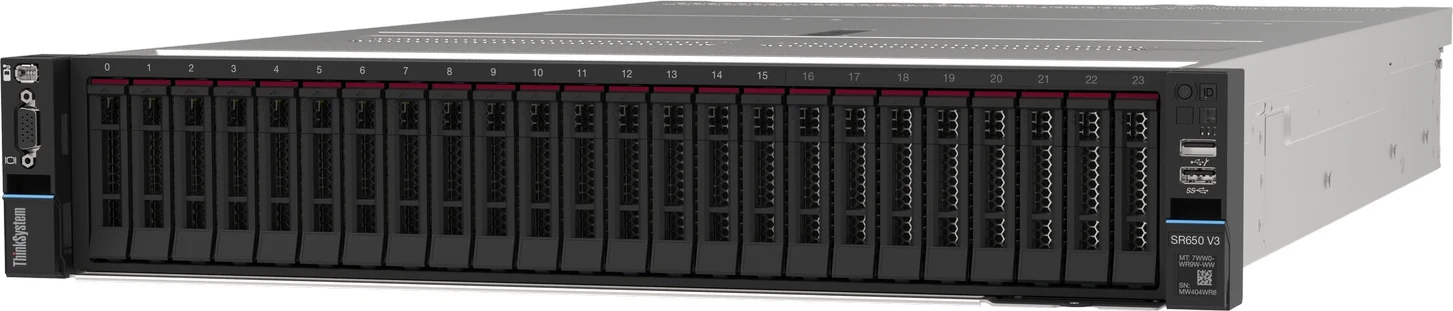
The ThinkSystem SR650 V3 is Lenovo’s two-socket 2U rack server, taking one or two Xeon Scalable chips from Intel’s 4th or 5th Gen families, and is pitched at firms from small businesses to large enterprises running databases, virtualisation, VDI or HPC. This data sheet sets out its full documented option range — 84 processors, three drive zones, riser and GPU rules, and XClarity management — so you can plan a build Lenovo will actually support.
2U Rack1 or 2 sockets5th Gen Xeon Scalable4th Gen Xeon ScalableXClarity Controller 2
64cores per processorPlatinum 8592+, 8592V and 8593Q
Our read of Lenovo’s documentation: where the SR650 V3 is strong, and the limits worth knowing before you spec one.
Strengths
+Three drive zones — front, mid-chassis and rear — take the 2U chassis to 40 × 2.5-inch or 20 × 3.5-inch bays, and up to 36 NVMe drives can each run on a dedicated x4 link with no oversubscription.
+One chassis spans two Xeon generations: Lenovo lists 84 processors, up to the 64-core, 385 W Platinum 8593Q.
+Up to twelve PCIe slots plus OCP 3.0, including a front-access option that puts two x16 slots and the OCP card beside up to 16 drive bays.
+Room for three double-wide GPUs — Lenovo lists its SR650 V4 successor at two.
+An optional Neptune direct-water module carries all processor heat out through an open loop, leaving the fans to cool everything else.
Watch-outs
!GPU builds constrain storage: no mid or rear bays and no 12 × 3.5-inch backplanes, and Lenovo documents three double-wide cards with 16 front 2.5-inch bays but only two with 24.
!Many air-cooled combinations cap inlet air at 30 °C — GPUs, 350 W processors, 256 GB 3DS RDIMMs, or mid/rear bays behind a full 24 × 2.5-inch or 12 × 3.5-inch front — and some drop to 25 °C.
!The 8 TB ceiling relies on 256 GB 3DS RDIMMs, a 5600 MHz part that Lenovo’s configurator offers only with 5th Gen processors; a 4th Gen build stops at 4 TB (32 × 128 GB).
!With one processor the server keeps 16 DIMM slots (4 TB), loses Riser 2 and front slot 11, and supports at most eight front 2.5-inch NVMe drives.
!Mid-chassis bays are simple-swap — the lid comes off to change a drive — and rule out full-length adapters and GPUs.
Processors84 SKUs
Cores / CPU8–64
DIMM slots32
Backplanes20
Max bays40
GPUsup to 8
PSU options11 · to 2,600 W
02 — Processors
84 supported processors, mapped
Lenovo lists 84 processors for the SR650 V3: 32 from the 5th Gen Xeon Scalable family and 52 from the 4th Gen, spanning 8 to 64 cores and 115 W to 385 W. Sixteen are single-socket-only parts. The landscape shows where each one sits; the explorer below it lets you sort and filter the full list.
Processor landscape — cores × TDP
84 SKUs · 2 families
5th Gen Xeon Scalable 324th Gen Xeon Scalable 52Bubble size = L3 cache · hover a bubble for the full SKU
Processor explorer
filter · sort · compare
Processor
Cores / threads
Base
L3 cache
TDP
W / core
Memory
Intel Xeon Platinum 8593Q
64 / 128
2.2 GHz
320 MB
385 W
6.0
DDR5-5600
Intel Xeon Platinum 8592+
64 / 128
1.9 GHz
320 MB
350 W
5.5
DDR5-5600
Intel Xeon Platinum 8592V
64 / 128
2 GHz
320 MB
330 W
5.2
DDR5-4800
Intel Xeon Platinum 8580
60 / 120
2 GHz
300 MB
350 W
5.8
DDR5-5600
Intel Xeon Platinum 8581V
60 / 120
2 GHz
300 MB
270 W
4.5
DDR5-4800
Intel Xeon Platinum 8490H
60 / 120
1.9 GHz
112.5 MB
350 W
5.8
DDR5-4800
Intel Xeon Platinum 8570
56 / 112
2.1 GHz
300 MB
350 W
6.3
DDR5-5600
Intel Xeon Platinum 8480+
56 / 112
2 GHz
105 MB
350 W
6.3
DDR5-4800
Intel Xeon Platinum 8480CL
56 / 112
2 GHz
105 MB
350 W
6.3
DDR5-4800
Intel Xeon Platinum 8571N
52 / 104
2.4 GHz
300 MB
300 W
5.8
DDR5-4800
Intel Xeon Platinum 8470
52 / 104
2 GHz
105 MB
350 W
6.7
DDR5-4800
Intel Xeon Platinum 8470Q
52 / 104
2.1 GHz
105 MB
350 W
6.7
DDR5-4800
Intel Xeon Platinum 8470N
52 / 104
1.7 GHz
97.5 MB
300 W
5.8
DDR5-4800
Intel Xeon Platinum 8558P
48 / 96
2.7 GHz
260 MB
350 W
7.3
DDR5-5600
Intel Xeon Platinum 8568Y+
48 / 96
2.3 GHz
300 MB
350 W
7.3
DDR5-5600
Intel Xeon Platinum 8558
48 / 96
2.1 GHz
260 MB
330 W
6.9
DDR5-5200
Intel Xeon Platinum 8558U
48 / 96
2 GHz
260 MB
300 W
6.3
DDR5-4800
Intel Xeon Platinum 8468
48 / 96
2.1 GHz
105 MB
350 W
7.3
DDR5-4800
Intel Xeon Platinum 8468H
48 / 96
2.1 GHz
105 MB
330 W
6.9
DDR5-4800
Intel Xeon Platinum 8468V
48 / 96
2.4 GHz
97.5 MB
330 W
6.9
DDR5-4800
Intel Xeon Platinum 8461V
48 / 96
2.2 GHz
97.5 MB
300 W
6.3
DDR5-4800
Intel Xeon Platinum 8458P
44 / 88
2.7 GHz
82.5 MB
350 W
8.0
DDR5-4800
Intel Xeon Platinum 8460H
40 / 80
2.2 GHz
105 MB
330 W
8.3
DDR5-4800
Intel Xeon Platinum 8460Y+
40 / 80
2 GHz
105 MB
300 W
7.5
DDR5-4800
Intel Xeon Gold 6554S
36 / 72
2.2 GHz
180 MB
270 W
7.5
DDR5-5200
Intel Xeon Platinum 8452Y
36 / 72
2 GHz
67.5 MB
300 W
8.3
DDR5-4800
Intel Xeon Gold 6558Q
32 / 64
3.2 GHz
60 MB
350 W
10.9
DDR5-5200
Intel Xeon Platinum 8562Y+
32 / 64
2.8 GHz
60 MB
300 W
9.4
DDR5-5600
Intel Xeon Gold 6530
32 / 64
2.1 GHz
160 MB
270 W
8.4
DDR5-4800
Intel Xeon Gold 6548N
32 / 64
2.8 GHz
60 MB
250 W
7.8
DDR5-5200
Intel Xeon Gold 6548Y+
32 / 64
2.5 GHz
60 MB
250 W
7.8
DDR5-5200
Intel Xeon Gold 6538Y+
32 / 64
2.2 GHz
60 MB
225 W
7.0
DDR5-5200
Intel Xeon Gold 6538N
32 / 64
2.1 GHz
60 MB
205 W
6.4
DDR5-5200
Intel Xeon Gold 6458Q
32 / 64
3.1 GHz
60 MB
350 W
10.9
DDR5-4800
Intel Xeon Platinum 8462Y+
32 / 64
2.8 GHz
60 MB
300 W
9.4
DDR5-4800
Intel Xeon Gold 6430
32 / 64
2.1 GHz
60 MB
270 W
8.4
DDR5-4400
Intel Xeon Gold 6454S
32 / 64
2.2 GHz
60 MB
270 W
8.4
DDR5-4800
Intel Xeon Platinum 8454H
32 / 64
2.1 GHz
82.5 MB
270 W
8.4
DDR5-4800
Intel Xeon Gold 6414U
32 / 64
2 GHz
60 MB
250 W
7.8
DDR5-4800
Intel Xeon Gold 6448H
32 / 64
2.4 GHz
60 MB
250 W
7.8
DDR5-4800
Intel Xeon Gold 6448Y
32 / 64
2.1 GHz
60 MB
225 W
7.0
DDR5-4800
Intel Xeon Gold 6433N
32 / 64
2 GHz
60 MB
205 W
6.4
DDR5-4400
Intel Xeon Gold 6438M
32 / 64
2.2 GHz
60 MB
205 W
6.4
DDR5-4800
Intel Xeon Gold 6438N
32 / 64
2 GHz
60 MB
205 W
6.4
DDR5-4800
Intel Xeon Gold 6438Y+
32 / 64
2 GHz
60 MB
205 W
6.4
DDR5-4800
Intel Xeon Gold 6443N
32 / 64
1.6 GHz
60 MB
195 W
6.1
DDR5-4400
Intel Xeon Gold 6428N
32 / 64
1.8 GHz
60 MB
185 W
5.8
DDR5-4000
Intel Xeon Gold 5520+
28 / 56
2.2 GHz
52.5 MB
205 W
7.3
DDR5-4800
Intel Xeon Gold 5512U
28 / 56
2.1 GHz
52.5 MB
185 W
6.6
DDR5-4800
Intel Xeon Platinum 8450H
28 / 56
2 GHz
75 MB
250 W
8.9
DDR5-4800
Intel Xeon Gold 5420+
28 / 56
2 GHz
52.5 MB
205 W
7.3
DDR5-4400
Intel Xeon Gold 6423N
28 / 56
2 GHz
52.5 MB
195 W
7.0
DDR5-4400
Intel Xeon Gold 6542Y
24 / 48
2.9 GHz
60 MB
250 W
10.4
DDR5-5200
Intel Xeon Silver 4516Y+
24 / 48
2.2 GHz
45 MB
185 W
7.7
DDR5-4400
Intel Xeon Gold 6442Y
24 / 48
2.6 GHz
60 MB
225 W
9.4
DDR5-4800
Intel Xeon Gold 5412U
24 / 48
2.1 GHz
45 MB
185 W
7.7
DDR5-4400
Intel Xeon Gold 5418Y
24 / 48
2 GHz
45 MB
185 W
7.7
DDR5-4400
Intel Xeon Gold 6403N
24 / 48
1.9 GHz
45 MB
185 W
7.7
DDR5-4000
Intel Xeon Gold 6418H
24 / 48
2.1 GHz
60 MB
185 W
7.7
DDR5-4800
Intel Xeon Gold 5411N
24 / 48
1.9 GHz
45 MB
165 W
6.9
DDR5-4400
Intel Xeon Gold 5418N
24 / 48
1.8 GHz
45 MB
165 W
6.9
DDR5-4000
Intel Xeon Silver 4416+
20 / 40
2 GHz
37.5 MB
165 W
8.3
DDR5-4000
Intel Xeon Gold 5433N
20 / 48
2.3 GHz
45 MB
160 W
8.0
DDR5-4000
Intel Xeon Gold 5423N
20 / 40
2.1 GHz
37.5 MB
145 W
7.3
DDR5-4000
Intel Xeon Gold 6416H
18 / 36
2.2 GHz
45 MB
165 W
9.2
DDR5-4800
Intel Xeon Gold 6544Y
16 / 32
3.6 GHz
45 MB
270 W
16.9
DDR5-5200
Intel Xeon Gold 6526Y
16 / 32
2.8 GHz
37.5 MB
195 W
12.2
DDR5-5200
Intel Xeon Silver 4514Y
16 / 32
2 GHz
30 MB
150 W
9.4
DDR5-4400
Intel Xeon Gold 6444Y
16 / 32
3.6 GHz
45 MB
270 W
16.9
DDR5-4800
Intel Xeon Platinum 8444H
16 / 32
2.9 GHz
45 MB
270 W
16.9
DDR5-4800
Intel Xeon Gold 6426Y
16 / 32
2.5 GHz
37.5 MB
185 W
11.6
DDR5-4800
Intel Xeon Gold 5416S
16 / 32
2 GHz
30 MB
150 W
9.4
DDR5-4400
Intel Xeon Silver 4510
12 / 24
2.4 GHz
30 MB
150 W
12.5
DDR5-4400
Intel Xeon Silver 4510T
12 / 24
2 GHz
30 MB
115 W
9.6
DDR5-4400
Intel Xeon Silver 4410Y
12 / 24
2 GHz
30 MB
150 W
12.5
DDR5-4000
Intel Xeon Silver 4410T
10 / 20
2.7 GHz
26.25 MB
150 W
15.0
DDR5-4000
Intel Xeon Gold 6534
8 / 16
3.9 GHz
22.5 MB
195 W
24.4
DDR5-4800
Intel Xeon Gold 5515+
8 / 16
3.2 GHz
22.5 MB
165 W
20.6
DDR5-4800
Intel Xeon Bronze 3508U
8 / 8
2.1 GHz
22.5 MB
125 W
15.6
DDR5-4400
Intel Xeon Silver 4509Y
8 / 16
2.6 GHz
22.5 MB
125 W
15.6
DDR5-4400
Intel Xeon Gold 6434
8 / 16
3.7 GHz
22.5 MB
195 W
24.4
DDR5-4800
Intel Xeon Gold 6434H
8 / 16
3.7 GHz
22.5 MB
195 W
24.4
DDR5-4800
Intel Xeon Gold 5415+
8 / 16
2.9 GHz
22.5 MB
150 W
18.8
DDR5-4400
Intel Xeon Bronze 3408U
8 / 8
1.8 GHz
22.5 MB
125 W
15.6
DDR5-4000
Single-socket-only SKUs — every U-suffix part plus 5411N, 5423N, 5433N, 6403N, 6423N, 6433N, 6443N, 8461V, 8571N and 8581V — have no UPI links and are sold only in factory (CTO) or preconfigured builds, not as option kits.
The vRAN parts 5423N and 5433N (48 PCIe lanes) and 6403N, 6423N, 6433N and 6443N (64 lanes) cannot drive Riser 3, leaving Riser 1 and the OCP slot as their only expansion.
Any processor rated at 270 W or more calls for the dual-rotor Performance fans.
With a 350 W processor, an air-cooled server is held to 30 °C inlet air, and to 25 °C when the front carries 24 × 2.5-inch or 12 × 3.5-inch drives.
Silver, Gold and Platinum SKUs include Intel AMX; the number of QAT, DLB, DSA and IAA engines differs from model to model.
03 — Memory
32 DIMM slots, 16 per processor
Each processor drives eight DDR5 channels with two DIMM sockets apiece. Populations of 1, 2, 4, 6, 8, 12 and 16 DIMMs on each processor are supported; eight per processor (one per channel) gives the fastest data rate, and filling the second socket in every channel doubles capacity at a lower one.
Capacity with every slot filled
by DIMM size
Operating speed
per Lenovo memory tables
Processor
1 DIMM / channel
2 DIMMs / channel
5th Gen Xeon Scalable
5600 MT/s · 3DS 5200
4400 MT/s*
4th Gen Xeon Scalable
4800 MT/s
4400 MT/s
* Lenovo’s memory section gives 4400 MT/s at two DIMMs per channel for 5th Gen RDIMMs and 3DS RDIMMs, and 4800 MT/s only for Performance+ RDIMMs; its summary tables quote 4800 MT/s at 2 DPC without that qualification.
The processor’s own memory bus caps every figure — across the listed SKUs it ranges from 4000 to 5600 MT/s.
Lenovo’s configurator pairs 5600 MHz DIMMs with 5th Gen and 4800 MHz DIMMs with 4th Gen. The 128 GB 2Rx4 RDIMM (4X77A93887) works with both, and the Bronze 3508U and Silver 4509Y, 4510 and 4510T also accept the 4800 MHz parts.
You cannot mix 9x4, 10x4 and 3DS RDIMMs, x4 with x8 parts, or DRAM densities, and a processor takes at most two DIMM capacities. 9x4 RDIMMs also give up ADDDC and memory mirroring.
04 — Storage
20 backplane options, up to 40 bays
Drives can live in three places: up to 24 hot-swap bays at the front, eight simple-swap bays in a mid-chassis cage and eight hot-swap bays at the rear. The headline layouts show the ceilings Lenovo documents; the chart after them plots the 20 individual backplanes it lists, which are combined to build each layout.
Headline layouts
front panel view
Front panel
Rear module
Lenovo config 25: three 8-bay SAS/SATA backplanes at the front, eight simple-swap bays in the mid cage (not drawn) and an 8-bay rear backplane — 40 SAS/SATA drives in total.
SAS/SATANVMeSAS/SATA + NVMe
Controllers & boot
On Board SATA Software RAID Mode — Software RAID. Onboard SATA - Intel VROC SATA RAID (Intel RSTe); RAID levels: see Intel VROC section of the guide
Intel VROC (VMD NVMe RAID) Standard (supports RAID 0, 1, 10 for all brands of drives) — Software RAID. Onboard NVMe - Intel VROC NVMe RAID; RAID levels: see Intel VROC section of the guide
Intel VROC (VMD NVMe RAID) Premium (license upgrade - to enable RAID-5 support) — Software RAID. Onboard NVMe - Intel VROC NVMe RAID; RAID levels: see Intel VROC section of the guide
RAID 940 adapters handle U.3 NVMe drives alongside SAS and SATA in Tri-Mode, but only on AnyBay backplanes and with each NVMe drive on a single PCIe lane; U.2 drives are excluded.
Intel VROC runs the 14 onboard SATA ports and up to 20 onboard NVMe ports; NVMe RAID 5 needs the VROC Premium licence.
Mid-bay drives are simple-swap and draw power from Riser 1, and 2.5-inch mid backplanes are fitted as a pair with no NVMe/SAS mixing.
Boot uses either the internal M.2 module (one or two drives) or two rear 7mm drives in place of slot 3 or 6 — never both — and 7mm also cannot share the chassis with a 4 × 2.5-inch rear cage.
The 24 × 2.5-inch and 12 × 3.5-inch SAS expander backplanes need only one 8-port controller for their front bays, but Lenovo does not support them for cluster applications.
Every documented backplane
20 with drive bays
2.5-inch3.5-inchEDSFF (E1.S / E3.S)
05 — Accelerators & I/O
GPUs, PCIe and networking
GPUs install in the rear risers. Double-wide cards use slots 2, 5 and 7 and block the neighbouring slot 1, 4 or 8, and every GPU in a server must be the same model. The L4 and L40S are Controlled GPUs, so Lenovo ships them only on its “for AI” base models. Up to 8 × single-wide, or 3 × double-wide with 16 front 2.5-inch bays (2 with 24).
NVIDIA L4 24GB PCIe Gen4 Passive GPU
single-wide
24GB · up to 8
NVIDIA RTX A1000 8GB PCIe Gen4 Active GPU
single-wide
8GB · up to 8
NVIDIA RTX A400 4GB PCIe Gen4 Active GPU
single-wide
4GB · up to 8
NVIDIA L40S 48GB PCIe Gen4 Passive GPU
double-wide
48GB · up to 3
I/O topology
80 lanes per CPU
Each processor supplies 80 PCIe 5.0 lanes at most, plus eight DDR5 channels, and reaches the second socket over up to four UPI links. Riser 1 (slots 1–3) hangs off CPU 1 and Riser 2 (slots 4–6) off CPU 2, which is why one-processor builds lose the middle riser.
Only one OCP slot can be used: fitting the front slots disconnects the rear OCP position.
Riser 3 uses the same PCIe connectors as the onboard NVMe ports. Lenovo’s riser rules call the two mutually exclusive, while its NVMe notes allow up to 12 onboard NVMe drives with Riser 3 fitted and an adapter for 16 or more.
All ten rear slots are offered only with 8 or 16 front 2.5-inch SAS/SATA or AnyBay bays; other front layouts may need a special bid.
UPI runs at up to 16 GT/s with 4th Gen and 20 GT/s with 5th Gen, over two to four links depending on the SKU.
The x8 slots are open-ended, so they physically accept x16 cards.
06 — Power & cooling
11 power supplies, 750–2,600 W
Eleven hot-swap supplies are listed, from 750 W to 2600 W: Titanium and Platinum AC units for 230 V, two Platinum units that also run from 110 V, and an 1100 W supply for −48 V DC telco racks. Up to two are fitted as a redundant pair, and both must be the same model.
AC−48 V DC
Supplies up to 1800 W take a C14 inlet; the 2400 W and 2600 W units use C20.
Larger supplies protrude further: 732 mm from the rack flange to the PSU handle with 1100 W or smaller, 755 mm with 1800 W and 781 mm with 2400 W.
The −48 V unit accepts −48 to −60 V DC and draws up to 26 A.
Each supply has its own integrated fan; the chassis adds five (one CPU) or six (two CPUs) hot-swap 60 mm fans with N+1 redundancy.
In China only, every supply also accepts 240 V DC.
07 — Management, security & OS
Run it, secure it, choose the OS
Management
XClarity Controller 2 (XCC2) on an ASPEED AST2600 BMC
XCC2 Platinum upgrade: remote console, virtual media, power capping, System Guard, Neighbor Group
Dedicated rear 1GbE management port · optional Redundant System Management Port Adapter
XClarity Provisioning Manager (UEFI, F1 at boot)
XClarity One cloud management (licensed per endpoint)
XClarity Essentials: OneCLI, UpdateXpress, Bootable Media Creator
XClarity Energy Manager · Lenovo Capacity Planner
Redfish REST API, IPMI 2.0 (IPMI-over-LAN off by default), SNMP 3.0
XClarity Mobile via the front USB port · optional External Diagnostics Handset
Security
Platform Firmware Resiliency hardware Root of Trust (NIST SP 800-193)
Integrated TPM 2.0 · Nationz TPM 2.0 in China only
UEFI Secure Boot — enabled in the factory or left for the customer
System Guard component-change detection (XCC2 Platinum)
Self-encrypting drives with KMIP key managers (IBM SKLM, Thales KeySecure)
Intel TDX, SGX and TME/MKTME
CNSA-compliant and FIPS 140-3-compliant XCC2 security modes (Platinum)
Optional chassis intrusion switch and lockable front bezel
NIST SP 800-147B compliant
Operating systems
Microsoft Windows Server 2019, 2022 and 2025
Windows 10 and 11 (dedicated base models; subset of adapters)
Lenovo’s own comparison tables place the SR650 V3 between the previous-generation SR650 V2 and the Xeon 6-based SR650 V4. The V4 guide quotes only 4th Gen figures for the V3 (60 cores, 350 W), so the V3 column here uses the V3 guide’s own specifications, which include 5th Gen.
The SR650 V3 shares its V3 generation with a 1U Intel sibling (SR630 V3), two AMD EPYC 2U machines — the two-socket SR665 V3 and single-socket SR655 V3 — the four-socket SR850 V3 and the ST650 V3 tower; the SR650 V4 is its Xeon 6 successor. The bars compare limits taken from each model’s own spec file.
This modelSiblings and successorEach value from that model’s own verified spec file · bars scale per column
Head-to-head comparisons
Every figure on this page, set against the machines buyers weigh it up with.
Five builds matched to what the SR650 V3 does well, each using only options our configurator allows on this model. Open one to adjust it; we check Lenovo’s thermal, riser and fan rules for the exact combination when we quote.
Virtualisation
All-NVMe cluster node
A pair of 32-core 5th Gen processors with 1 TB at one DIMM per channel, eight NVMe drives for a hyperconverged or local datastore and a mirrored M.2 boot pair. The 6548Y+ runs memory at up to 5200 MT/s, so the 5600 MHz DIMMs clock down to match.
2 × Xeon Gold 6548Y+ — 32 cores @ 2.5 GHz, 250 W each
Sixteen 3.6 GHz cores per socket keep core-based licence counts down, while a RAID 940 in Tri-Mode puts U.3 NVMe drives under hardware RAID on the same AnyBay backplane.
2 × Xeon Gold 6544Y — 16 cores @ 3.6 GHz, 270 W each
16 × 64 GB TruDDR5 — 1 TB
8 × 3.84 TB NVMe U.3 on an 8-bay AnyBay backplane
RAID 940-8i with 8 GB flash cache (Tri-Mode)
2 × 480 GB M.2 boot
Broadcom 57414 2 × 25GbE OCP 3.0
Windows Server 2025
Tri-Mode links each NVMe drive to the controller over a single PCIe lane, and 270 W processors need the Performance fans.
Three double-wide NVIDIA L40S cards (48 GB each) in slots 2, 5 and 7 — the most the chassis takes — with 5th Gen Platinum cores and a 100GbE OCP uplink, so no GPU slot is spent on networking.
2 × Xeon Platinum 8562Y+ — 32 cores @ 2.8 GHz, 300 W each
The L40S is a Controlled GPU, sold only on Lenovo’s “for AI” base models. Lenovo documents three double-wide cards with the 16-bay 2.5-inch front (two with 24 bays), and GPU servers take no mid or rear drives. The third card sits on Riser 3, which shares PCIe connectors with the onboard NVMe ports, and air-cooled GPU servers are limited to 30 °C inlet air.
The 3.5-inch chassis at full stretch — twelve front, four mid and four rear bays — filled with 20 TB SATA drives behind a single 16-port RAID controller for a backup repository or archive tier.
2 × Xeon Silver 4514Y — 16 cores @ 2 GHz, 150 W each
20 × 20 TB 3.5-inch SATA — 400 TB raw
12 front + 4 mid + 4 rear 3.5-inch bays
RAID 940-16i with 8 GB flash cache
16 × 32 GB TruDDR5 — 512 GB, at 4400 MT/s on this processor
Broadcom 57504 4 × 25GbE OCP 3.0
2 × 1100 W Titanium
Windows Server 2025
Mid and rear bays call for the Performance fans and limit inlet air to 30 °C, and the mid-cage drives are simple-swap. Lenovo’s matrix narrows the M.2 choices for this layout, so we confirm the boot device at quotation.
For DC-powered telco rooms: the 1100 W −48 V supply, 5th Gen Gold 6538N processors with QuickAssist and Dynamic Load Balancer engines on board, and four 25GbE ports in the OCP slot.
2 × Xeon Gold 6538N — 32 cores @ 2.1 GHz, 205 W each
16 × 32 GB TruDDR5 — 512 GB
4 × 1.92 TB SATA SSD
2 × 480 GB M.2 boot
Intel E810-DA4 4 × 25GbE OCP 3.0
2 × 1100 W −48 V DC hot-swap
Red Hat Enterprise Linux 9
The DC supply uses the 2.5 m −48 V DC interconnecting cable Lenovo lists for it and a −48 to −60 V feed, and both supplies in the server must be the same model.
Lenovo ThinkSystem isn’t in our refurbished configurator, so the nearest re-certified alternatives are Dell and HPE two-socket 2U servers from the DDR4 era. They run DDR4 rather than DDR5, but suit projects where a proven previous-generation platform is enough.
Gen10 Plus · re-certified
HPE ProLiant DL380 Gen10 Plus
2U · two sockets
32 DIMM slots · up to 8 TB DDR4
Up to 24 × SFF or 12 × LFF
DDR4-3200 · PCIe 4.0 · OCP 3.0 · iLO 5
The closest match in memory layout — 32 DIMM slots and OCP 3.0 networking — for virtualisation and database refreshes.
RAID 540 / 940 (8, 16 or 32 ports, up to 8 GB flash) · 440 HBAs · NVMe retimers
Expansion & networking
PCIe slots
Up to 12: 10 rear on four risers + 2 front x16 PCIe 4.0
OCP
1 × OCP 3.0 SFF — rear PCIe 5.0 x16 or front PCIe 4.0 x16
Internal
Dedicated bay for a cabled RAID adapter or HBA (2.5-inch chassis)
Serial
Optional DB-9 COM port in slot 3 or 6
Accelerators
GPU envelope
Up to 8 × single-wide or 3 × double-wide
Double-wide slots
2, 5 and 7
CXL
CXL 1.1 ready
Power
Supplies
Up to two hot-swap, redundant; both must be identical
AC Titanium
750, 1100, 1800 and 2600 W (230 V)
AC Platinum
750 and 1100 W (230 V / 115 V) · 1800 and 2400 W (230 V)
DC
1100 W, −48 to −60 V DC
Ports & video
Front
1 × USB 3.2 Gen 1 · 1 × USB 2.0 (also XCC) · external diagnostics port · optional VGA
Rear
3 × USB 3.2 Gen 1 · 1 × VGA · 1 × 1GbE XCC management · optional DB-9 serial
Internal
1 × USB 3.2 Gen 1 · MicroSD slot for XCC2
Video
16 MB, integrated in XCC2 · up to 1920 × 1200 at 60 Hz
Environment & warranty
ASHRAE
Class A2 in most configurations; A3, A4 or H1 depending on configuration
Operating temperature
10–35 °C (A2)
Maximum altitude
3,050 m
Warranty
1 or 3 years by model · customer-replaceable units and onsite, 9 × 5 next business day
12 — FAQ
SR650 V3 questions, answered from the documentation
What is the maximum memory of the Lenovo ThinkSystem SR650 V3?
With two processors it holds 8 TB, filling all 32 DIMM slots with 256 GB 3DS RDIMMs. Those are 5600 MHz parts, which Lenovo’s configurator pairs with 5th Gen Xeon, so a 4th Gen server reaches 4 TB with 32 × 128 GB. A one-processor build has 16 slots and a 4 TB ceiling.
Which processors does the SR650 V3 support?
Lenovo lists 84: 32 5th Gen and 52 4th Gen Intel Xeon Scalable models, from 8 to 64 cores and 115 W to 385 W. The top part is the 64-core, 385 W Platinum 8593Q. Sixteen SKUs, including every U-suffix model, are single-socket only.
How many drives can the SR650 V3 hold?
Up to 40 × 2.5-inch drives (24 front, 8 mid, 8 rear) or 20 × 3.5-inch drives (12 front, 4 mid, 4 rear), plus either two rear 7mm or two internal M.2 boot drives. Up to 36 of the 2.5-inch bays can be NVMe, each with a dedicated x4 link.
How many GPUs does the SR650 V3 support?
Up to eight single-wide or three double-wide GPUs. Lenovo documents the three-card limit with 16 front 2.5-inch bays and a two-card limit with 24, and GPU servers cannot use mid or rear drive bays or 12 × 3.5-inch backplanes. Lenovo currently lists the NVIDIA L4, RTX A1000, RTX A400 and L40S.
How many PCIe slots does the SR650 V3 have?
Up to 12 plus an OCP 3.0 slot: ten at the rear across four risers, and two PCIe 4.0 x16 slots at the front in layouts with up to 16 drive bays. Rear slots run at PCIe 5.0 or 4.0 depending on the riser, and some need the second processor.
What power supplies are available for the SR650 V3?
Eleven hot-swap options: ten Titanium and Platinum AC units from 750 W to 2600 W, plus an 1100 W −48 V DC unit. Lenovo’s power-supply table marks only the 750 W and 1100 W Platinum units as 110 V-capable; the other AC units are 230 V models. A server takes up to two supplies, and both must be identical.
How big and heavy is the SR650 V3?
The chassis is 445 mm wide (482 mm across the rack flanges), 87 mm high and 766 mm deep. It weighs 21.4 kg in its base configuration and up to 38.8 kg fully built; Lenovo’s enhanced rail kits are for servers of 34 kg or more shipped in a rack.
What changed between the SR650 V3 and the SR650 V4?
The V4 switches to Intel Xeon 6 processors — up to 86 P-cores and 88 PCIe 5.0 lanes each — DDR5 at up to 6400 MHz with MRDIMM support, up to 32 E3.S bays, two OCP slots and XClarity Controller 3. It lists two double-wide GPUs rather than three, and 16 rather than 20 3.5-inch bays.
How does the SR650 V3 differ from the SR630 V3 and SR665 V3?
The SR630 V3 is the 1U model with the same Xeon families and 32 DIMM slots, but Lenovo lists it for up to three GPUs and supplies of up to 1800 W. The SR665 V3 is the 2U AMD alternative, with EPYC 9004 and 9005 processors of up to 160 cores, 24 DIMM slots and 6 TB of memory.
Is the Lenovo ThinkSystem SR650 V3 end of life?
Lenovo’s product guide still lists the SR650 V3 with currently supported processors and options, and it gives no end-of-service date for the model. The base warranty is one or three years depending on machine type, with optional one- or two-year extensions from Lenovo Services. Our end-of-life checker is the place to look for any dates Lenovo publishes later.
Specifications are extracted from Lenovo’s published documents and independently re-checked line by line. Configurations are quote-based; availability and exact options are confirmed at quotation. Last reviewed 2026-09-11.