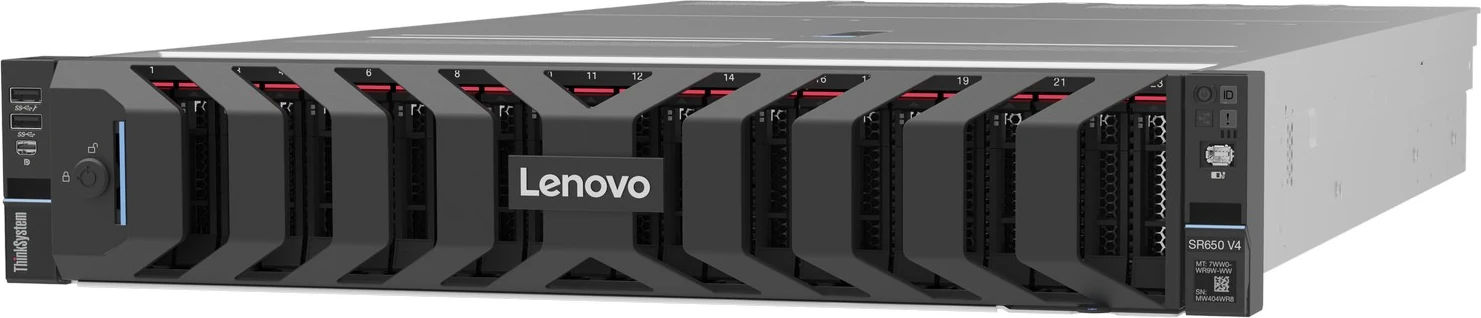
The ThinkSystem SR650 V4 is Lenovo’s general-purpose 2U two-socket rack server for Intel Xeon 6 processors with Performance-cores. This data sheet maps what the Xeon 6 platform adds — MRDIMMs, CXL memory in drive bays, 36 direct-attached NVMe drives, a second OCP slot — and the trade-offs between drives, PCIe slots and GPUs that decide a workable build.
2U Rack1 or 2 socketsXeon 6 P-coreXClarity Controller 3
86cores per processorXeon 6 6787P · 172 per server
Our read of Lenovo’s documentation: where the SR650 V4 is strong, and the limits worth knowing before you spec one.
Strengths
+Up to 36 NVMe drives — 24 front, 8 mid and 4 rear — connect straight to the processors on a full x4 link each, so an all-flash build needs no retimer adapters.
+Memory options missing from Lenovo’s SR650 V3 column: MRDIMMs at 8000 MT/s on five processors, and up to twelve CXL 2.0 modules in front E3.S 2T bays.
+All ten rear slots are PCIe 5.0, and slots are ordered one at a time rather than as whole risers, so a server carries only the slots it needs and can gain more later.
+Two OCP 3.0 slots, one per processor and each x8 or x16 with a cable kit, take adapters of up to 400 GbE without using a PCIe slot.
+Cooling runs from air to two open-loop Neptune modules; the Compute Complex version also water-cools the DIMMs and voltage regulators.
Watch-outs
!NVMe bays and PCIe slots share the same onboard connectors: 24 front NVMe bays leave four rear slots, and the 36-drive layout leaves one.
!Double-wide GPUs stop at two, in slots 4 and 7, which close slots 3 and 6; for four double-wide cards with NVLink Lenovo points to the SR650a V4.
!Fitting any GPU removes the mid and rear drive bays, and a 3.5-inch GPU build is held to the 8-drive C4DB backplane.
!MRDIMMs run only at one per channel (eight per processor) and only with five 6700-series SKUs; air-cooled storage or GPU builds using them, or 256 GB 3DS RDIMMs, are limited to 30 °C inlet air.
!The 3.5-inch ceiling falls to 16 bays (12 front, 4 rear) from the V3’s 20, because the mid cage is now 2.5-inch only.
Processors27 SKUs
Cores / CPU8–86
DIMM slots32
Backplanes16
Max bays40
GPUsup to 10
PSU options14 · to 3,200 W
02 — Processors
27 supported processors, mapped
Lenovo lists 27 Xeon 6 P-core processors for the SR650 V4 — ten 6500-series and seventeen 6700-series parts — from the 8-core, 135 W 6503P to the 86-core, 350 W 6787P. Every SKU has eight DDR5 channels rated to 6400 MT/s and 88 PCIe 5.0 lanes; the landscape and explorer below plot and filter the full list.
Processor landscape — cores × TDP
27 SKUs · 1 family
Xeon 6 P-core 27Bubble size = L3 cache · hover a bubble for the full SKU
Processor explorer
filter · sort · compare
Processor
Cores / threads
Base
L3 cache
TDP
W / core
Memory
Intel Xeon 6 6787P
86 / 172
2 GHz
336 MB
350 W
4.1
DDR5-6400
Intel Xeon 6 6781P
80 / 160
2 GHz
336 MB
350 W
4.4
DDR5-6400
Intel Xeon 6 6761P
64 / 128
2.5 GHz
336 MB
350 W
5.5
DDR5-6400
Intel Xeon 6 6767P
64 / 128
2.4 GHz
336 MB
350 W
5.5
DDR5-6400
Intel Xeon 6 6760P
64 / 128
2.2 GHz
320 MB
330 W
5.2
DDR5-6400
Intel Xeon 6 6747P
48 / 96
2.7 GHz
288 MB
330 W
6.9
DDR5-6400
Intel Xeon 6 6741P
48 / 96
2.5 GHz
288 MB
300 W
6.3
DDR5-6400
Intel Xeon 6 6740P
48 / 96
2.1 GHz
288 MB
270 W
5.6
DDR5-6400
Intel Xeon 6 6736P
36 / 72
2 GHz
144 MB
205 W
5.7
DDR5-6400
Intel Xeon 6 6732P
32 / 64
3.8 GHz
144 MB
350 W
10.9
DDR5-6400
Intel Xeon 6 6745P
32 / 64
3.1 GHz
336 MB
300 W
9.4
DDR5-6400
Intel Xeon 6 6737P
32 / 64
2.9 GHz
144 MB
270 W
8.4
DDR5-6400
Intel Xeon 6 6730P
32 / 64
2.5 GHz
288 MB
250 W
7.8
DDR5-6400
Intel Xeon 6 6731P
32 / 64
2.5 GHz
144 MB
245 W
7.7
DDR5-6400
Intel Xeon 6 6530P
32 / 64
2.3 GHz
144 MB
225 W
7.0
DDR5-6400
Intel Xeon 6 6527P
24 / 48
3 GHz
144 MB
255 W
10.6
DDR5-6400
Intel Xeon 6 6521P
24 / 48
2.6 GHz
144 MB
225 W
9.4
DDR5-6400
Intel Xeon 6 6520P
24 / 48
2.4 GHz
144 MB
210 W
8.8
DDR5-6400
Intel Xeon 6 6725P
16 / 32
3.7 GHz
192 MB
235 W
14.7
DDR5-6400
Intel Xeon 6 6724P
16 / 32
3.6 GHz
72 MB
210 W
13.1
DDR5-6400
Intel Xeon 6 6517P
16 / 32
3.2 GHz
72 MB
190 W
11.9
DDR5-6400
Intel Xeon 6 6511P
16 / 32
2.3 GHz
72 MB
150 W
9.4
DDR5-6400
Intel Xeon 6 6515P
16 / 32
2.3 GHz
72 MB
150 W
9.4
DDR5-6400
Intel Xeon 6 6505P
12 / 24
2.2 GHz
48 MB
150 W
12.5
DDR5-6400
Intel Xeon 6 6714P
8 / 16
4 GHz
48 MB
165 W
20.6
DDR5-6400
Intel Xeon 6 6507P
8 / 16
3.5 GHz
48 MB
150 W
18.8
DDR5-6400
Intel Xeon 6 6503P
8 / 16
2.8 GHz
48 MB
135 W
16.9
DDR5-6400
Six parts — 6511P, 6521P, 6731P, 6741P, 6761P and 6781P — are rich one-socket (R1S) processors with no UPI links: one socket only, factory-built only, with no field upgrade and no support on the water-cooled 7DK2 machine type.
Only the 6747P, 6761P, 6767P, 6781P and 6787P can run MRDIMMs at 8000 MT/s.
Every two-socket SKU connects over four UPI 2.0 links at 24 GT/s.
Lenovo matches Entry heatsinks to processors of 205 W or less and Standard heatsinks to parts up to 330 W; Performance heatsinks, with a separate radiator, suit most configurations.
Nine LCC-die parts (6503P, 6505P, 6507P, 6511P, 6515P, 6517P, 6714P, 6724P, 6725P) can only be factory-set to the Power Efficiency operating mode and cannot use the CXL heterogeneous interleave mode.
An air-cooled server with the 350 W 6732P is limited to 30 °C inlet air.
03 — Memory
32 DIMM slots, 16 per processor
Each processor drives eight DDR5 channels with two sockets per channel, so a two-processor server has 32 slots. RDIMMs run at up to 6400 MT/s with one DIMM per channel and 5200 MT/s with two. 256 GB 3DS RDIMMs take the server to 8 TB, while MRDIMMs trade capacity for bandwidth at 8000 MT/s.
Capacity with every slot filled
by DIMM size
Operating speed
per Lenovo memory tables
Processor
1 DIMM / channel
2 DIMMs / channel
RDIMM (all 27 processors)
6400 MT/s
5200 MT/s
3DS RDIMM (256 GB)
6400 MT/s
not stated*
MRDIMM (6747P, 6761P, 6767P, 6781P, 6787P)
8000 MT/s
not supported
* Lenovo’s speed list quotes the two-DIMMs-per-channel figure for standard RDIMMs only, although sixteen 256 GB 3DS RDIMMs per processor is a supported quantity.
Every RDIMM in the server must share one part number and both processors need the same DIMM count; the 96, 128 and 256 GB parts come in lots of 8 or 16 per processor, and the 64 GB MRDIMM only as 8.
Lenovo lists twelve 256 GB DIMMs per processor as planned for November 2026.
CXL 2.0 modules (96 or 128 GB) occupy front E3.S 2T bays, are not hot-swap, are not supported under Windows Server or VMware ESXi, and cannot be combined with the 7DK2 water-cooled build.
The Compute Complex Neptune option (machine type 7DK2) limits the server to 16 DIMMs, one per channel.
ECC covers every DIMM, SDDC and ADDDC need x4-based DIMMs, and memory mirroring leaves half the installed capacity usable.
04 — Storage
16 backplane options, up to 40 bays
Drives fit in three zones: the front (3.5-inch, 2.5-inch or EDSFF E3.S), a simple-swap mid cage of eight 2.5-inch bays, and the rear (four 3.5-inch or up to eight 2.5-inch). The headline layouts are the documented ceilings; the chart after them plots the 16 individual backplanes Lenovo combines to build them.
Headline layouts
front panel view
Front panel
Rear module
Storage config 27: three 8-bay SAS/SATA backplanes at the front, two 4-bay SAS/SATA backplanes in the mid cage (not drawn) and an 8-bay rear backplane — 40 drives in all.
SAS/SATANVMeSAS/SATA + NVMe
Controllers & boot
Onboard NVMe (Non RAID NVMe, feature BC4V) - PCIe 5.0, RAID via Intel VROC — Software RAID. Onboard; each drive PCIe 5.0 x4; JBOD or VROC RAID
ThinkSystem M.2 RAID B550i-2i SATA/NVMe Enablement Kit (4Y37B09898) — Boot. Internal non-hot-swap M.2; NVMe only (x1 lane per drive); integrated Broadcom RAID; max 1
ThinkSystem M.2 RAID B545i-2i SATA/NVMe Adapter (4Y37A93746) — Boot. Internal non-hot-swap M.2; SATA and NVMe (x1 lane per drive); integrated Broadcom RAID; max 1
ThinkSystem M.2 B350i-2i NVMe Enablement Kit (4Y37B09897) — Boot. Internal non-hot-swap M.2; NVMe only (x2 lanes per drive); RAID via VROC; max 1
ThinkSystem SR650/a V4 M.2 RAID B540p-2HS SATA/NVMe Enablement Kit (4XH7B03860) — Boot. Rear hot-swap M.2; SATA and NVMe; integrated Broadcom RAID; max 1
ThinkSystem SR650/a V4 Front M.2 RAID B550d-2HS SATA/NVMe Enablement Kit (4XH7B11660) — Boot. Front hot-swap M.2 (E3.S and 2.5-inch front configs only); NVMe only; integrated Broadcom RAID; max 1
ThinkSystem SR650/a V4 M.2 RAID B540d-2HS SATA/NVMe Enablement Kit (4XH7B03857) — Boot. Front hot-swap M.2 (feature C217); SATA and NVMe (x1 lane per drive); integrated Broadcom RAID; max 1; B540 hot-swap drives need 4XH7A96837 drive assembly kit per drive for field upgrades
ThinkSystem 440-16e SAS/SATA PCIe Gen4 12Gb HBA — HBA. External SAS HBA (JBOD to external enclosures/tape), part 4Y37A09724 feature B8P7 - lp2127 L6104
Front hot-swap M.2 RAID B550d-2HS SATA/NVMe Enablement Kit (2 x M.2 NVMe; E3.S and 2.5-inch front configs only) — boot
Front hot-swap M.2 RAID B540d-2HS SATA/NVMe Enablement Kit (2 x M.2 SATA/NVMe) — boot
The processors have no onboard SATA, so SATA drives always sit behind a RAID adapter or HBA; onboard NVMe runs each drive at PCIe 5.0 x4, as JBOD or with Intel VROC RAID.
VROC comes in three licences — RAID 1 only, Standard (0/1/10) and Premium (adds RAID 5). ESXi accepts VROC RAID 1 only, and VROC arrays cannot use SED encryption.
Tri-Mode on a RAID 940 (feature CH5Z) mixes U.3 NVMe with SAS and SATA on AnyBay backplanes, at one PCIe lane per NVMe drive; U.2 drives are excluded.
The RAID 960W-32i is NVMe-only — up to 16 U.2 drives, no SAS or SATA — and installs in slots 3 to 8.
Mid-cage drives are simple-swap: the lid comes off and the cage levers up. The cage shares power connectors with slots 2 and 10, so it excludes them, config 27 aside.
Boot M.2 goes internally, in a rear hot-swap cage in slot 8 or slot 5 (always slot 5 with open-loop cooling), or in a front hot-swap cage on 8- or 16-bay 2.5-inch layouts and E3.S layouts of up to six backplanes.
A cabled internal (CFF) RAID adapter or HBA frees a rear slot, but only with 2.5-inch front bays; E3.S builds take no RAID adapter at all.
Every documented backplane
16 with drive bays
2.5-inch3.5-inchEDSFF (E1.S / E3.S)
05 — Accelerators & I/O
GPUs, PCIe and networking
GPUs install in the rear risers. The low-profile NVIDIA L4 fits any of slots 1 to 10; the double-wide L40S and RTX 4500 Ada need slots 4 and 7, each of which blocks its neighbour. Mixed GPU models are not allowed, and the L4 and L40S are Controlled parts that Lenovo does not offer in every market. Up to 10 × single-wide NVIDIA L4, or 2 × double-wide.
NVIDIA L4 24GB PCIe Gen4 Passive GPU
single-wide
24GB · up to 10
NVIDIA L40S 48GB PCIe Gen4 Passive GPU
double-wide
48GB · up to 2
NVIDIA RTX 4500 Ada 24GB PCIe Active GPU
double-wide
24GB · up to 2
I/O topology
88 lanes per CPU
Each Xeon 6 processor supplies 88 PCIe 5.0 lanes and eight DDR5 channels, and two-socket SKUs connect over four UPI 2.0 links at 24 GT/s. Risers 1 and 2 and OCP slot 1 hang off CPU 1; Risers 3 and 4 and OCP slot 2 need CPU 2.
Riser 1 and Riser 4 slots are fitted as pairs, and Riser 1 turns full-height when the 8-bay 2.5-inch rear cage is installed.
All x8 slots are open-ended, so x16 cards fit physically.
Open-loop water cooling routes its hoses through slot 8, which is then lost to adapters, and holds OCP slot 2 to x8.
An optional 4-to-1 adapter in an OCP slot lets four servers share one remote-management network connection.
A DB-9 serial port is available as a bracket in slot 5 or slot 8.
06 — Power & cooling
14 power supplies, 800–3,200 W
Lenovo lists 14 hot-swap supplies from 800 W to 3200 W in two families — CRPS Premium, which adds zero-output standby, finer power metering and virtual reseat, and standard CRPS. Besides the Titanium and Platinum AC units, 1300 W versions exist for HVAC/HVDC and for −48 V DC feeds.
AC277 VAC / HVDC−48 V DC
Only the 800 W and 1300 W Titanium CRPS Premium units may be fitted singly; every other supply is ordered as a pair, and paired supplies must be identical.
The 800 W and 1300 W units also run at 115 V (the 1300 W delivers 1000 W there); the 2000, 2700 and 3200 W supplies need 230 V, and the 2700 W and 3200 W units use C20 inlets.
Lenovo gives the −48 V unit’s range as −44 to −54 V DC in the power-supply section but −48 to −60 V DC, at 29.8 A, in the electrical specifications.
The HVAC/HVDC unit takes 200–277 V AC single-phase or 240–380 V DC; in China every supply also accepts 240 V DC.
Five (one CPU) or six (two CPUs) 60 mm fans give N+1 rotor redundancy: Standard 24K single-rotor, Performance 20K dual-rotor, or Ultra 21K dual-rotor, which E3.S fronts and the 36-NVMe layout require.
07 — Management, security & OS
Run it, secure it, choose the OS
Management
XClarity Controller 3 on an ASPEED AST2600 BMC, built on OpenBMC
Management subsystem on a separate System I/O Board (DC-SCM)
XCC3 Premier licence: remote console, virtual media, System Guard, Neighbor Group, power capping, boot and crash video capture
SUSE Linux Enterprise Server 15 SP6, 15 SP7 and 16
Ubuntu 22.04, 24.04 and 26.04 LTS
VMware ESXi 8.0 U3, 9.0 and 9.1 — factory preload offered, except with an NVIDIA GPU
08 — Compare
SR650 V3 → SR650 V4
Lenovo’s comparison table in the SR650 V4 guide sets the new server against the model it replaces. The table describes the V3 with 4th Gen Xeon Scalable processors; the SR650 V3 data sheet lists that server’s full processor range.
2 × 4th Gen Xeon Scalable · up to 60 cores · 350 W
2 × Xeon 6700/6500 P-core · up to 86 cores, 172 threads · 350 W
PCIe lanes per CPU
80 × PCIe 5.0
88 × PCIe 5.0
Memory
DDR5 to 4800 MHz · RDIMM, 3DS and 9x4 RDIMM
DDR5 to 6400 MHz · RDIMM, 3DS, MRDIMM · up to 12 CXL 2.0 modules
Maximum memory
8 TB · 32 DIMMs
8 TB · 32 DIMMs
Drive bays
20 × 3.5" or 40 × 2.5"
16 × 3.5", 40 × 2.5" or 32 × E3.S
Mid bays
Up to 4 × 3.5" or 8 × 2.5"
8 × 2.5", simple-swap
Boot
Internal M.2 or 2 × rear 7mm
Internal M.2 or front/rear hot-swap M.2
Onboard NVMe ports
20
36
OCP 3.0
1 × PCIe Gen5 x16, rear or front
2 × rear, PCIe Gen5
PCIe slots
Up to 10 rear (up to 9 at Gen5) + 2 optional front
Up to 10 rear, all PCIe 5.0
GPUs
8 single-wide or 3 double-wide
10 single-wide or 2 double-wide
Management
XClarity Controller 2
XClarity Controller 3 (OpenBMC)
AC power supplies
750, 1100, 1800, 2400, 2600 W
800, 1300, 2000, 2700, 3200 W
DC and HVDC
1100 W −48 V DC
1300 W −48 V DC · 1300 W HVAC/HVDC
Source: Lenovo Press LP2127 (SR650 V4 product guide), Table 1 — Comparing the SR650 V4 to the previous generation SR650 V3.
The SR650 V4 family side by side
The SR650 V4 anchors Lenovo’s Xeon 6 rack line. The SR630 V4 is its 1U counterpart; the SR650a V4, and the fixed SR650i V4 inference build made from it, move GPUs to the front of a deeper 2U chassis; the SR850 V4 scales to four sockets; and the SR650 V3 is the model it replaces. Each bar below is drawn from that model’s verified spec file.
This modelSiblings and successorEach value from that model’s own verified spec file · bars scale per column
Head-to-head comparisons
Every figure on this page, set against the machines buyers weigh it up with.
Four builds that play to documented SR650 V4 strengths, each assembled from parts our configurator accepts for this model. Open any of them to change it; before quoting we run the exact mix past Lenovo’s thermal, slot and fan rules.
Virtualisation
Dense VM host at full memory speed
Two 48-core 6740P processors give 96 cores, and sixteen 64 GB RDIMMs — one per channel — hold 1 TB at the 6400 MT/s ceiling. With only eight front NVMe bays in use, all ten rear PCIe slots stay available, and a RAID 1 M.2 pair keeps the hypervisor off the datastore.
2 × Xeon 6 6740P — 48 cores @ 2.1 GHz, 270 W each
16 × 64 GB TruDDR5 RDIMM — 1 TB, one per channel
8 × 7.68 TB NVMe on an 8-bay NVMe backplane
2 × 480 GB M.2 NVMe on the B550i-2i, RAID 1
Intel E810-DA2 2 × 25GbE OCP 3.0
2 × 1300 W Titanium CRPS
VMware ESXi 9.0
Air-cooled servers with 64 GB or larger DIMMs, or processors above 205 W, are limited to 35 °C inlet air.
The 64-core 6767P is one of the five processors that run MRDIMMs, and eight 64 GB MRDIMMs per socket fill every channel at 8000 MT/s — 1 TB of the fastest memory the platform offers. Eight NVMe drives and a 100GbE OCP uplink round out an analytics node built around memory bandwidth.
2 × Xeon 6 6767P — 64 cores @ 2.4 GHz, 350 W each
16 × 64 GB TruDDR5 MRDIMM — 1 TB at 8000 MT/s
8 × 3.84 TB NVMe on an 8-bay NVMe backplane
2 × 480 GB M.2 NVMe boot, RAID 1
Broadcom 57508 2 × 100GbE OCP 3.0
2 × 2000 W Titanium CRPS Premium (230 V)
Red Hat Enterprise Linux 9
Lenovo lists a single MRDIMM, the 64 GB part, at eight per processor, so an MRDIMM build stops at 1 TB. Air-cooled storage builds with MRDIMMs are limited to 30 °C, and 350 W processors exceed the Standard heatsink’s 330 W rating.
Two double-wide NVIDIA L40S cards (48 GB each) sit in slots 4 and 7, fed by 32-core 6737P processors and 1 TB of RDIMM. A 100GbE OCP adapter carries the traffic without taking a PCIe slot, and front NVMe bays keep models and datasets local.
2 × Xeon 6 6737P — 32 cores @ 2.9 GHz, 270 W each
2 × NVIDIA L40S 48 GB, double-wide
16 × 64 GB TruDDR5 RDIMM — 1 TB
4 × 7.68 TB NVMe on an 8-bay NVMe backplane
2 × 480 GB M.2 NVMe boot, RAID 1
NVIDIA ConnectX-6 2 × 100GbE QSFP56 OCP 3.0
2 × 2700 W Titanium CRPS Premium (230 V)
Ubuntu Server 24.04 LTS
The L40S is a Controlled GPU, not offered in every market. With GPUs fitted the mid and rear bays are unavailable, slots 3 and 6 are blocked, and the air-cooled inlet limit is 35 °C. Lenovo will not preload ESXi on a server with an NVIDIA GPU.
Twelve front and four rear 3.5-inch bays — the most the chassis takes — filled with 20 TB SATA drives behind a 16-port RAID 940 give 320 TB raw for a backup repository or archive tier. Sixteen-core 6515P processors at 150 W are ample for moving data.
2 × Xeon 6 6515P — 16 cores @ 2.3 GHz, 150 W each
16 × 20 TB 3.5-inch SATA HDD — 320 TB raw
12-bay front and 4-bay rear 3.5-inch backplanes
RAID 940-16i with 8 GB flash
16 × 32 GB TruDDR5 RDIMM — 512 GB
2 × 480 GB M.2 NVMe boot
Broadcom 57504 4 × 25GbE OCP 3.0
2 × 1300 W Titanium CRPS
Windows Server 2025
Rear drive bays hold an air-cooled server to 30 °C inlet air, and this layout leaves two rear PCIe slots. With no SATA ports on the processors, the drives depend on the 16-port adapter (Lenovo also allows the 440-16i HBA here).
Our refurbished configurators cover Dell and HPE rather than Lenovo, so the closest re-certified stand-ins are two-socket 2U servers from the DDR4 generation. They suit virtualisation and storage refreshes where DDR5, MRDIMMs and CXL are not requirements.
Gen10 Plus · re-certified
HPE ProLiant DL380 Gen10 Plus
2U · two sockets
32 DIMM slots · up to 8 TB DDR4
Up to 24 × SFF or 12 × LFF
DDR4-3200 · PCIe 4.0 · OCP 3.0 · iLO 5
Mirrors the SR650 V4’s 32-slot memory layout and OCP networking for a like-for-like virtualisation host on a tighter budget.
Up to 10 rear, all PCIe 5.0 (6 full-height + 4 low-profile)
OCP
2 × OCP 3.0 SFF, PCIe 5.0 x8 or x16
Internal
CFF RAID adapter or HBA bay (2.5-inch front layouts)
Serial
Optional DB-9 bracket in slot 5 or 8
Accelerators
GPU envelope
Up to 10 × single-wide or 2 × double-wide
Double-wide slots
4 and 7 (blocking 3 and 6)
Listed GPUs
NVIDIA L4, L40S and RTX 4500 Ada
Power
Supplies
Up to two hot-swap; identical when paired
Titanium AC
800, 1300, 2000, 2700 and 3200 W
Platinum AC
800, 1300 and 2700 W
Other
1300 W HVAC/HVDC · 1300 W −48 V DC
Ports & video
Front
External diagnostics port · optional 2 × USB 3 (5 Gb/s, one shared with XCC) · optional Mini DisplayPort
Rear
2 × USB 3 (5 Gb/s) · VGA · 1GbE RJ-45 XCC port · optional DB-9 serial
Internal
Optional USB 3 (5 Gb/s) port
Video
16 MB, integrated in XCC3 · up to 1920 × 1200 at 60 Hz
Environment & warranty
ASHRAE
Class A2 in most configurations; A3, A4 or H1 depending on configuration
Operating temperature
10–35 °C (A2)
Maximum altitude
3,050 m
Warranty
1 or 3 years by machine type · customer-replaceable units and onsite, 9 × 5 next business day
12 — FAQ
SR650 V4 questions, answered from the documentation
What is the maximum memory of the Lenovo ThinkSystem SR650 V4?
Two processors give 32 DIMM slots, and with 256 GB 3DS RDIMMs in every slot the SR650 V4 holds 8 TB. A one-processor server has 16 slots, and the water-cooled 7DK2 model is limited to 16 DIMMs at one per channel. CXL 2.0 modules in E3.S 2T bays can add capacity, though not under Windows Server or ESXi.
Which processors does the SR650 V4 support?
Lenovo lists 27 Intel Xeon 6 processors with Performance-cores: ten 6500-series and seventeen 6700-series SKUs, from 8 to 86 cores and 135 W to 350 W. The 86-core 6787P is the top part. Six SKUs are single-socket R1S processors without UPI links.
How many drives can the SR650 V4 hold?
The ceilings are 40 drives in 2.5-inch form (24 at the front, 8 in the mid cage, 8 at the rear), 16 in 3.5-inch form (12 front, 4 rear) or 32 E3.S 1T drives across the front, with a pair of M.2 drives for boot on top. As many as 36 NVMe drives can run on direct x4 links, but that layout leaves just one rear PCIe slot.
How many GPUs does the SR650 V4 support?
Up to ten single-wide NVIDIA L4 cards, or two double-wide GPUs — the L40S or RTX 4500 Ada — in slots 4 and 7. A GPU rules out the mid and rear drive zones, and the water-cooled 7DK2 model takes no GPUs. For four double-wide GPUs with NVLink, Lenovo recommends the SR650a V4.
How many PCIe slots does the SR650 V4 have?
Up to ten, all PCIe 5.0 and all at the rear — six full-height and four low-profile across four risers — plus two OCP 3.0 slots. Risers 3 and 4 need the second processor, and the slot count falls as NVMe drives claim the shared connectors: 24 NVMe bays leave four slots.
What power supplies are available for the SR650 V4?
Lenovo lists fourteen: Titanium and Platinum AC models from 800 W to 3200 W, a 1300 W HVAC/HVDC supply and a 1300 W −48 V DC supply. The 800 W and 1300 W AC models also accept 115 V; the 2000 W and larger ones need 230 V. Two identical supplies form a redundant pair, and most models must be ordered in pairs.
How big and heavy is the SR650 V4?
The chassis measures 445 × 87 × 796 mm (width × height × depth), widening to 482 mm at the EIA flanges, and weighs up to 38.8 kg. Lenovo’s V4 toolless friction and slide rail kits fit it; its Long Travel rail kits do not.
What changed between the SR650 V3 and the SR650 V4?
Lenovo’s comparison lists Xeon 6 processors of up to 86 cores and 88 PCIe 5.0 lanes (from 60 cores and 80 lanes), DDR5 at 6400 MHz rather than 4800 MHz with MRDIMM and CXL support, 36 onboard NVMe ports instead of 20, two OCP slots, XClarity Controller 3 and supplies up to 3200 W. It gives up one double-wide GPU (two, not three) and four 3.5-inch bays (16, not 20).
How does the SR650 V4 differ from the SR630 V4 and SR650a V4?
The SR630 V4 is the 1U model: the same Xeon 6 P-cores plus E-core options of up to 144 cores, 32 DIMM slots, up to 12 × 2.5-inch or 16 × E3.S drives and three single-wide GPUs. The SR650a V4 is also 2U but 924 mm deep, and mounts its GPUs at the front — up to eight single-wide or four double-wide — with just eight drive bays.
Is the Lenovo ThinkSystem SR650 V4 end of life?
No. The SR650 V4 guide was last revised on 8 September 2026, still shows orderable base models and sets no end-of-service date. How long support lasts depends on the warranty or service plan bought with each server; our end-of-life checker will list vendor dates if Lenovo publishes them.
Sources & verification
Where these figures come from
Lenovo ThinkSystem SR650 V4 Server (September 8, 2026) — Standard specifications (Table 2), SR650 V4 vs SR650 V3 (Table 1), processors (Tables 13–15), memory (Tables 19–21), NVMe/slot trade-offs (Tables 23–25), backplanes and storage configs (Tables 27–34), controllers (Table 52), VROC (Table 54), slots (Tables 71–72), GPUs (Table 82), fans (Table 88), power (Table 89), dimensions (Table 110), operating environment, security and OS support.
Specifications are extracted from Lenovo’s published documents and independently re-checked line by line. Configurations are quote-based; availability and exact options are confirmed at quotation. Last reviewed 2026-09-11.