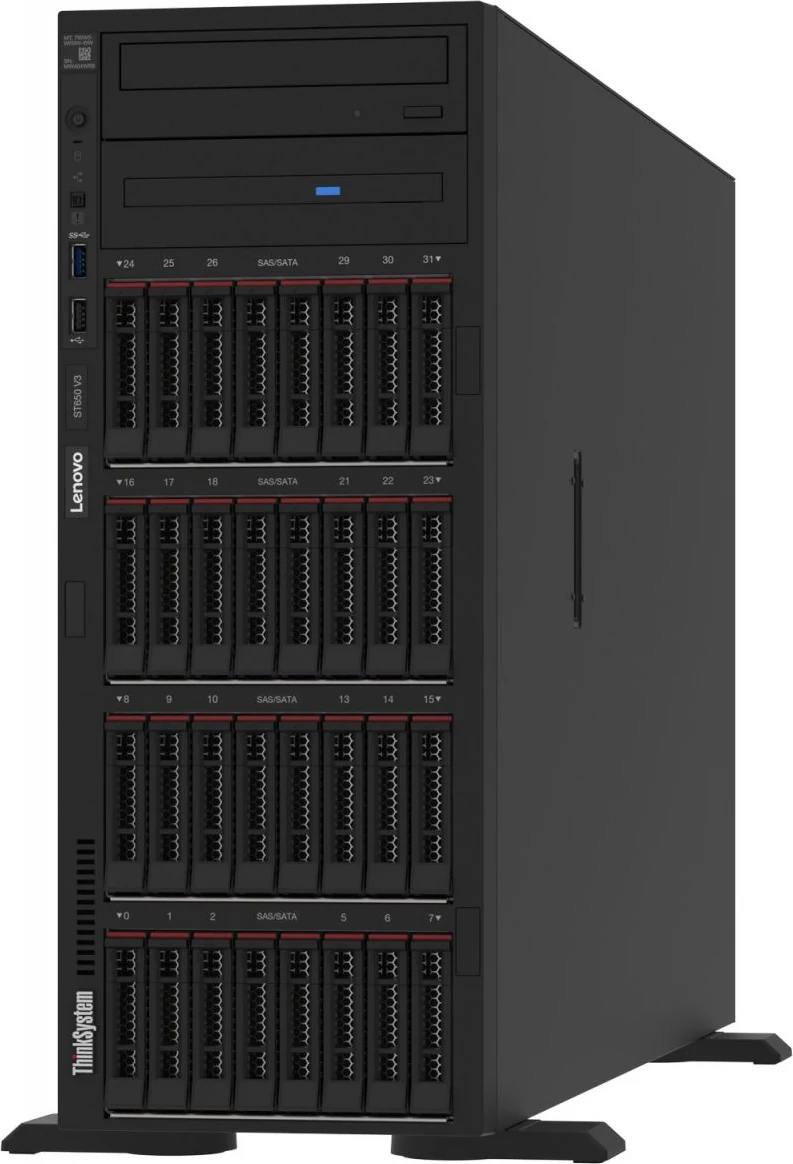
The ThinkSystem ST650 V3 is Lenovo’s dual-socket tower, built on 4th or 5th Gen Xeon Scalable processors and convertible to a 4U rack server. It takes up to 32 hot-swap 2.5-inch drives (24 NVMe) or 16 3.5-inch drives, two 5.25-inch media bays in most layouts, 4 TB of DDR5 and nine PCIe slots. This page maps those options and the thermal, slot and processor rules behind them.
Tower / 4U Rack1 or 2 sockets5th Gen Xeon Scalable4th Gen Xeon ScalableXClarity Controller 2
64cores per server2 × 32-core Xeon · up to 250 W
4TBDDR5 maximum32 × 128 GB · 16 DIMMs per CPU
322.5" hot-swap baysor 16 × 3.5" (12 with media bays)
Our read of Lenovo’s documentation: where the ST650 V3 is strong, and the limits worth knowing before you spec one.
Strengths
+Storage-rich for a tower: up to 32 × 2.5-inch or 16 × 3.5-inch hot-swap bays, and up to 24 NVMe drives with a full x4 link each, 12 of them on onboard ports.
+Two half-height 5.25-inch media bays take an LTO tape drive, RDX dock or slim DVD writer, so backup media can live inside the server.
+Thirty-two DIMM slots on 16 channels reach 4 TB, with ECC, SDDC and ADDDC for x4 RDIMMs plus memory mirroring.
+Nine PCIe slots — five of them PCIe 5.0 — all on the system board, plus a cabled internal RAID or HBA position that uses none of them.
+Hot-swap drives, fans and power: up to two redundant supplies to 2600 W and four 92 mm fans, and it converts to a 4U rack server.
Watch-outs
!Big and heavy for an office floor: 734 mm deep, 462 mm tall and up to 39.1 kg. Lenovo’s storage-rich and GPU-rich test builds are declared at 56 and 59 dBA operating; the GPU-rich one uses eight NVIDIA A2 cards that its GPU table no longer lists.
!The guide contradicts itself on one-processor use: an ordering note says single-processor configurations are not supported, yet it lists single-socket U-series processors and describes what a one-CPU server keeps.
!GPU claims outrun the parts list: the specifications allow eight single-wide or four double-wide GPUs, but the GPU table currently offers only the NVIDIA L4, a Controlled GPU sold on the “for AI” base model.
!Processors above 195 W, DIMMs over 64 GB and any GPU all push the supported room temperature below 35 °C, and Standard single-rotor fans suit only builds under 200 W TDP with no GPU or M.2.
!No OCP slot, the lockable front door is unavailable once the tower is rack-mounted, and the rack kit uses static rails with no cable management arm.
Processors41 SKUs
Cores / CPU8–32
DIMM slots32
Backplanes6
Max bays32
GPUsup to 8
PSU options6 · to 2,600 W
02 — Processors
41 supported processors, mapped
Lenovo lists 41 processors: 16 from the 5th Gen Xeon Scalable family (“Emerald Rapids”) and 25 from the 4th Gen family (“Sapphire Rapids”), from 8-core Bronze parts to 32-core Gold parts, at 115 W to 250 W. Each has eight DDR5 channels and up to 80 PCIe 5.0 lanes, and a pair connects over up to three UPI links at up to 20 GT/s.
Processor landscape — cores × TDP
41 SKUs · 2 families
5th Gen Xeon Scalable 164th Gen Xeon Scalable 25Bubble size = L3 cache · hover a bubble for the full SKU
Processor explorer
filter · sort · compare
Processor
Cores / threads
Base
L3 cache
TDP
W / core
Memory
Intel Xeon Gold 6548N
32 / 64
2.8 GHz
60 MB
250 W
7.8
DDR5-5200
Intel Xeon Gold 6548Y+
32 / 64
2.5 GHz
60 MB
250 W
7.8
DDR5-5200
Intel Xeon Gold 6538Y+
32 / 64
2.2 GHz
60 MB
225 W
7.0
DDR5-5200
Intel Xeon Gold 6538N
32 / 64
2.1 GHz
60 MB
205 W
6.4
DDR5-5200
Intel Xeon Gold 6414U
32 / 64
2 GHz
60 MB
250 W
7.8
DDR5-4800
Intel Xeon Gold 6448H
32 / 64
2.4 GHz
60 MB
250 W
7.8
DDR5-4800
Intel Xeon Gold 6448Y
32 / 64
2.1 GHz
60 MB
225 W
7.0
DDR5-4800
Intel Xeon Gold 6438M
32 / 64
2.2 GHz
60 MB
205 W
6.4
DDR5-4800
Intel Xeon Gold 6438N
32 / 64
2 GHz
60 MB
205 W
6.4
DDR5-4800
Intel Xeon Gold 6438Y+
32 / 64
2 GHz
60 MB
205 W
6.4
DDR5-4800
Intel Xeon Gold 6428N
32 / 64
1.8 GHz
60 MB
185 W
5.8
DDR5-4000
Intel Xeon Gold 5520+
28 / 56
2.2 GHz
52.5 MB
205 W
7.3
DDR5-4800
Intel Xeon Gold 5512U
28 / 56
2.1 GHz
52.5 MB
185 W
6.6
DDR5-4800
Intel Xeon Platinum 8450H
28 / 56
2 GHz
75 MB
250 W
8.9
DDR5-4800
Intel Xeon Gold 5420+
28 / 56
2 GHz
52.5 MB
205 W
7.3
DDR5-4400
Intel Xeon Gold 6542Y
24 / 48
2.9 GHz
60 MB
250 W
10.4
DDR5-5200
Intel Xeon Silver 4516Y+
24 / 48
2.2 GHz
45 MB
185 W
7.7
DDR5-4400
Intel Xeon Gold 6442Y
24 / 48
2.6 GHz
60 MB
225 W
9.4
DDR5-4800
Intel Xeon Gold 5412U
24 / 48
2.1 GHz
45 MB
185 W
7.7
DDR5-4400
Intel Xeon Gold 5418Y
24 / 48
2 GHz
45 MB
185 W
7.7
DDR5-4400
Intel Xeon Gold 6418H
24 / 48
2.1 GHz
60 MB
185 W
7.7
DDR5-4800
Intel Xeon Gold 5411N
24 / 48
1.9 GHz
45 MB
165 W
6.9
DDR5-4400
Intel Xeon Gold 5418N
24 / 48
1.8 GHz
45 MB
165 W
6.9
DDR5-4000
Intel Xeon Silver 4416+
20 / 40
2 GHz
37.5 MB
165 W
8.3
DDR5-4000
Intel Xeon Gold 6416H
18 / 36
2.2 GHz
45 MB
165 W
9.2
DDR5-4800
Intel Xeon Gold 6526Y
16 / 32
2.8 GHz
37.5 MB
195 W
12.2
DDR5-5200
Intel Xeon Silver 4514Y
16 / 32
2 GHz
30 MB
150 W
9.4
DDR5-4400
Intel Xeon Gold 6426Y
16 / 32
2.5 GHz
37.5 MB
185 W
11.6
DDR5-4800
Intel Xeon Gold 5416S
16 / 32
2 GHz
30 MB
150 W
9.4
DDR5-4400
Intel Xeon Silver 4510
12 / 24
2.4 GHz
30 MB
150 W
12.5
DDR5-4400
Intel Xeon Silver 4510T
12 / 24
2 GHz
30 MB
115 W
9.6
DDR5-4400
Intel Xeon Silver 4410Y
12 / 24
2 GHz
30 MB
150 W
12.5
DDR5-4000
Intel Xeon Silver 4410T
10 / 20
2.7 GHz
26.25 MB
150 W
15.0
DDR5-4000
Intel Xeon Gold 6534
8 / 16
3.9 GHz
22.5 MB
195 W
24.4
DDR5-4800
Intel Xeon Gold 5515+
8 / 16
3.2 GHz
22.5 MB
165 W
20.6
DDR5-4800
Intel Xeon Bronze 3508U
8 / 8
2.1 GHz
22.5 MB
125 W
15.6
DDR5-4400
Intel Xeon Silver 4509Y
8 / 16
2.6 GHz
22.5 MB
125 W
15.6
DDR5-4400
Intel Xeon Gold 6434
8 / 16
3.7 GHz
22.5 MB
195 W
24.4
DDR5-4800
Intel Xeon Gold 6434H
8 / 16
3.7 GHz
22.5 MB
195 W
24.4
DDR5-4800
Intel Xeon Gold 5415+
8 / 16
2.9 GHz
22.5 MB
150 W
18.8
DDR5-4400
Intel Xeon Bronze 3408U
8 / 8
1.8 GHz
22.5 MB
125 W
15.6
DDR5-4000
Single-socket-only parts — the 3508U, 5512U, 3408U, 5412U and 6414U, plus the 5411N — have no UPI links and are CTO-only.
Every other model is also sold as an ST650 V3 option kit, which includes a heat sink but no system fan.
Memory bus speed depends on the model: 4000 MHz on parts such as the 3408U and 4410Y, up to 5200 MHz on the fastest 5th Gen Gold parts. The Bronze 3508U and 3408U have no Hyper-Threading.
Built-in accelerators vary widely: the Platinum 8450H has four DSA and four IAA engines, while many Silver and Gold models have one DSA and no QAT.
Hotter processors need cooler rooms: Lenovo’s ambient table allows up to 195 W at 35 °C, 150 W at 40 °C and 125 W at 45 °C.
For ErP Lot 9 compliance, Lenovo tells UK and EU buyers to have the Efficiency – Favoring Performance preset (BFYE) applied in the factory.
03 — Memory
32 DIMM slots, 16 per processor
Each processor drives eight DDR5 channels at two DIMMs per channel, so a two-socket ST650 V3 has 32 slots. Lenovo allows seven fill levels per processor — one, two, four, six, eight, twelve or sixteen DIMMs — and advises filling all eight channels for best performance. Its speed figures disagree: the memory section below gives 5th Gen processors 5600 MHz at one DIMM per channel and 4400 MHz at two, the key features 5600 and 4800 MHz, and the specifications table 4800 and 4400 MHz.
Capacity with every slot filled
by DIMM size
Operating speed
per Lenovo memory tables
Processor
1 DIMM / channel
2 DIMMs / channel
5th Gen Xeon (memory section; to the CPU’s bus speed)
5600 MHz RDIMM · 5200 MHz 3DS
4400 MHz · 4800 MHz Performance+
4th Gen Xeon (to the CPU’s bus speed)
4800 MHz
4400 MHz
Two DIMM lists apply: 5600 MHz RDIMMs of 16, 32, 64, 96 and 128 GB for 5th Gen processors, and 4800 MHz RDIMMs of 16, 32 and 64 GB for 4th Gen. The 128 GB 5600 MHz module also works with 4th Gen at 4800 MHz, and four 5th Gen parts (3508U, 4509Y, 4510, 4510T) accept the 4800 MHz modules too.
Lenovo attributes the 4 TB ceiling to 128 GB 3DS RDIMMs, but the 3DS section of its current memory table is empty; the 128 GB module it does list is a 2Rx4 RDIMM, and 32 of those also make 4 TB.
The specifications table quotes 4800 MHz at one DIMM per channel and 4400 MHz at two for every processor, and the key features give 5th Gen parts 4800 MHz at two per channel without mentioning Performance+ RDIMMs; the current memory tables list no Performance+ module.
Protection includes ECC, Bounded Fault, SDDC and ADDDC on x4 DIMMs (ADDDC not with 9x4 DIMMs and only with Gold or Platinum processors), plus memory mirroring, which halves usable capacity and is unavailable with 9x4 DIMMs.
Only two DIMM capacities can be mixed per processor, and x4 with x8 DIMMs, 16/24/32 Gb DRAM densities or the DIMM types cannot be mixed at all.
Persistent memory is not supported.
04 — Storage
6 backplane options, up to 32 bays
All drives are front-mounted and hot-swap, on eight-bay 2.5-inch or four-bay 3.5-inch backplanes: up to 32 × 2.5-inch (24 NVMe) or 12 × 3.5-inch alongside two 5.25-inch media bays, or 16 × 3.5-inch once a fourth drive cage replaces the media bays. Lenovo documents 29 storage configurations; the four layouts shown here are the headline maximums, and the chart underneath counts bays for each of the six backplane kits used to build them.
Headline layouts
front panel view
Front panel
Config 20: four 8-bay SAS/SATA backplanes run by 12 Gb RAID or HBA adapters — for example one RAID 940-32i, or a 16-port adapter plus a cabled 16-port CFF card. Lenovo’s specifications and front photo keep both media bays here, but its optical-drive section calls this the one layout without them. The capacity ceiling is 983.04 TB with 30.72 TB SAS/SATA SSDs.
SAS/SATANVMeSAS/SATA + NVMe
Controllers & boot
Onboard SATA (8 ports) - Intel VROC SATA RAID (RSTe) RAID 0/1/10/5 (AVV0) — Software RAID. onboard, PCH; JBOD/AHCI also
Intel VROC (VMD NVMe RAID) Standard - RAID 0/1/10 (BR9B) — Software RAID. onboard NVMe, up to 12 drives, Intel and non-Intel SSDs
ThinkSystem 440-16e SAS/SATA PCIe Gen4 12Gb HBA — HBA. External SAS HBA (JBOD to external enclosures/tape), part 4Y37A09724 feature B8P7 - lp1604 L2503
Intel VROC SATA RAID (Intel RSTe) — Software RAID. Onboard SATA ports with Intel VROC SATA RAID (formerly Intel RSTe) software RAID - lp1604 L400, lp1604 L1737; not supported by virtualization hypervisors
Onboard ports: 8 SATA under Intel VROC SATA RAID (levels 0, 1, 5, 10; not for hypervisors), and 12 NVMe with two processors or 4 with one. VROC NVMe RAID needs a Standard (RAID 0/1/10) or Premium (adds RAID 5) key, and ESXi supports it only for RAID 1.
Lenovo’s feature summary claims up to 12 SATA drives on the onboard controller; its specifications and controller tables say 8.
RAID adapters: RAID 540-8i and 540-16i (RAID 0/1/10) and RAID 940-8i, 940-16i and 940-32i (up to RAID 60, 4 GB or 8 GB flash), plus 440-8i and 440-16i HBAs. The server holds up to four flash supercaps, which caps the number of RAID 940 cards.
A cabled CFF RAID 940-16i or 440-16i HBA sits beside the drive bays, cabled to an onboard NVMe port, and occupies none of the nine slots.
M.2 boot uses one module with one or two SATA or NVMe drives: the VROC-based 2-Bay Enablement Kit, the B540i-2i (Broadcom RAID) or the NVMe 2-Bay RAID adapter (Marvell). NVMe M.2 drives require the dual-rotor Performance fans.
Media bays: Lenovo’s optical-drive section names the four-backplane 2.5-inch build as the one without them, whereas its specifications, drive-bay description and front figure put that restriction on the 16 × 3.5-inch build. An LTO drive is supported, but not recommended, when the server lies on its side in a rack.
The configuration tables name 9350, 5350, 4350, 9450, 5450 and 4450 adapters that the current adapter table does not include; we confirm the controller for each layout at quotation.
External storage: 440-8e and 440-16e SAS HBAs, the RAID 940-8e, 16 Gb and 32 Gb Emulex Fibre Channel HBAs, and D1224 or D4390 enclosures.
Every documented backplane
6 with drive bays
2.5-inch3.5-inchEDSFF (E1.S / E3.S)
05 — Accelerators & I/O
GPUs, PCIe and networking
Lenovo’s specifications allow up to eight single-wide or four double-wide GPUs across slots 1–8, but the only card in its GPU table today is the NVIDIA L4 24 GB — 72 W, single-wide and low-profile — at up to eight per server. The L4 is a Controlled GPU, so it is configured only on the “for AI” base model 7D7ACTOAWW. A zone holding an L4 needs the air duct and thermal kits and then accepts only low-profile adapters; GPUs also require dual-rotor fans and, per Lenovo’s ambient table, a room at 30 °C or lower. Up to 8 × NVIDIA L4 (slots 1–8); double-wide rules documented, but no double-wide GPU listed.
NVIDIA L4 24GB PCIe Gen4 Passive GPU
single-wide
24GB · up to 8
I/O topology
80 lanes per CPU
Each Xeon brings eight DDR5 channels and up to 80 PCIe 5.0 lanes, and the two sockets are joined by up to three UPI links. All nine slots sit on the system board: CPU 1 feeds slots 1–3 and 9, CPU 2 feeds slots 5–8, and Lenovo’s tables disagree about slot 4 (see notes). Networking starts with two onboard 10GBASE-T ports.
Network adapters Lenovo lists
11 options
Adapter
Ports
Form
Broadcom BCM57416 2 x 10GBASE-T RJ45 onboard + dedicated XCC 1GbE port
Slot 4 (PCIe 5.0 x8): the slot list marks it as CPU 1 and the one-processor section keeps it, but the specifications table and I/O section say slots 4–8 require CPU 2.
Slots 1–8 are full-height, full-length and slot 9 is full-height, half-length; the x8 slots are x8 physical.
The onboard BCM57416 supports SR-IOV with up to 128 virtual functions, RoCE, iSCSI boot and PXE/UEFI network boot.
Network cards span 1GbE (Broadcom 5719, Intel I350-T4), 10GBASE-T (Broadcom 57412 and 57416, Intel X710-T2L and T4L), 25GbE (Broadcom 57414 and 57504, ConnectX-6 Lx) and 100GbE (Broadcom 57508, slots 1, 3, 5 and 7); the 57412 needs an x16 slot.
Two internal USB 3.2 Gen 1 connectors serve operating-system or licence keys, and a MicroSD slot gives the XCC2 up to 4 GB of Remote Disc on Card storage.
06 — Power & cooling
6 power supplies, 750–2,600 W
Up to two hot-swap supplies, redundant and identical: Titanium units of 1100 W, 1800 W and 2600 W (230 V only) and Platinum units of 750 W, 1100 W and 1800 W, of which the 750 W and 1100 W Platinum models also run on 110 V. In China all six also accept 240 V DC.
AC
Maximum inlet current at 200 V: 5.9 A (1100 W Titanium), 9.7 A (1800 W Titanium), 13.2 A (2600 W), 4.1 A (750 W Platinum), 6 A (1100 W Platinum) and 10 A (1800 W Platinum); at 100 V the two low-line units draw 8.4 A and 12 A.
Lenovo lists C13 cords for supplies up to 1800 W and C19 cords for the 2600 W unit; on 100–127 V power the 1100 W Platinum supply needs a cord rated above 10 A.
Cooling is up to four 92 mm hot-swap fans — Standard single-rotor or Performance dual-rotor, never mixed — plus fans inside each supply. Performance fans are N+1 rotor-redundant and lose no performance after a rotor failure at 27 °C or below; Standard fans are not redundant.
Three fans are enough only for one-processor builds with two backplanes and SAS/SATA drives; four single-rotor fans need processors under 200 W, DIMMs of 64 GB or less, and no GPU or M.2.
Lenovo’s generation table mentions a −48 V DC 1100 W Platinum supply that its power-supply table does not list, and its power text calls every unit dual-voltage although the table limits 110 V input to the 750 W and 1100 W Platinum units.
07 — Management, security & OS
Run it, secure it, choose the OS
Management
XClarity Controller 2 on an AST2600 BMC (dual-core Arm Cortex-A7, 1.2 GHz)
Dedicated rear 1GbE XCC port · front USB 2.0 for XClarity One Mobile
XCC2 Platinum upgrade: remote console, virtual media, power capping, System Guard, Neighbor Group
IPMI 2.0 (IPMI-over-LAN off by default), SNMPv3, CIM-XML, REST and Redfish
Light path diagnostics for DIMMs, drive bays and supplies · rear port for the External Diagnostics Handset
MicroSD slot for XCC2 Remote Disc on Card storage and firmware history
XClarity Provisioning Manager (F1), XClarity One, XClarity Essentials and Energy Manager
Security
Platform Firmware Resiliency hardware Root of Trust (NIST SP 800-193)
TPM 2.0 · Nationz TPM 2.0 for China (CTO only)
UEFI Secure Boot enabled at the factory (BPKQ) or left for later (BPKR)
Intel CBnT, TME/MKTME, SGX and TDX
Self-encrypting drives with KMIP key managers (IBM SKLM, Thales KeySecure)
Lockable side cover · optional lockable front door (tower only) and intrusion switch
NIST SP 800-147B compliant
Operating systems
Microsoft Windows Server 2019, 2022 and 2025
Red Hat Enterprise Linux 8.8, 8.10, 9.2 and 9.4–10.2 (5th Gen); 8.6 onward on 4th Gen
SUSE Linux Enterprise Server 15 SP5–SP7 and 16 (5th Gen); 15 SP4 onward on 4th Gen
Ubuntu 22.04, 24.04 and 26.04 LTS
VMware ESXi 7.0 U3, 8.0 U2/U3, 9.0 and 9.1 (8.0 U1 on 4th Gen) · factory preload, not with an NVIDIA GPU
08 — Compare
ST650 V2 → ST650 V3
Lenovo compares the ST650 V3 with the ST650 V2. The 32-DIMM layout and 4 TB ceiling carry over; the V3 moves to DDR5 and PCIe 5.0, trades 36-core 3rd Gen parts for 32-core 4th and 5th Gen ones, drops persistent memory and simple-swap bays, and lifts NVMe support to 24 drives.
Previous generationThinkSystem ST650 V2
This modelThinkSystem ST650 V3
Processors
2 × 3rd Gen Xeon Scalable · up to 36 cores, 3.6 GHz, 250 W
2 × 4th or 5th Gen Xeon Scalable · up to 32 cores, 3.9 GHz, 250 W
PCIe lanes per CPU
64 × PCIe 4.0
80 × PCIe 5.0
Memory
DDR4 to 3200 MHz · 8 channels · 2 DPC
DDR5 to 5600 MHz · 8 channels · 2 DPC
DIMM slots · maximum
32 · 4 TB
32 · 4 TB
Persistent memory
Intel Optane PMem 200 Series
Not supported
3.5" bays
Up to 16 hot-swap (8 NVMe) or 12 simple-swap SATA
Up to 16 hot-swap (16 NVMe) · no simple-swap
2.5" bays
Up to 32 hot-swap (16 NVMe)
Up to 32 hot-swap (24 NVMe)
Onboard NVMe ports
8
12
PCIe slots
Up to 9 (1 optional): 4 × Gen4 x16, up to 4 × x8, 1 × Gen4 x4
Source: Lenovo Press LP1604 (ST650 V3 product guide), Table 1 — Comparing the ThinkSystem ST650 V3 to the previous generation ST650 V2.
The ST650 V3 family side by side
Among the ThinkSystem towers covered here, the ST650 V3 is the dual-socket model; the ST250 V3, ST50 V3 and ST45 V3 each take one processor. For a rack, the 2U SR650 V3 and 1U SR630 V3 use the two Xeon Scalable generations this tower does. Each bar reflects that model’s verified spec file.
This modelSiblings and successorEach value from that model’s own verified spec file · bars scale per column
Head-to-head comparisons
Every figure on this page, set against the machines buyers weigh it up with.
Four builds that use the ST650 V3’s storage and slot count, assembled only from parts our configurator allows on this server. Lenovo ties fans, room temperature and controller choice to each storage configuration, so those are rechecked for the exact parts at quotation. Memory speeds follow Lenovo’s memory section and processor tables (see the memory notes for the specifications table’s lower figure).
Virtualisation
Branch Hyper-V host on eight NVMe drives
For a branch or head office without a server room: two 16-core, 195 W Gold 6526Y processors — the highest TDP Lenovo permits at 35 °C — with one 64 GB DIMM in each of the 16 channels for 1 TB. Eight NVMe drives on the onboard ports hold the VMs under VROC Premium RAID 5, which Lenovo supports under Windows.
2 × Xeon Gold 6526Y — 16 cores @ 2.8 GHz, 195 W each
16 × 64 GB TruDDR5-5600 RDIMM — 1 TB, one per channel (up to 5200 MHz, this processor’s bus speed)
8 × 3.84 TB NVMe on one 8-bay NVMe backplane (config 22, onboard NVMe ports)
Intel VROC NVMe RAID Premium — RAID 5 across the eight drives
2 × 480 GB M.2 NVMe boot drives on the M.2 module
Broadcom 57504 4 × 10/25GbE SFP28 PCIe adapter
Onboard 2 × 10GBASE-T
2 × 1100 W Titanium hot-swap supplies (230 V)
Windows Server 2025 Datacenter
Config 22 needs both processors. NVMe M.2 drives call for the dual-rotor Performance fans, and SED encryption is not available with VROC NVMe RAID.
A capacity tier for backups and archives: sixteen 20 TB drives give 320 TB raw, or 280 TB in RAID 6 on a single RAID 940-16i. Two 12-core Silver 4510s at 150 W keep the build inside Lenovo’s conditions for four Standard fans, and sixteen 16 GB DIMMs fill every channel for 256 GB.
2 × Xeon Silver 4510 — 12 cores @ 2.4 GHz, 150 W each
16 × 16 GB TruDDR5-5600 RDIMM — 256 GB, every channel filled (up to 4400 MHz, this processor’s bus speed)
16 × 20 TB 3.5-inch 7.2K SATA HDD on four 4-bay backplanes (config 4) — 320 TB raw
Sixteen 3.5-inch bays take the media-bay space, so this build has no internal tape or RDX. Above 35 °C Lenovo limits 3.5-inch builds to two backplanes, so this layout needs a room at 35 °C or less.
The full 32-bay front on one RAID 940-32i (config 20-6): thirty-two 3.84 TB SAS SSDs give 122.88 TB raw for database or ERP data that wants flash capacity behind a single controller, driven by two 24-core, 250 W Gold 6542Y processors and 1 TB of 64 GB DIMMs, one per channel.
2 × Xeon Gold 6542Y — 24 cores @ 2.9 GHz, 250 W each
16 × 64 GB TruDDR5-5600 RDIMM — 1 TB, one per channel (up to 5200 MHz, the processor’s bus speed)
32 × 3.84 TB 2.5-inch SAS SSD on four 8-bay SAS/SATA backplanes — 122.88 TB raw
Lenovo’s ambient table accepts 250 W processors with all four backplanes only at 25 °C or lower and only with DIMMs of 64 GB or less — hence the 64 GB modules — and processors of 200 W or more rule out the single-rotor Standard fans. Its storage-rich acoustic build (32 SAS HDDs, two 195 W processors) is declared at 56 dBA operating, so site it away from desks.
Video analytics or small-model inference at a site with no rack: four 72 W NVIDIA L4 GPUs with 24 GB apiece beside two 28-core Gold 5520+ processors, which include Intel AMX, with 1 TB of memory and eight 7.68 TB NVMe drives for footage or models. A dual-port 100GbE card provides the uplink.
2 × Xeon Gold 5520+ — 28 cores @ 2.2 GHz, 205 W each
16 × 64 GB TruDDR5-5600 RDIMM — 1 TB (up to 4800 MHz, the processor’s bus speed)
8 × 7.68 TB NVMe on one 8-bay NVMe backplane (config 22)
2 × 480 GB M.2 NVMe boot drives
Broadcom 57508 2 × 100GbE QSFP56 PCIe adapter
2 × 1800 W Titanium hot-swap supplies
Ubuntu Server 24.04 LTS
The L4 is a Controlled GPU, so this is ordered on the “for AI” base model 7D7ACTOAWW. Each zone holding an L4 needs Lenovo’s air duct and thermal kits and then takes only low-profile cards; dual-rotor fans are required, and GPU builds are held to 30 °C ambient or lower.
Lenovo sits outside our refurbished range, which is limited to Dell and HPE machines. The closest re-certified match is HPE’s ML350 Gen10, a two-socket tower that also converts to a 4U rack; if the server is heading for a rack anyway, 2U storage models are alternatives. All three are DDR4-era Xeon Scalable machines.
Gen10 · re-certified
HPE ProLiant ML350 Gen10
Tower / 4U rack · one or two sockets
24 DIMM slots · up to 3 TB DDR4
Up to 24 × SFF or 12 × LFF
iLO 5
The like-for-like option: the same tower-or-rack flexibility for sites that can accept fewer bays, DDR4 and an earlier Xeon Scalable generation.
1 or 3 years by machine type · CRU and onsite, 9 × 5 next business day
12 — FAQ
ST650 V3 questions, answered from the documentation
What is the maximum memory of the Lenovo ThinkSystem ST650 V3?
4 TB, with all 32 slots holding 128 GB DIMMs across two processors. Lenovo credits that figure to 3DS RDIMMs, although the 128 GB module in its current table is a standard 2Rx4 RDIMM. With one processor, 16 slots and 2 TB remain.
Which processors does the ST650 V3 support?
Lenovo lists 41 Intel Xeon Scalable models — 16 5th Gen and 25 4th Gen — from 8 to 32 cores and 115 W to 250 W. Six of them (the U-suffix parts and the 5411N) are single-socket only and have no UPI links.
How many drives does the ST650 V3 hold?
Up to 32 hot-swap 2.5-inch drives, 24 of which can be NVMe, or 16 hot-swap 3.5-inch drives (all of which can be NVMe) when the media bays make way for a fourth cage; with the media bays kept, the 3.5-inch maximum is 12. An internal M.2 module adds one or two boot drives.
How many GPUs can the ST650 V3 take?
Lenovo’s specifications say eight single-wide or four double-wide, but its GPU table lists only the NVIDIA L4 24 GB, up to eight in slots 1–8. The L4 is a Controlled GPU ordered on the “for AI” base model, and GPU builds need dual-rotor fans and a room at 30 °C or lower. The eight NVIDIA A2 cards in Lenovo’s GPU-rich acoustic test are not in that table.
What PCIe slots does the ST650 V3 have?
Nine, all on the system board: five PCIe 5.0 (three x16, two x8) and four PCIe 4.0 (one x16, three x8). Slots 1–8 are full-height and full-length and slot 9 is half-length. There is no OCP slot, and a cabled internal RAID or HBA adapter can be fitted without using a slot.
Can the ST650 V3 run with one processor?
Lenovo’s guide is inconsistent. An ordering note says single-processor configurations are not supported, yet it offers six single-socket-only processors and describes a one-processor server with 16 DIMMs (2 TB), slots 1–4 and 9, eight onboard SATA and four onboard NVMe ports. We confirm with Lenovo before quoting a one-socket build.
Can the ST650 V3 be mounted in a rack?
Yes. The Tower to Rack Conversion Kit (4M27A60835) makes it a 4U rack server on static rails with a supported rack range of 559–914 mm; there is no cable management arm, and the lockable front door cannot be used in rack form. A separate kit adds stabilising feet to turn a rack-configured server back into a tower.
How big, heavy and loud is the ST650 V3?
It measures 175 mm wide, 462 mm high and 734 mm deep, and weighs up to 39.1 kg. Lenovo declares 41 dBA for its typical configuration, rising to 56 dBA for a storage-rich build (32 SAS HDDs) and 59 dBA for a GPU-rich build (eight NVIDIA A2 cards, which the current GPU table does not list) when operating.
What changed from the ST650 V2?
According to Lenovo’s comparison, the V3 moves from 3rd Gen Xeon, DDR4-3200 and PCIe 4.0 to 4th or 5th Gen Xeon, DDR5-5600 and PCIe 5.0, with 80 lanes per processor instead of 64. NVMe support rises to 24 × 2.5-inch or 16 × 3.5-inch drives and onboard NVMe ports from 8 to 12, while persistent memory and simple-swap bays are dropped; the maximum core count falls from 36 to 32.
Is the Lenovo ThinkSystem ST650 V3 end of life?
The current product guide still lists orderable processors, memory, drives and options and gives no end-of-sale or end-of-service date. The 7D7B machine type includes one year of base warranty and 7D7A three, with Lenovo service upgrades available; our end-of-life checker records any date Lenovo announces.
Sources & verification
Where these figures come from
Lenovo ThinkSystem ST650 V3 Server Product Guide (August 4, 2026) — Key features, ST650 V3 vs ST650 V2 (Table 1), standard specifications (Table 2), base models (Table 3), processors (Tables 14–17), one-processor configurations, memory (Tables 19–20 and rules), drive bays, backplanes and storage configurations (Tables 21–25), M.2 (Table 29), controllers and VROC (Tables 32–33), optical and backup (Tables 47–48), I/O, network adapters (Table 50), external storage (Tables 51–52), GPUs (Tables 53–54), fans (Table 55), power (Tables 56, 75), management, security, rack kit (Tables 70–72), OS support, dimensions (Table 74) and operating environment (Table 76); Figures 1, 4 and 5 (images).
Specifications are extracted from Lenovo’s published documents and independently re-checked line by line. Configurations are quote-based; availability and exact options are confirmed at quotation. Last reviewed 2026-09-11.