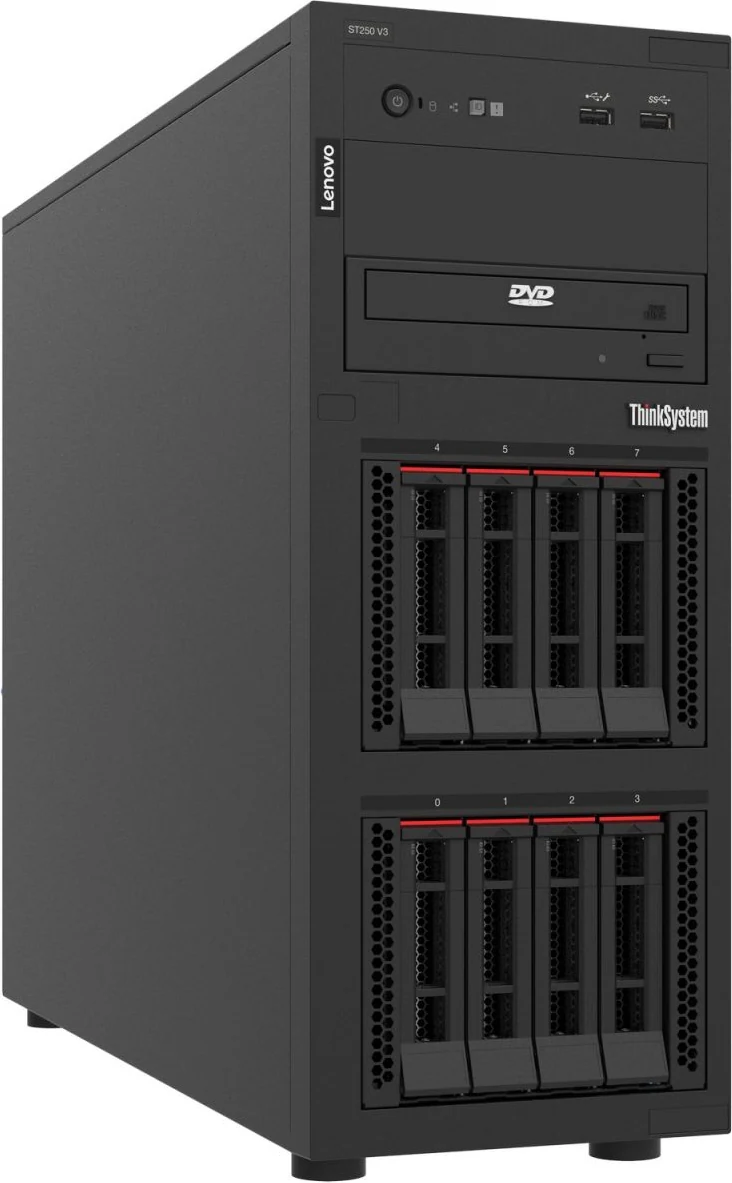
Lenovo compares the ST250 V3 with the ST250 V2 and the first ST250. The chassis layout carries over — the same bay counts, two media bays and four slots — while the V3 adds DDR5, a PCIe 5.0 x16 slot, larger supplies and a second NVMe bay in the simple-swap cage.
Previous generationThinkSystem ST250 V2
This modelThinkSystem ST250 V3
Form factor
Tower, convertible to 5U rack
Tower, convertible to 5U rack
Processors
Xeon E-2300, up to 8 cores / 95 W · Pentium
Xeon 6300 or E-2400, up to 8 cores / 95 W · Pentium
Chipset
Intel C256
Intel C266
Memory
4 × DDR4 UDIMM, up to 128 GB
4 × DDR5 UDIMM, up to 128 GB
Drive bays
8 × 3.5" HS, 16 × 2.5" HS, 8 × 3.5" SS, or 7 × 3.5" SS + 1 NVMe
8 × 3.5" HS, 16 × 2.5" HS, 8 × 3.5" SS, or 6 × 3.5" SS + 2 NVMe
PCIe slots
4 (x4, x16, x4, x4) · x16 slot PCIe 4.0
4 (x4, x16, x4, x4) · x16 slot PCIe 5.0
Rear USB
4 × USB 3.2 Gen 2 (10 Gb/s)
4 × USB 3.2 Gen 1 (5 Gb/s)
Power supplies
250 W or 300 W fixed, or 550 W hot-swap
300 W or 500 W fixed, or 800 W hot-swap
Source: Lenovo Press LP1803 (ST250 V3 product guide), Table 1 — Comparing the ST250 V3 to the ST250s.
The 1U SR250 V3 has the same 18-processor features table (its ordering table lists ten), 128 GB UDIMM ceiling and XCC2 management, but trades drive count and media bays for a 561 mm rack chassis. Below the ST250 V3, the ST50 V3 and ST45 V3 towers use non-hot-swap drives; above it, the ST650 V3 tower takes one or two processors. Bars compare each model’s own spec-file limits.
Every figure on this page, set against the machines buyers weigh it up with.