UK’s trusted IT infrastructure partner since 2003
Servnet
FinanceToolsConfiguratorGet in Touch
Head-to-head · every figure from the vendor documents

HPE DL380 Gen10 vs Lenovo SR665 V3

A specification-by-specification comparison of the HPE ProLiant DL380 Gen10 and the Lenovo ThinkSystem SR665 V3, built from HPE’s and Lenovo’s own documents. 1 headline measure favours the DL380 Gen10, 5 favour the SR665 V3, and they share no processors.

Bottom line. DL380 Gen10 leads on AI and acceleration. SR665 V3 leads on virtualisation, databases and in-memory work, storage density, network throughput. Neither vendor publishes benchmarks for these machines, so every call here is made on what their documents state.

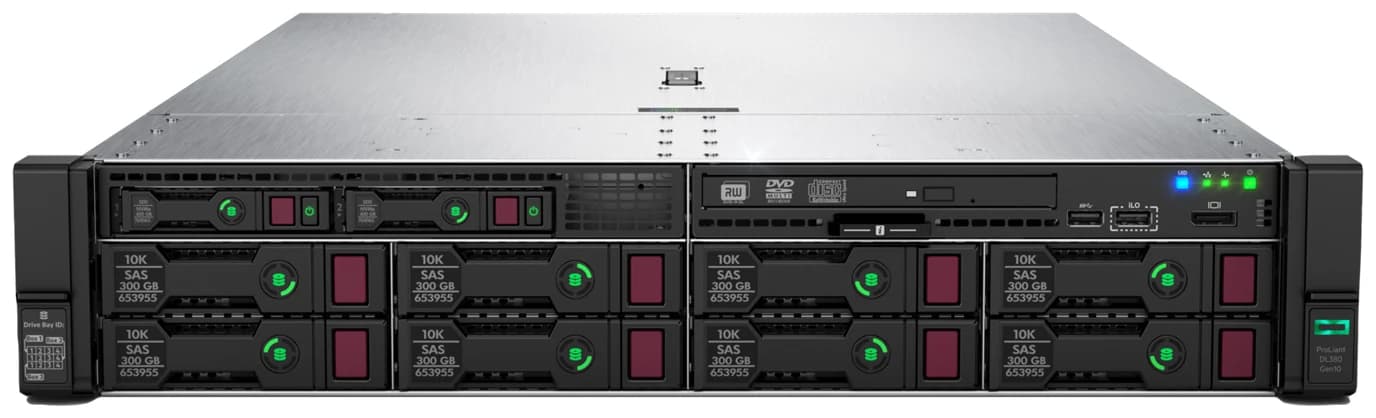
DL380 Gen10 front: eight 2.5-inch SAS bays, two premium bays, an optical drive and the media-bay ports, with the model badge at the right
HPE ProLiant
DL380 Gen10
2U Rack2 sockets24 DIMMHPE iLO 5
VS
Lenovo ThinkSystem SR665 V3 front: 24 numbered 2.5-inch drive bays, VGA and diagnostics ports at left, two USB ports at right
Lenovo ThinkSystem
SR665 V3
2U Rack2 sockets24 DIMMXClarity Controller 2
01 — Scoreboard

The measures that decide it

Each row is a figure both vendors publish. Bars show the split between the two; a badge marks the larger figure, which is not always the better buy — a shallower chassis or a lower power ceiling can matter more.

DL380 Gen102
Processor sockets
SR665 V32
DL380 Gen1056
Cores, fully populated
Largest listed processor × its socket count
SR665 V3320Higher
DL380 Gen103 TB
Memory ceiling
As each document states it
SR665 V36 TBHigher
DL380 Gen1024
Drive bays
SR665 V340Higher
DL380 Gen10Up to 8Higher
Accelerators
SR665 V3Up to 7
DL380 Gen102,200 W
Largest power supply
SR665 V32,600 WHigher
DL380 Gen102U Rack
Rack height
SR665 V32U Rack
DL380 Gen10100 GbE class
Fastest network option
SR665 V3400 GbE classHigher
02 — Verdict

Which one, and why

Drawn from the measures above and each model’s own data sheet. Neither vendor publishes benchmark results for these servers, so nothing here claims one is “faster”.

Choose the DL380 Gen10 if…

  • Accelerators: Up to 8 against Up to 7 on the SR665 V3
  • Expansion is the whole argument for this chassis. Three riser positions carry as many as eight PCIe 3.0 slots, and the pair of x16/x16/x16 GPU riser kits each take three single-width accelerators — six across two processors. The 1U DL360 Gen10, built from the identical processor table, reaches three slots in total.

Choose the SR665 V3 if…

  • Cores, fully populated: 320 against 56 on the DL380 Gen10
  • Memory ceiling: 6 TB against 3 TB on the DL380 Gen10
  • Drive bays: 40 against 24 on the DL380 Gen10
  • Lenovo lists 48 processors across two EPYC generations in one chassis, spanning 8 cores (EPYC 9015) to 160 (EPYC 9845) at up to 400 W.
03 — By workload

Where each one pulls ahead

Calls made on documented capacity only — cores, memory, bays, accelerators and network options — with the figures behind each one shown.

VirtualisationDL380 Gen10: 56 cores with 3 TB. SR665 V3: 320 cores with 6 TB.SR665 V3
Databases & in-memoryMemory ceiling 3 TB against 6 TB, across 24 and 24 DIMM slots.SR665 V3
Storage density24 bays in 2U against 40 in 2U.SR665 V3
AI & acceleration8 accelerators against 7 in the vendor documents.DL380 Gen10
Network throughputFastest card listed: 100 GbE class against 400 GbE class.SR665 V3
04 — Specifications

Side by side, differences first

Everything both documents state, grouped. The default view hides rows where the two machines are identical.

Processors

Every processor each vendor lists for the model, from its own document.

SpecificationDL380 Gen10SR665 V3
Processors listed11348
Most cores per processor28160
Highest processor TDP205 W400 W
Processor families2nd Gen Intel Xeon Scalable (Platinum) · 1st Gen Intel Xeon Scalable (Platinum) · 2nd Gen Intel Xeon Scalable (Gold) · 1st Gen Intel Xeon Scalable (Gold) · 2nd Gen Intel Xeon Scalable (Silver) · 1st Gen Intel Xeon Scalable (Silver) · 2nd Gen Intel Xeon Scalable (Bronze) · 1st Gen Intel Xeon Scalable (Bronze)AMD EPYC 9005 · AMD EPYC 9004

Memory

SpecificationDL380 Gen10SR665 V3
Largest module listed512 GB256 GB
Fastest rated speed2,933 MT/s6,400 MT/s
Memory typesRDIMM DDR4-2933 (2nd Gen Intel Xeon Scalable only) · RDIMM DDR4-2666 (1st Gen Intel Xeon Scalable only) · LRDIMM DDR4-2933 · Intel Optane Persistent Memory for HPE (2666 MT/s) + 1 moreRDIMM DDR5-6400 (5th Gen EPYC) · RDIMM DDR5-4800 (4th Gen EPYC) · 9x4 RDIMM · 3DS RDIMM DDR5-6400

Storage

Bay counts are the maximum each document states, including rear and mid-chassis positions.

SpecificationDL380 Gen10SR665 V3
Maximum bays2440
Documented layouts1519
Bay sizes2.5-inch · 3.5-inch3.5-inch · 2.5-inch
Boot devicesHPE NS204i-p x2 Lanes NVMe PCIe3 x8 OS Boot Device · 2 x M.2 SATA on the default primary riser; RAID 1 requires HPE FIO Enable Smart Array SW RAID (784308-B21) · HPE Smart Array S100i SR Gen10 SW RAID (embedded, 14 SATA ports of which 12 accessible) + 1 moreM.2 SATA/x4 NVMe 2-Bay Adapter (4Y37A79663) · M.2 NVMe 2-Bay RAID Adapter (4Y37A09750) · M.2 RAID B540i-2i SATA/NVMe Adapter (4Y37A90063) + 4 more
Storage controllers1521

Accelerators & I/O

SpecificationDL380 Gen10SR665 V3
Accelerators supportedUp to 8Up to 7
Double-wide cards listed146
OCP slots01
PCIe network slots812
Network cards listed2232

Power & platform

SpecificationDL380 Gen10SR665 V3
Power-supply options810
Output range500–2,200 W750–2,600 W
Input typesAC · −48 V DC · 277 VAC / HVDCAC · −48 V DC
ManagementHPE iLO 5XClarity Controller 2
Chassis depthVendors measure depth differently — see each data sheetSFF drives: 8.73 x 44.54 x 67.94 cm (3.44 x 17.54 x 26.75 in)766 mm
05 — The data

Processors, memory, bays and power

The same charts each data sheet carries, drawn to the same scale so the two ranges can be read against each other.

DL380 Gen10: processors by cores and TDP

HPE ProLiant DL380 Gen10 processors0816243250 W100 W150 W200 W250 WCores per processorIntel Xeon Platinum 8280 — 28 cores · 205 W · 2.7 GHz base · 38.5 MB cache · 2933Intel Xeon Platinum 8280L — 28 cores · 205 W · 2.7 GHz base · 38.5 MB cache · 2933Intel Xeon Platinum 8280M — 28 cores · 205 W · 2.7 GHz base · 38.5 MB cache · 2933Intel Xeon Platinum 8276 — 28 cores · 165 W · 2.2 GHz base · 38.5 MB cache · 2933Intel Xeon Platinum 8276L — 28 cores · 165 W · 2.2 GHz base · 38.5 MB cache · 2933Intel Xeon Platinum 8276M — 28 cores · 165 W · 2.2 GHz base · 38.5 MB cache · 2933Intel Xeon Platinum 8270 — 26 cores · 205 W · 2.7 GHz base · 35.75 MB cache · 2933Intel Xeon Platinum 8268 — 24 cores · 205 W · 2.9 GHz base · 35.75 MB cache · 2933Intel Xeon Platinum 8260 — 24 cores · 165 W · 2.4 GHz base · 35.75 MB cache · 2933Intel Xeon Platinum 8260L — 24 cores · 165 W · 2.4 GHz base · 35.75 MB cache · 2933Intel Xeon Platinum 8260M — 24 cores · 165 W · 2.4 GHz base · 35.75 MB cache · 2933Intel Xeon Platinum 8260Y — 24 cores · 165 W · 2.4 GHz base · 35.75 MB cache · 2933Intel Xeon Platinum 8253 — 16 cores · 125 W · 2.2 GHz base · 22 MB cache · 2933Intel Xeon Platinum 8256 — 4 cores · 105 W · 3.8 GHz base · 16.5 MB cache · 2933Intel Xeon Platinum 8180 — 28 cores · 205 W · 2.5 GHz base · 38.5 MB cache · 2666Intel Xeon Platinum 8180M — 28 cores · 205 W · 2.5 GHz base · 38.5 MB cache · 2666Intel Xeon Platinum 8176 — 28 cores · 165 W · 2.1 GHz base · 38.5 MB cache · 2666Intel Xeon Platinum 8170 — 26 cores · 165 W · 2.1 GHz base · 35.75 MB cache · 2666Intel Xeon Platinum 8164 — 26 cores · 150 W · 2 GHz base · 35.75 MB cache · 2666Intel Xeon Platinum 8168 — 24 cores · 205 W · 2.7 GHz base · 33 MB cache · 2666Intel Xeon Platinum 8165 — 24 cores · 205 W · 2.3 GHz base · 33 MB cache · 2666Intel Xeon Platinum 8160 — 24 cores · 150 W · 2.1 GHz base · 33 MB cache · 2666Intel Xeon Platinum 8153 — 16 cores · 125 W · 2 GHz base · 22 MB cache · 2666Intel Xeon Platinum 8158 — 12 cores · 150 W · 3 GHz base · 24.75 MB cache · 2666Intel Xeon Platinum 8156 — 4 cores · 105 W · 3.6 GHz base · 16.5 MB cache · 2666Intel Xeon Gold 6258R — 28 cores · 205 W · 2.7 GHz base · 38.5 MB cache · 2933Intel Xeon Gold 6238R — 28 cores · 165 W · 2.2 GHz base · 38.5 MB cache · 2933Intel Xeon Gold 6230R — 26 cores · 150 W · 2.1 GHz base · 35.75 MB cache · 2933Intel Xeon Gold 6248R — 24 cores · 205 W · 3 GHz base · 35.75 MB cache · 2933Intel Xeon Gold 6240R — 24 cores · 165 W · 2.4 GHz base · 35.75 MB cache · 2933Intel Xeon Gold 6212U — 24 cores · 165 W · 2.4 GHz base · 35.75 MB cache · 2933Intel Xeon Gold 6252 — 24 cores · 150 W · 2.1 GHz base · 35.75 MB cache · 2933Intel Xeon Gold 6252N — 24 cores · 150 W · 2.3 GHz base · 35.75 MB cache · 2933Intel Xeon Gold 5220R — 24 cores · 150 W · 2.2 GHz base · 35.75 MB cache · 2666Intel Xeon Gold 6262V — 24 cores · 135 W · 1.9 GHz base · 33 MB cache · 2933Intel Xeon Gold 6238 — 22 cores · 140 W · 2.1 GHz base · 30.25 MB cache · 2933Intel Xeon Gold 6238L — 22 cores · 140 W · 2.1 GHz base · 30.25 MB cache · 2933Intel Xeon Gold 6238M — 22 cores · 140 W · 2.1 GHz base · 30.25 MB cache · 2933Intel Xeon Gold 6242R — 20 cores · 205 W · 3.1 GHz base · 35.75 MB cache · 2933Intel Xeon Gold 6248 — 20 cores · 150 W · 2.5 GHz base · 27.5 MB cache · 2933Intel Xeon Gold 6210U — 20 cores · 150 W · 2.5 GHz base · 27.5 MB cache · 2933Intel Xeon Gold 6230 — 20 cores · 125 W · 2.1 GHz base · 27.5 MB cache · 2933Intel Xeon Gold 6230N — 20 cores · 125 W · 2.3 GHz base · 27.5 MB cache · 2933Intel Xeon Gold 6209U — 20 cores · 125 W · 2.1 GHz base · 27.5 MB cache · 2933Intel Xeon Gold 5218R — 20 cores · 125 W · 2.1 GHz base · 27.5 MB cache · 2666Intel Xeon Gold 6222V — 20 cores · 115 W · 1.8 GHz base · 27.5 MB cache · 2933Intel Xeon Gold 6254 — 18 cores · 200 W · 3.1 GHz base · 24.75 MB cache · 2933Intel Xeon Gold 6240 — 18 cores · 150 W · 2.6 GHz base · 24.75 MB cache · 2933Intel Xeon Gold 6240L — 18 cores · 150 W · 2.6 GHz base · 24.75 MB cache · 2933Intel Xeon Gold 6240M — 18 cores · 150 W · 2.6 GHz base · 24.75 MB cache · 2933Intel Xeon Gold 6240Y — 18 cores · 150 W · 2.6 GHz base · 24.75 MB cache · 2933Intel Xeon Gold 5220 — 18 cores · 125 W · 2.2 GHz base · 24.75 MB cache · 2666Intel Xeon Gold 5220S — 18 cores · 125 W · 2.7 GHz base · 24.75 MB cache · 2666Intel Xeon Gold 6246R — 16 cores · 205 W · 3.4 GHz base · 35.75 MB cache · 2933Intel Xeon Gold 6242 — 16 cores · 150 W · 2.8 GHz base · 22 MB cache · 2933Intel Xeon Gold 6226R — 16 cores · 150 W · 2.9 GHz base · 22 MB cache · 2933Intel Xeon Gold 6208U — 16 cores · 150 W · 2.9 GHz base · 22 MB cache · 2933Intel Xeon Gold 5218 — 16 cores · 125 W · 2.3 GHz base · 22 MB cache · 2666Intel Xeon Gold 5218B — 16 cores · 125 W · 2.3 GHz base · 22 MB cache · 2666Intel Xeon Gold 5218N — 16 cores · 110 W · 2.3 GHz base · 22 MB cache · 2666Intel Xeon Gold 6256 — 12 cores · 205 W · 3.6 GHz base · 33 MB cache · 2933Intel Xeon Gold 6246 — 12 cores · 165 W · 3.3 GHz base · 24.75 MB cache · 2933Intel Xeon Gold 6226 — 12 cores · 125 W · 2.7 GHz base · 19.25 MB cache · 2933Intel Xeon Gold 5215 — 10 cores · 85 W · 2.5 GHz base · 13.75 MB cache · 2666Intel Xeon Gold 5215L — 10 cores · 85 W · 2.5 GHz base · 13.75 MB cache · 2666Intel Xeon Gold 5215M — 10 cores · 85 W · 2.5 GHz base · 13.75 MB cache · 2666Intel Xeon Gold 6250 — 8 cores · 185 W · 3.9 GHz base · 35.75 MB cache · 2933Intel Xeon Gold 6250L — 8 cores · 185 W · 3.9 GHz base · 35.75 MB cache · 2933Intel Xeon Gold 6244 — 8 cores · 150 W · 3.6 GHz base · 24.75 MB cache · 2933Intel Xeon Gold 6234 — 8 cores · 130 W · 3.3 GHz base · 24.75 MB cache · 2933Intel Xeon Gold 5217 — 8 cores · 115 W · 3 GHz base · 11 MB cache · 2666Intel Xeon Gold 5222 — 4 cores · 105 W · 3.8 GHz base · 16.5 MB cache · 2933Intel Xeon Gold 6152 — 22 cores · 140 W · 2.1 GHz base · 30.25 MB cache · 2666Intel Xeon Gold 6148 — 20 cores · 150 W · 2.4 GHz base · 27.5 MB cache · 2666Intel Xeon Gold 6138 — 20 cores · 125 W · 2 GHz base · 27.5 MB cache · 2666Intel Xeon Gold 6154 — 18 cores · 200 W · 3 GHz base · 24.75 MB cache · 2666Intel Xeon Gold 6150 — 18 cores · 165 W · 2.7 GHz base · 24.75 MB cache · 2666Intel Xeon Gold 6140 — 18 cores · 140 W · 2.3 GHz base · 24.75 MB cache · 2666Intel Xeon Gold 6143 — 16 cores · 205 W · 2.8 GHz base · 22 MB cache · 2666Intel Xeon Gold 6142 — 16 cores · 150 W · 2.6 GHz base · 22 MB cache · 2666Intel Xeon Gold 6130 — 16 cores · 125 W · 2.1 GHz base · 22 MB cache · 2666Intel Xeon Gold 6132 — 14 cores · 140 W · 2.6 GHz base · 19.25 MB cache · 2666Intel Xeon Gold 5120 — 14 cores · 105 W · 2.2 GHz base · 19.25 MB cache · 2400Intel Xeon Gold 5117 — 14 cores · 105 W · 2 GHz base · 19.25 MB cache · 2400Intel Xeon Gold 6146 — 12 cores · 165 W · 3.2 GHz base · 24.75 MB cache · 2666Intel Xeon Gold 6136 — 12 cores · 150 W · 3 GHz base · 24.75 MB cache · 2666Intel Xeon Gold 6126 — 12 cores · 125 W · 2.6 GHz base · 19.25 MB cache · 2666Intel Xeon Gold 5118 — 12 cores · 105 W · 2.3 GHz base · 16.5 MB cache · 2400Intel Xeon Gold 5115 — 10 cores · 85 W · 2.4 GHz base · 13.75 MB cache · 2400Intel Xeon Gold 6137 — 8 cores · 205 W · 3.9 GHz base · 24.75 MB cache · 2666Intel Xeon Gold 6144 — 8 cores · 150 W · 3.5 GHz base · 24.75 MB cache · 2666Intel Xeon Gold 6134 — 8 cores · 130 W · 3.2 GHz base · 24.75 MB cache · 2666Intel Xeon Gold 6134M — 8 cores · 130 W · 3.2 GHz base · 24.75 MB cache · 2666Intel Xeon Gold 6128 — 6 cores · 115 W · 3.4 GHz base · 19.25 MB cache · 2666Intel Xeon Gold 5122 — 4 cores · 105 W · 3.6 GHz base · 16.5 MB cache · 2666Intel Xeon Silver 4216 — 16 cores · 100 W · 2.1 GHz base · 22 MB cache · 2400Intel Xeon Silver 4214R — 12 cores · 100 W · 2.4 GHz base · 16.5 MB cache · 2400Intel Xeon Silver 4214 — 12 cores · 85 W · 2.2 GHz base · 16.5 MB cache · 2400Intel Xeon Silver 4214Y — 12 cores · 85 W · 2.2 GHz base · 16.5 MB cache · 2400Intel Xeon Silver 4210R — 10 cores · 100 W · 2.4 GHz base · 13.75 MB cache · 2400Intel Xeon Silver 4210 — 10 cores · 85 W · 2.2 GHz base · 13.75 MB cache · 2400Intel Xeon Silver 4215R — 8 cores · 130 W · 3.2 GHz base · 11 MB cache · 2400Intel Xeon Silver 4215 — 8 cores · 85 W · 2.5 GHz base · 11 MB cache · 2400Intel Xeon Silver 4208 — 8 cores · 85 W · 2.1 GHz base · 11 MB cache · 2400Intel Xeon Silver 4116 — 12 cores · 85 W · 2.1 GHz base · 16.5 MB cache · 2400Intel Xeon Silver 4114 — 10 cores · 85 W · 2.2 GHz base · 13.75 MB cache · 2400Intel Xeon Silver 4110 — 8 cores · 85 W · 2.1 GHz base · 11 MB cache · 2400Intel Xeon Silver 4108 — 8 cores · 85 W · 1.8 GHz base · 11 MB cache · 2400Intel Xeon Silver 4112 — 4 cores · 85 W · 2.6 GHz base · 8.25 MB cache · 2400Intel Xeon Bronze 3206R — 8 cores · 85 W · 1.9 GHz base · 11 MB cache · 2133Intel Xeon Bronze 3204 — 6 cores · 85 W · 1.9 GHz base · 8.25 MB cache · 2133Intel Xeon Bronze 3106 — 8 cores · 85 W · 1.7 GHz base · 11 MB cache · 2133Intel Xeon Bronze 3104 — 6 cores · 85 W · 1.7 GHz base · 8.25 MB cache · 2133828028 cores — the top SKU6262V5.6 W/core — most efficient
2nd Gen Intel Xeon Scalable (Platinum) 141st Gen Intel Xeon Scalable (Platinum) 112nd Gen Intel Xeon Scalable (Gold) 471st Gen Intel Xeon Scalable (Gold) 232nd Gen Intel Xeon Scalable (Silver) 91st Gen Intel Xeon Scalable (Silver) 52nd Gen Intel Xeon Scalable (Bronze) 21st Gen Intel Xeon Scalable (Bronze) 2Bubble size = L3 cache · hover a bubble for the full SKU

SR665 V3: processors by cores and TDP

Lenovo ThinkSystem SR665 V3 processors081624324048566472808896104112120128136144152160100 W150 W200 W250 W300 W350 W400 WCores per processorAMD EPYC 9845 — 160 cores / 320 threads · 390 W · 2.1 GHz base · 320 MB cache · 6400AMD EPYC 9825 — 144 cores / 288 threads · 390 W · 2.2 GHz base · 384 MB cache · 6400AMD EPYC 9745 — 128 cores / 256 threads · 400 W · 2.4 GHz base · 256 MB cache · 6400AMD EPYC 9655 — 96 cores / 192 threads · 400 W · 2.6 GHz base · 384 MB cache · 6400AMD EPYC 9655P — 96 cores / 192 threads · 400 W · 2.6 GHz base · 384 MB cache · 6400AMD EPYC 9645 — 96 cores / 192 threads · 320 W · 2.3 GHz base · 256 MB cache · 6400AMD EPYC 9565 — 72 cores / 144 threads · 400 W · 3.15 GHz base · 384 MB cache · 6400AMD EPYC 9575F — 64 cores / 128 threads · 400 W · 3.3 GHz base · 256 MB cache · 6400AMD EPYC 9555 — 64 cores / 128 threads · 360 W · 3.2 GHz base · 256 MB cache · 6400AMD EPYC 9555P — 64 cores / 128 threads · 360 W · 3.2 GHz base · 256 MB cache · 6400AMD EPYC 9535 — 64 cores / 128 threads · 300 W · 2.4 GHz base · 256 MB cache · 6400AMD EPYC 9475F — 48 cores / 96 threads · 400 W · 3.65 GHz base · 256 MB cache · 6400AMD EPYC 9455 — 48 cores / 96 threads · 300 W · 3.15 GHz base · 256 MB cache · 6400AMD EPYC 9455P — 48 cores / 96 threads · 300 W · 3.15 GHz base · 256 MB cache · 6400AMD EPYC 9365 — 36 cores / 72 threads · 300 W · 3.4 GHz base · 192 MB cache · 6400AMD EPYC 9375F — 32 cores / 64 threads · 320 W · 3.8 GHz base · 256 MB cache · 6400AMD EPYC 9355 — 32 cores / 64 threads · 280 W · 3.55 GHz base · 256 MB cache · 6400AMD EPYC 9355P — 32 cores / 64 threads · 280 W · 3.55 GHz base · 256 MB cache · 6400AMD EPYC 9335 — 32 cores / 64 threads · 210 W · 3 GHz base · 128 MB cache · 6400AMD EPYC 9275F — 24 cores / 48 threads · 320 W · 4.1 GHz base · 256 MB cache · 6400AMD EPYC 9255 — 24 cores / 48 threads · 200 W · 3.25 GHz base · 128 MB cache · 6400AMD EPYC 9175F — 16 cores / 32 threads · 320 W · 4.2 GHz base · 512 MB cache · 6400AMD EPYC 9135 — 16 cores / 32 threads · 200 W · 3.65 GHz base · 64 MB cache · 6400AMD EPYC 9115 — 16 cores / 32 threads · 125 W · 2.6 GHz base · 64 MB cache · 6400AMD EPYC 9015 — 8 cores / 16 threads · 125 W · 3.6 GHz base · 64 MB cache · 6400AMD EPYC 9754 — 128 cores / 256 threads · 360 W · 2.25 GHz base · 256 MB cache · 4800AMD EPYC 9734 — 112 cores / 224 threads · 340 W · 2.2 GHz base · 256 MB cache · 4800AMD EPYC 9684X — 96 cores / 192 threads · 400 W · 2.55 GHz base · 1150 MB cache · 4800AMD EPYC 9654 — 96 cores / 192 threads · 360 W · 2.4 GHz base · 384 MB cache · 4800AMD EPYC 9654P — 96 cores / 192 threads · 360 W · 2.4 GHz base · 384 MB cache · 4800AMD EPYC 9634 — 84 cores / 168 threads · 290 W · 2.25 GHz base · 384 MB cache · 4800AMD EPYC 9554 — 64 cores / 128 threads · 360 W · 3.1 GHz base · 256 MB cache · 4800AMD EPYC 9554P — 64 cores / 128 threads · 360 W · 3.1 GHz base · 256 MB cache · 4800AMD EPYC 9534 — 64 cores / 128 threads · 280 W · 2.45 GHz base · 256 MB cache · 4800AMD EPYC 9474F — 48 cores / 96 threads · 360 W · 3.6 GHz base · 256 MB cache · 4800AMD EPYC 9454 — 48 cores / 96 threads · 290 W · 2.75 GHz base · 256 MB cache · 4800AMD EPYC 9454P — 48 cores / 96 threads · 290 W · 2.75 GHz base · 256 MB cache · 4800AMD EPYC 9374F — 32 cores / 64 threads · 320 W · 3.85 GHz base · 256 MB cache · 4800AMD EPYC 9384X — 32 cores / 64 threads · 320 W · 3.1 GHz base · 768 MB cache · 4800AMD EPYC 9354 — 32 cores / 64 threads · 280 W · 3.25 GHz base · 256 MB cache · 4800AMD EPYC 9354P — 32 cores / 64 threads · 280 W · 3.25 GHz base · 256 MB cache · 4800AMD EPYC 9334 — 32 cores / 64 threads · 210 W · 2.7 GHz base · 128 MB cache · 4800AMD EPYC 9274F — 24 cores / 48 threads · 320 W · 4.05 GHz base · 256 MB cache · 4800AMD EPYC 9224 — 24 cores / 48 threads · 200 W · 2.5 GHz base · 64 MB cache · 4800AMD EPYC 9254 — 24 cores / 48 threads · 200 W · 2.9 GHz base · 128 MB cache · 4800AMD EPYC 9174F — 16 cores / 32 threads · 320 W · 4.1 GHz base · 256 MB cache · 4800AMD EPYC 9184X — 16 cores / 32 threads · 320 W · 3.55 GHz base · 768 MB cache · 4800AMD EPYC 9124 — 16 cores / 32 threads · 200 W · 3 GHz base · 64 MB cache · 4800EPYC 9845160 cores · 2.4 W/core — top SKU and most efficient
AMD EPYC 9005 25AMD EPYC 9004 23Bubble size = L3 cache · hover a bubble for the full SKU

DL380 Gen10: memory with every slot filled

8 GB192 GB16 GB384 GB32 GB768 GB64 GB1.5 TB128 GB3 TB512 GB12 TB24 slots · 12 per processor · each tick = one DIMM

SR665 V3: memory with every slot filled

16 GB384 GB32 GB768 GB64 GB1.5 TB96 GB2.3 TB128 GB3 TB256 GB6 TB24 slots · 12 per processor · each tick = one DIMM

DL380 Gen10: drive bays

Front panel

24 × 2.5" SAS/SATA at the front — 24 bays in total.

SAS/SATANVMeSAS/SATA + NVMe

SR665 V3: drive bays

Front panel

24 × 2.5" SAS/SATA at the front — 24 bays in total.

SAS/SATANVMeSAS/SATA + NVMe

DL380 Gen10: power supplies

05001000150020002500500 W Platinum — Up to 94% efficiency; standard C14 inlet. 100-240 VAC. 1840 BTU/hr at 200 VAC.500Platinum800 W Platinum — Up to 94% efficiency; standard C14 inlet. 100-240 VAC. 2958 BTU/hr at 200 VAC.800Platinum800 W Titanium — Up to 96% efficiency; standard C14 inlet. 200-240 VAC. One of the three part numbers HPE names as meeting the EU/UK Lot 9 96% single-output requirement from 1 January 2024.800Titanium800 W Up to 94% (DC input) — -48VDC input, -40 Vdc to -72 Vdc.800DC800 W Up to 94% (universal AC/DC) — Universal high-voltage AC/DC; supports 277VAC/380VDC inputs (200-277 VAC rated).800DC1600 W Platinum — Up to 94% efficiency; C14 inlet supporting HPE Power Discovery Services (blue connector). 200-240 VAC. 5918 BTU/hr at 200 VAC.1600Platinum1600 W Up to 94% (DC input) — -48VDC. Requires power cable kit P22173-B21 or power lug kit P36877-B21. Not supported with Intel Optane Persistent Memory (128/256/512 GB).1600DC2200 W Titanium — HPE 1800W-2200W Flex Slot Titanium; up to 96% efficiency and EU Lot 9 compliant. Rated output varies with input: 1800W at 200 VAC, 1900W at 208 VAC, 2000W at 220 VAC, 2100W at 230 VAC, 2200W at 240 VAC.2200TitaniumWatts · dashed line = output at 100–120 V low line
AC277 VAC / HVDC−48 V DC

SR665 V3: power supplies

050010001500200025003000750 W Platinum — AC input power - 80 PLUS Platinum efficiency; input 230V/115V; max quantity 2750Platinum750 W Titanium — AC input power - 80 PLUS Titanium efficiency; input 230V; max quantity 2750Titanium750 W Titanium — AC input power - 80 PLUS Titanium efficiency; input 230V; max quantity 2750Titanium1100 W n/a (DC input) — -48V DC input power; input -48V DC; max quantity 21100DC1100 W Platinum — AC input power - 80 PLUS Platinum efficiency; input 230V/115V; max quantity 21100Platinum1100 W Titanium — AC input power - 80 PLUS Titanium efficiency; input 230V; max quantity 21100Titanium1800 W Platinum — AC input power - 80 PLUS Platinum efficiency; input 230V; max quantity 21800Platinum1800 W Titanium — AC input power - 80 PLUS Titanium efficiency; input 230V; max quantity 21800Titanium2400 W Platinum — AC input power - 80 PLUS Platinum efficiency; input 230V; max quantity 22400Platinum2600 W Titanium — AC input power - 80 PLUS Titanium efficiency; input 230V; max quantity 22600TitaniumWatts · dashed line = output at 100–120 V low line
AC−48 V DC
07 — Questions

DL380 Gen10 vs SR665 V3, answered

Is the DL380 Gen10 or the SR665 V3 the faster server?

Neither document publishes benchmark results, so this page compares what they do state. The DL380 Gen10 lists 113 processors up to 28 cores at 205 W; the SR665 V3 lists 48 up to 160 cores at 400 W. Fully populated that is 56 cores against 320.

Which holds more memory?

The DL380 Gen10 has 24 DIMM slots and a stated ceiling of 3.0 TB. The SR665 V3 has 24 and 6 TB.

Which takes more drives?

DL380 Gen10: 24 bays across 15 documented layouts. SR665 V3: 40 across 19. Counts include rear and mid-chassis positions where the vendor documents them.

Can either take GPUs?

DL380 Gen10: up to 8 accelerators, 14 double-wide cards listed. SR665 V3: up to 7, 6 double-wide listed.

Do they share any processors?

No. The two documents list different processors, so a like-for-like processor build is not possible across these two.

Where these figures come from. DL380 Gen10: HPE ProLiant DL380 Gen10 Server QuickSpecs (a00008180enw, Version 77, 16 June 2025) (HPE document). SR665 V3: Lenovo ThinkSystem SR665 V3 Server Product Guide (publication date is not printed in the text export; guide contains 'New as of July 2026' notes) (Lenovo document). Each claim on this page is derived from those documents, checked page by page on the two data sheets, and carries no pricing.

Other comparisons in this class

Not sure which one fits your environment?

Our UK specialists will recommend the right option for your workload and send itemised pricing — vendor-neutral, no obligation.

Response within 4 business hours · 20+ yr UK reseller

Talk to a UK specialist

Get expert advice or a no-obligation quote — servers, storage, networking, maintenance, finance and cloud. We reply the same working day.

or call 0800 987 4111