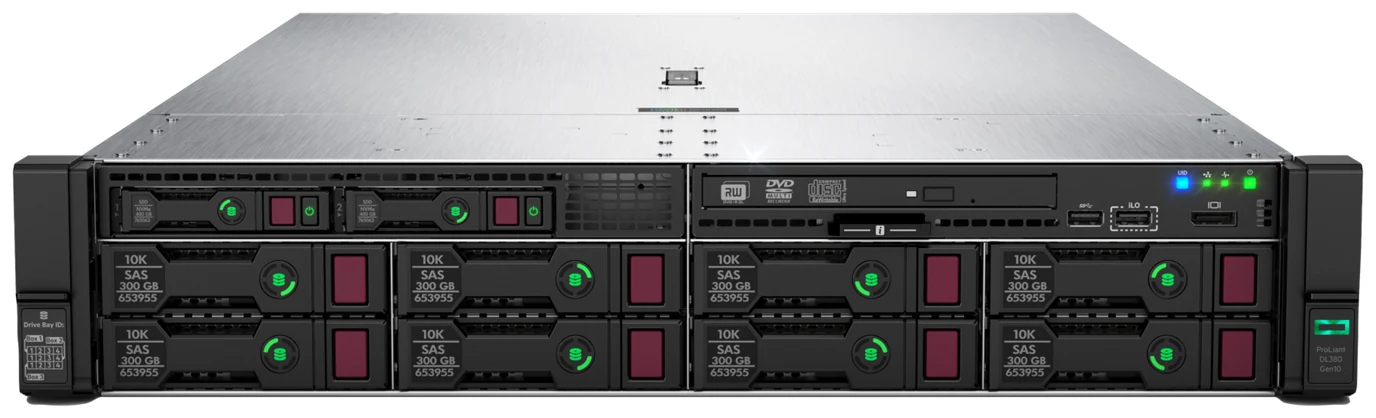
What are the specifications of the HPE ProLiant DL380 Gen10?
A 2U rack server on the Intel C621 chipset, taking one or two 1st or 2nd Generation Xeon Scalable processors, up to 28 cores apiece, with 24 DDR4 slots behind them that HPE rates to 3.0 TB, and a front built from drive-cage kits — up to 24 small-form-factor bays or 12 large ones, with rear and mid-tray options above that. Expansion runs to eight PCIe 3.0 slots across three risers, networking goes in a single FlexibleLOM bay, and management is iLO 5. Two hot-plug Flex Slot supplies run from 500 W to 2200 W.
How much memory can a DL380 Gen10 take?
The published ceiling is 3 TB, which means every slot carrying a 128 GB load-reduced module. Two catches sit behind it: version 77 has no LRDIMM kit to order against that row, and 1.5 TB per socket is reachable only on an M- or L-suffix processor, of which the table holds fifteen out of 113. Build it from registered memory instead and the top figure is 1.54 TB, using 64 GB modules throughout. All 24 slots exist only with both sockets populated: one processor gives you twelve.
How many drives does the DL380 Gen10 hold?
Thirty 2.5-inch drives at most — twenty-four at the front and six at the rear, which is the figure HPE prints in both its chassis list and its maximum-storage table. In large-form-factor shape the limit is nineteen 3.5-inch drives, twelve at the front plus a four-drive mid-tray and a three-drive rear box, with two 2.5-inch SSDs behind them. NVMe is capped at twenty drives because the machine runs out of PCIe lanes before the bays run out.
What is the difference between the DL380 Gen10 and the DL380 Gen10 Plus?
They are different servers that happen to share a name. This page covers the plain Gen10: 1st and 2nd Generation Xeon Scalable processors, 24 DDR4 slots, PCIe 3.0 risers and a FlexibleLOM network bay. The Gen10 Plus is a separate product with its own QuickSpecs, document a50002553enw, built on 3rd Generation Xeon Scalable. Nothing described here — the processor table, the memory ceiling, the slot count, the drive-cage kits — applies to that machine, and a quote for one is not a quote for the other.
Which processors does the DL380 Gen10 support?
HPE lists 113, split 41 first-generation and 72 second-generation, from four cores at 85 W up to twenty-eight at 205 W. The filter that matters in practice is the memory column: fifty of them are rated at DDR4-2933, while 41 stop at 2666, 18 at 2400 and four at 2133 regardless of what modules go in. Four parts are single-socket only, two different models cannot be mixed, and a first-generation chip cannot be upgraded to a second-generation one in the field.
How many PCIe slots and GPUs does the DL380 Gen10 take?
Up to eight PCIe 3.0 slots — three on the primary riser, three on the secondary and two on the tertiary — but the secondary and tertiary both need the second processor, so a one-socket machine has three. Twenty accelerators are listed, with supported quantities from two to eight: eight single-width A2 cards, seven T4s, five Quadro P2200 or RTX 4000, three of most double-width cards, and two of the A40, A30, A16, M10 and RTX 8000. Every GPU build needs the high-performance fan kit, models cannot be mixed, and the four-drive mid-tray excludes accelerators entirely.
Does the DL380 Gen10 support NVMe drives?
Yes, through SlimSAS risers that connect drives directly to the processors rather than through a RAID controller. The premium cage carries six SAS or SATA drives plus two NVMe, or eight SAS/SATA; the express bay kit makes a whole box NVMe. Twenty drives is the ceiling, since box 1 can only be partly filled once the other two boxes are full. All of it sits on PCIe 3.0, so a Gen4 SSD will work here but will go no faster than a Gen3 one.
Which power supplies does the DL380 Gen10 use?
Two hot-plug Flex Slot units. Working up the ordering section: 500 W Platinum, then 800 W in Platinum, in Titanium, as a −48 V DC model and as a universal AC/DC unit for 200–277 V, then two units at 1600 W — one Platinum, one −48 V DC — and at the top an 1800–2200 W Titanium whose output rises with the input voltage. For the UK and EU 96 % efficiency rule, the two Titanium units are the compliant parts on this server.
Is the HPE ProLiant DL380 Gen10 end of life?
Page one of the QuickSpecs is stamped with a retirement notice — HPE has taken the document out of service and withdrawn the hardware it covers from sale. That is an end of sale rather than an end of support — the date that governs a particular machine is the service entitlement recorded against its serial number, which our end-of-life checker records as the vendors publish it. Third-party maintenance covers the platform where HPE’s own contracts have lapsed.
Does Servnet sell the DL380 Gen10 new or refurbished?
Refurbished, and only refurbished. HPE stopped selling this 2017 platform some time ago, so each machine leaves us re-certified rather than new, built up in our refurbished ProLiant configurator and covered by a Servnet hardware warranty or by third-party maintenance, whichever suits. Send us the configuration you want and we will put a quote against it.