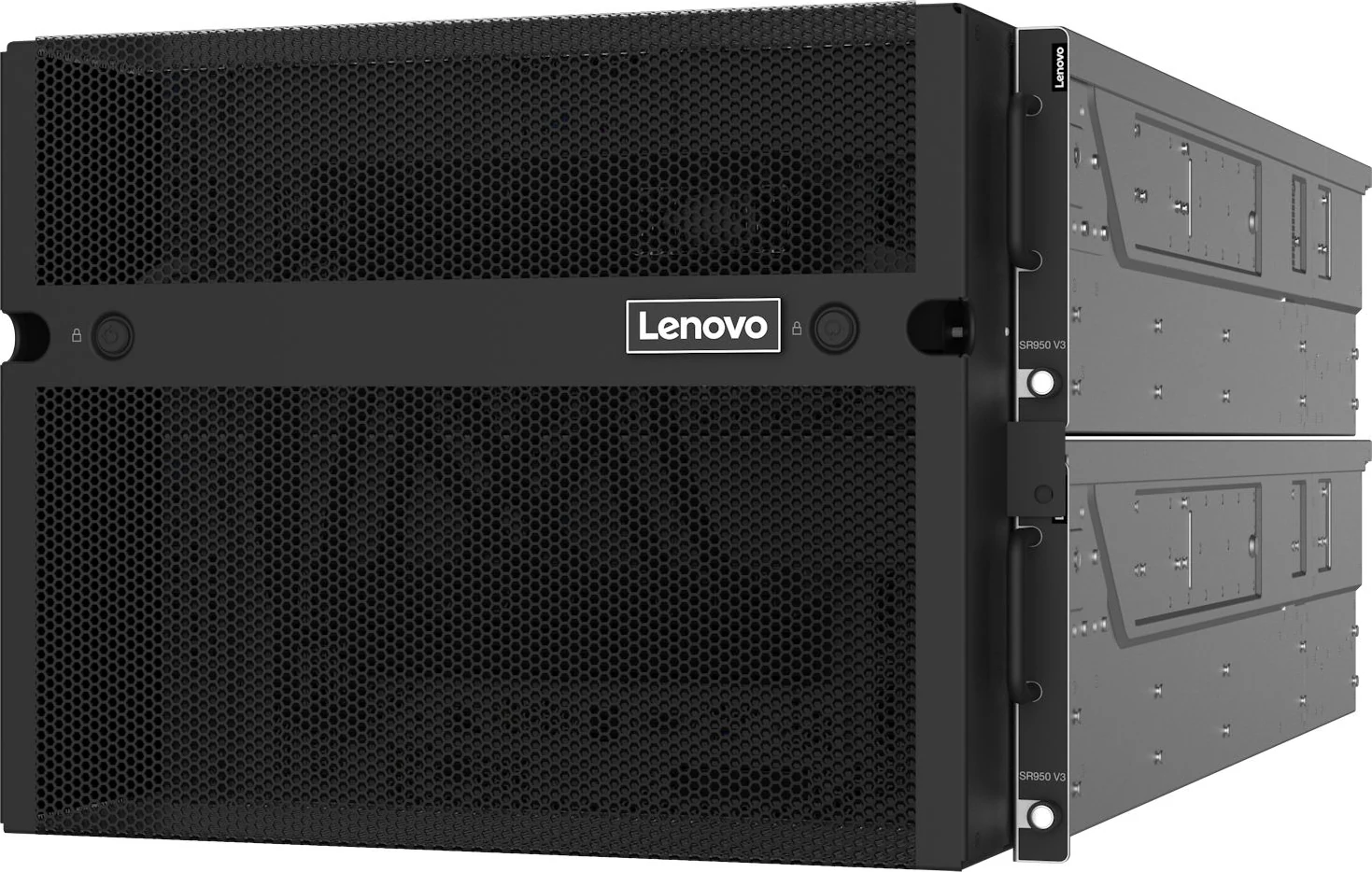
The ThinkSystem SR950 V3 is Lenovo’s eight-socket scale-up server: two 4U chassis cabled into one 8U system with eight 4th Gen Xeon Platinum processors, 128 DIMM slots and up to 32 TB of DDR5. It is aimed at SAP HANA, large transactional databases and analytics that want one very large memory space. This page maps its processors, memory rules, 16-bay storage, 14 PCIe slots and power.
Our read of Lenovo’s documentation: where the SR950 V3 is strong, and the limits worth knowing before you spec one.
Strengths
+Eight sockets in one 8U server: up to 480 cores and 128 DIMM slots, and the UPI mesh keeps every processor within one hop of every other.
+Lenovo quotes 32 TB of DDR5 — double the 16 TB ceiling of the four-socket SR860 V3.
+Up to 16 E3.S PCIe 5.0 NVMe drives connect directly to the processors through onboard connectors, with no retimer or switch cards, and Intel VROC provides RAID without an adapter.
+Six front PCIe 5.0 x16 slots are standard, and risers add up to eight more at the rear — all full-height, half-length.
+XCC2 Platinum is built in, so remote console, virtual media, power capping and an XClarity Energy Manager licence need no upgrade.
Watch-outs
!All eight processors are mandatory and must be identical — there is no four-socket starting point — and the choice is six Platinum H-series parts.
!No GPU support, no internal optical or tape drive, and no SAS adapter for external storage.
!Storage stops at 16 bays with no 2.5-inch NVMe option, and the 2.5-inch bays are listed for SAS and SATA SSDs only.
!The supplies need 200–240 V: 110 V is not supported, and a full build runs 12 of them.
!The 32 TB figure relies on 256 GB 3DS RDIMMs that the guide’s memory table does not list; the listed DIMMs stop at 16 TB.
Processors6 SKUs
Cores / CPU16–60
DIMM slots128
Backplanes2
Max bays16
PSU options1 · to 1,800 W
02 — Processors
6 supported processors, mapped
Lenovo supports six processors in the SR950 V3, all 4th Gen Xeon Scalable Platinum H-series parts, and every server takes exactly eight identical chips. They run from the 16-core, 2.9 GHz 8444H to the 60-core, 350 W 8490H, so a finished system has between 128 and 480 cores. All six are sold in factory (CTO) builds only.
Processor landscape — cores × TDP
6 SKUs · 1 family
4th Gen Xeon Scalable 6Bubble size = L3 cache · hover a bubble for the full SKU
Processor explorer
filter · sort · compare
Processor
Cores / threads
Base
L3 cache
TDP
W / core
Memory
Intel Xeon Platinum 8490H
60 / 120
1.9 GHz
112.5 MB
350 W
5.8
DDR5-4800
Intel Xeon Platinum 8468H
48 / 96
2.1 GHz
105 MB
330 W
6.9
DDR5-4800
Intel Xeon Platinum 8460H
40 / 80
2.2 GHz
105 MB
330 W
8.3
DDR5-4800
Intel Xeon Platinum 8454H
32 / 64
2.1 GHz
82.5 MB
270 W
8.4
DDR5-4800
Intel Xeon Platinum 8450H
28 / 56
2 GHz
75 MB
250 W
8.9
DDR5-4800
Intel Xeon Platinum 8444H
16 / 32
2.9 GHz
45 MB
270 W
16.9
DDR5-4800
Every listed SKU has four UPI 2.0 links at 16 GT/s, 80 PCIe 5.0 lanes and a 4800 MHz memory bus.
All six carry four DSA and four IAA engines; only the 8454H, 8468H and 8490H add four QAT and four DLB engines as well.
Each processor is cooled by a 2U heatsink plus two satellite heatsinks.
Lenovo marks five of the six as having more than its 1.875 MB-per-core L3 baseline; the 8490H is the exception.
For UK and EU orders Lenovo asks for the “Efficiency – Favoring Performance” UEFI preset (feature BFYE) to meet ErP Lot 9.
03 — Memory
128 DIMM slots, 16 per processor
Each of the eight processors has eight DDR5 channels with two sockets per channel — 16 DIMM slots per processor, 128 in total. Per processor, the permitted counts are 16, 12, 8, 6, 4, 2 or a single DIMM. One DIMM per channel runs at 4800 MT/s; populating the second socket in each channel lowers the rate to 4400 MT/s.
Capacity with every slot filled
by DIMM size
Operating speed
per Lenovo memory tables
Processor
1 DIMM / channel
2 DIMMs / channel
4th Gen Xeon Scalable (Platinum H)
4800 MT/s
4400 MT/s
Lenovo’s 32 TB maximum (4 TB per processor) assumes 128 × 256 GB 3DS RDIMMs, but the current memory table lists only 64, 96 and 128 GB RDIMMs — with those, 128 slots × 128 GB comes to 16 TB.
The 128 GB RDIMM (4X77A93887) is sold as a 5600 MHz part; in this server it is held to 4800 MHz.
RDIMMs and 3DS RDIMMs cannot be mixed, and 9x4 RDIMMs, UDIMMs and LRDIMMs are unsupported. The 64, 96 and 128 GB parts use 16Gb, 24Gb and 32Gb DRAM respectively, and DRAM densities cannot be combined.
A processor may carry at most two DIMM capacities; 128 GB and 256 GB 3DS RDIMMs may be combined only as eight of each per processor.
Memory mirroring needs identical pairs (at least one pair per processor) and leaves half the installed capacity usable.
04 — Storage
2 backplane options, up to 16 bays
All 16 drive bays are hot-swap and sit at the front of the two chassis, built from four 4-bay backplanes. Each backplane is either 2.5-inch SAS/SATA or E3.S 1T PCIe 5.0 NVMe, so there is no 2.5-inch NVMe option, and Lenovo lists SSDs only — no hard drives — for the 2.5-inch bays.
Headline layouts
front panel view
Front panel
Four 2.5-inch SAS/SATA backplanes, four bays each, driven by a RAID 940 adapter or 440-8i HBA in slot P1 or S1. With 30.72 TB SAS SSDs Lenovo puts the ceiling at 491.52 TB.
SAS/SATANVMeSAS/SATA + NVMe
Controllers & boot
Intel VROC RAID1 Only — Software RAID. Onboard NVMe - Intel VROC NVMe RAID; RAID 1 only (no RAID 0/10/5); Intel and non-Intel NVMe SSDs
Intel VROC (VMD NVMe RAID) Standard — Software RAID. Onboard NVMe - Intel VROC NVMe RAID; RAID levels: see Intel VROC section of the guide
Intel VROC (VMD NVMe RAID) Premium — Software RAID. Onboard NVMe - Intel VROC NVMe RAID; RAID levels: see Intel VROC section of the guide
The two backplane types can be combined only as one-and-two, two-and-one or two-and-two; a three-and-one split is not supported.
Lenovo describes each NVMe drive as having a full, non-oversubscribed x4 link, but calls it PCIe Gen4 in one passage and Gen5 x4 in the controller section.
Boot is the M.2 NVMe 2-Bay RAID Adapter in the primary chassis: one or two NVMe drives on a Marvell 88NR2241 controller (RAID 0 or 1), each on a PCIe 3.0 x1 link. The four onboard M.2 connectors are reserved and unsupported.
Under ESXi, VROC NVMe RAID is limited to RAID 1; Windows and Linux get RAID 0, 1, 5 and 10, with RAID 5 requiring the Premium licence. Self-encrypting drive functions are not available with VROC NVMe RAID.
Field upgrades to M.2 also need the SR950 V3 M.2 NVMe Cable Option Kit (4XH7A91520).
Every documented backplane
2 with drive bays
2.5-inch3.5-inchEDSFF (E1.S / E3.S)
05 — I/O & networking
PCIe and networking
I/O topology
80 lanes per CPU
The eight processors form a mesh: each has four UPI links, two to partners in its own chassis and two to processors in the other one, so any processor is at most one hop from any other. Links between the chassis run over eight UPI cables across the front of the server.
The primary (lower) chassis holds the Intel C741 PCH, which serves the M.2 boot adapter and every front port.
Rear risers are optional and fill in the order P7/P8, P5/P6, S7/S8, S5/S6. Lenovo’s generation-comparison table still describes the rear slots as Gen4, while the riser table also lists a Gen5 kit (4XC7B02609).
The optional second XCC2 management port occupies slot P5 even though it takes no signals from the PCIe connector.
RAID adapters and the HBA go only in front slots P1 and S1, two at most; the OCP card needs the OCP Adapter Enablement Kit.
Every listed PCIe network and Fibre Channel adapter, up to the ConnectX-7 NDR200/200GbE card, is supported in any of the 14 slots. Lenovo also describes the server as CXL 1.1 ready.
06 — Power & cooling
1 power supply, 1,800 W
Power comes from 1800 W 80 PLUS Titanium hot-swap supplies — 8 or 12 of them, four or six per chassis — running N+N inside each chassis. They need 200–240 V AC; 110 V is not supported.
AC
With eight supplies, the upper four power-supply bays of each chassis are used.
The supplies take C13 inlets. Lenovo’s rear photograph shows C19 sockets, which the guide says do not apply to the current 1800 W unit.
Maximum inlet current per supply is 9.7 A at 200 V AC and 8.7 A at 220 V AC; the China-only DC input (180–300 V) is rated 8.3 A at 240 V DC.
Cooling is 24 dual-rotor 60 mm simple-swap fans, 12 per chassis in six two-fan modules; each chassis can lose two rotors and keep running. Each supply has its own fan as well.
Zero-output (standby) mode is not supported on these supplies.
07 — Management, security & OS
Run it, secure it, choose the OS
Management
XClarity Controller 2 on an ASPEED AST2600 BMC, with the Platinum feature level standard
Remote KVM, virtual media, boot capture and power capping included
Front RJ45 XCC2 port · optional second port (Rear Management NIC Adapter Kit, slot P5)
Lenovo’s guide compares the SR950 V3 with the original ThinkSystem SR950. The move to 4th Gen Xeon more than doubles the core count, memory moves to DDR5, PCIe to Gen5 and the supplies to Titanium, while the maximum bay count falls from 24 to 16. Table 2 gives the V3 up to 4 GB of RAID flash, although its controller table also lists a RAID 940-8i with 8 GB.
Previous generationThinkSystem SR950
This modelThinkSystem SR950 V3
Processors
Up to 8 × 2nd Gen Xeon Scalable · up to 28 cores · 205 W
8 × 4th Gen Xeon Scalable · up to 60 cores · 350 W
Cores per server
224
480
PCIe lanes per CPU
48 × PCIe 3.0
80 × PCIe 5.0
Memory
DDR4 to 2933 MHz · 6 channels per CPU · 96 DIMMs
DDR5 to 4800 MHz · 8 channels per CPU · 128 DIMMs
Maximum memory
24 TB
32 TB
Drive bays
Up to 24 × 2.5" (12 NVMe, PCIe Gen 3)
16 × 2.5" SAS/SATA or 16 × E3.S PCIe 5.0 NVMe
M.2 boot
2 × M.2 SATA, hardware RAID
2 × M.2 NVMe, hardware RAID
RAID adapter flash
Up to 8 GB
Up to 4 GB (Table 2; an 8 GB 940-8i is also listed)
Networking slot
LOM (PCIe 3.0 x16) + optional 2 × ML2
Optional OCP 3.0 (PCIe 4.0 x16), up to 25GbE
PCIe slots
Up to 17, all PCIe 3.0
Up to 14: 6 front Gen5 + 8 rear
GPUs
Not supported
Not supported
Management
XClarity Controller
XClarity Controller 2
Power supplies
Up to 4 · 1100–2000 W Platinum
Up to 12 · 1800 W Titanium
Source: Lenovo Press LP1729 (SR950 V3 product guide), Table 2 — Comparing the SR950 V3 to the SR950.
The SR950 V3 family side by side
The nearest relatives of the eight-socket SR950 V3 are Lenovo’s four-socket SR860 V3 (4U) and SR850 V3 (2U), which the Xeon 6 SR860 V4 and SR850 V4 succeed; the two-socket SR650 V3 is shown for scale. The bars compare limits from each model’s own spec file.
This modelSiblings and successorEach value from that model’s own verified spec file · bars scale per column
Four builds for workloads Lenovo names for this server, every part picked from the SR950 V3 options in our configurator. Each one carries the eight identical processors Lenovo requires; we confirm DIMM population, supply count and any SAP certification needs when we quote.
SAP HANA
16 TB in-memory database node
Eight 60-core 8490H processors with every one of the 128 slots holding a 128 GB RDIMM give 16 TB — the figure Lenovo quotes for its SAP HANA appliance on this server — plus eight E3.S NVMe drives for local capacity.
8 × Xeon Platinum 8490H — 60 cores @ 1.9 GHz, 350 W each
128 × 128 GB TruDDR5 RDIMM — 16 TB, two per channel (4400 MT/s)
8 × 7.68 TB E3.S PCIe 5.0 NVMe on two backplanes
Intel VROC Standard (NVMe RAID 0, 1, 10)
2 × 480 GB M.2 NVMe boot, RAID 1
ConnectX-6 Dx 2 × 100GbE QSFP56 PCIe adapter
1800 W Titanium supplies — 8 or 12 as the build requires
SUSE Linux Enterprise Server 15
SAP HANA systems are ordered on machine type 7DC6. Lenovo quotes 16 TB for its HANA appliance and 24 TB (96 × 256 GB) for TDI; going past 16 TB needs 256 GB 3DS RDIMMs, which the guide’s memory table does not currently list.
The 16-core, 2.9 GHz 8444H keeps the whole server at 128 cores — the fewest this chassis can have — for engines licensed per core, while 64 × 96 GB RDIMMs give 6 TB at the full one-per-channel 4800 MT/s.
8 × Xeon Platinum 8444H — 16 cores @ 2.9 GHz, 270 W each
64 × 96 GB TruDDR5 RDIMM — 6 TB, one per channel (4800 MT/s)
16 × 15.36 TB E3.S PCIe 5.0 NVMe across four backplanes
Intel VROC Premium — adds NVMe RAID 5
2 × 480 GB M.2 NVMe boot, RAID 1
ConnectX-6 Lx 2 × 25GbE OCP 3.0
1800 W Titanium supplies — 8 or 12 as the build requires
Windows Server 2025 Datacenter
Lenovo advises keeping each VROC array on drives attached to a single processor; arrays that span processors perform unpredictably.
Eight 48-core 8468H processors (384 cores) and 8 TB across all 128 slots suit very large virtual machines. Lenovo drives the 2.5-inch SAS/SATA bays from RAID adapters or HBAs rather than VROC, so a RAID 940 gives the SAS SSD datastore hardware RAID.
8 × Xeon Platinum 8468H — 48 cores @ 2.1 GHz, 330 W each
128 × 64 GB TruDDR5 RDIMM — 8 TB, two per channel (4400 MT/s)
8 × 3.84 TB SAS SSD on two 4-bay backplanes
RAID 940-8i with 8 GB flash cache
2 × 480 GB M.2 NVMe boot, RAID 1
Intel E810-DA4 4 × 25GbE PCIe adapter
1800 W Titanium supplies — 8 or 12 as the build requires
VMware ESXi 8.0
The RAID 940 fits only slot P1 or S1 and needs a supercap, which mounts in the CPU-board air baffle.
The 32-core 8454H is the smallest SR950 V3 processor that adds QAT and DLB engines to the DSA and IAA units every SKU has. Eight of them, 12 TB of memory, 16 NVMe drives and 200 Gb networking suit large in-memory analytics.
8 × Xeon Platinum 8454H — 32 cores @ 2.1 GHz, 270 W each
128 × 96 GB TruDDR5 RDIMM — 12 TB, two per channel (4400 MT/s)
16 × 7.68 TB E3.S PCIe 5.0 NVMe across four backplanes
Intel VROC Standard (NVMe RAID 0, 1, 10)
2 × 480 GB M.2 NVMe boot, RAID 1
NVIDIA ConnectX-7 2 × NDR200/200GbE PCIe Gen5
1800 W Titanium supplies — 8 or 12 as the build requires
6 × front FHHL PCIe 5.0 x16 (standard) + up to 8 × rear FHHL x16 on Gen4 or Gen5 risers
OCP
1 × OCP 3.0 SFF, PCIe 4.0 x16, adapters up to 25GbE (enablement kit required)
Fibre Channel
Emulex LPe35002 and QLogic QLE2772 32Gb
External SAS
Not supported
GPU
Not supported
CXL
CXL 1.1 ready
Power
Supplies
8 or 12 × 1800 W Titanium hot-swap (4 or 6 per chassis), N+N within each chassis
Input
200–240 V AC (no 110 V) · 180–300 V DC in China only
Connector
C13
Inlet current per supply
9.7 A at 200 V AC · 8.7 A at 220 V AC
Ports & video
Front
VGA · 2 × USB 3.2 Gen 1 · USB 2.0 (XCC) · DB-9 serial · RJ-45 XCC · diagnostics port
Rear
No ports
Internal
USB 3.1 · MicroSD slot for XCC2
Video
16 MB, integrated in XCC2 · up to 1920 × 1200 at 60 Hz
Environment & warranty
ASHRAE
Class A2 in most configurations; A3, A4 or H1 depending on configuration
Operating temperature
10–35 °C (A2)
Maximum altitude
3,050 m
Acoustics (LpAm)
57.3 dBA idle · 61.9 dBA operating
Warranty
1 or 3 years by machine type · CRU and onsite, 9 × 5 next business day
11 — FAQ
SR950 V3 questions, answered from the documentation
What is the maximum memory of the Lenovo ThinkSystem SR950 V3?
Lenovo quotes 32 TB: 128 slots filled with 256 GB 3DS RDIMMs, or 4 TB per processor. The guide’s current memory table lists only 64, 96 and 128 GB RDIMMs, and with the largest of those the server reaches 16 TB.
Can the SR950 V3 run with fewer than eight processors?
No. Lenovo requires all eight sockets to be populated with identical processors. The choice is six 4th Gen Xeon Platinum H-series parts from 16 to 60 cores, so a server has 128 to 480 cores.
How is the SR950 V3 built physically?
It is two 4U chassis, primary and secondary, joined by eight UPI cables and two sideband cables at the front to make one 8U system. Each chassis measures 443 × 175 × 973 mm, weighs up to 50 kg and ships in its own box.
How many drives does the SR950 V3 hold?
Sixteen hot-swap front bays, made up of four 4-bay backplanes that are either 2.5-inch SAS/SATA or E3.S 1T PCIe 5.0 NVMe. The types can be mixed only in one-and-two, two-and-one or two-and-two combinations, and there is no 2.5-inch NVMe option. Two M.2 NVMe boot drives sit on a separate RAID adapter.
Does the SR950 V3 support GPUs?
No. Lenovo lists no GPU support for the SR950 V3, as it did for the original SR950. The adapters it lists for the slots are network, Fibre Channel and storage controllers.
How many PCIe slots does the SR950 V3 have?
Up to 14 plus an OCP 3.0 slot. Six full-height, half-length PCIe 5.0 x16 slots at the front are standard, and up to eight more x16 slots at the rear come on four optional 2-slot risers, in Gen4 or Gen5 versions.
What power does the SR950 V3 need?
Eight or twelve 1800 W Titanium hot-swap supplies, four or six per chassis, redundant N+N within each chassis. They take 200–240 V AC through C13 inlets — 110 V is not supported — and draw up to 9.7 A each at 200 V.
Is the SR950 V3 suitable for SAP HANA?
Lenovo positions it for SAP HANA and offers a dedicated machine type, 7DC6, for HANA configurations. The guide quotes up to 16 TB for a HANA appliance and 24 TB (96 × 256 GB) for TDI deployments.
How does the SR950 V3 differ from the SR860 V3?
The SR860 V3 is a 4U server with two or four sockets, 64 DIMM slots and a 16 TB memory ceiling, and it takes up to eight single-wide (or four double-wide) GPUs and 48 × 2.5-inch drives. The SR950 V3 doubles the sockets and memory ceiling but has no GPU support and 16 bays.
Is the Lenovo ThinkSystem SR950 V3 end of life?
Lenovo’s product guide still lists current processor, memory and option ordering information for the SR950 V3 and gives no end-of-service date. The machine type sets a one- or three-year base warranty, which Lenovo Services can extend by a further one or two years; our end-of-life checker tracks any dates Lenovo publishes.
Sources & verification
Where these figures come from
Lenovo ThinkSystem SR950 V3 Server Product Guide (publication date is not printed in the text export) — Standard specifications (Table 3), SR950 V3 vs SR950 (Table 2), processors (Tables 5–6), memory (Table 8 and rules), backplanes, M.2 and controllers (Tables 9–15), drives (Tables 16–19), I/O and risers (Tables 22–27), cooling (Table 28), power (Tables 29, 43), security, OS support, dimensions (Table 42) and operating environment.
Specifications are extracted from Lenovo’s published documents and independently re-checked line by line. Configurations are quote-based; availability and exact options are confirmed at quotation. Last reviewed 2026-09-11.