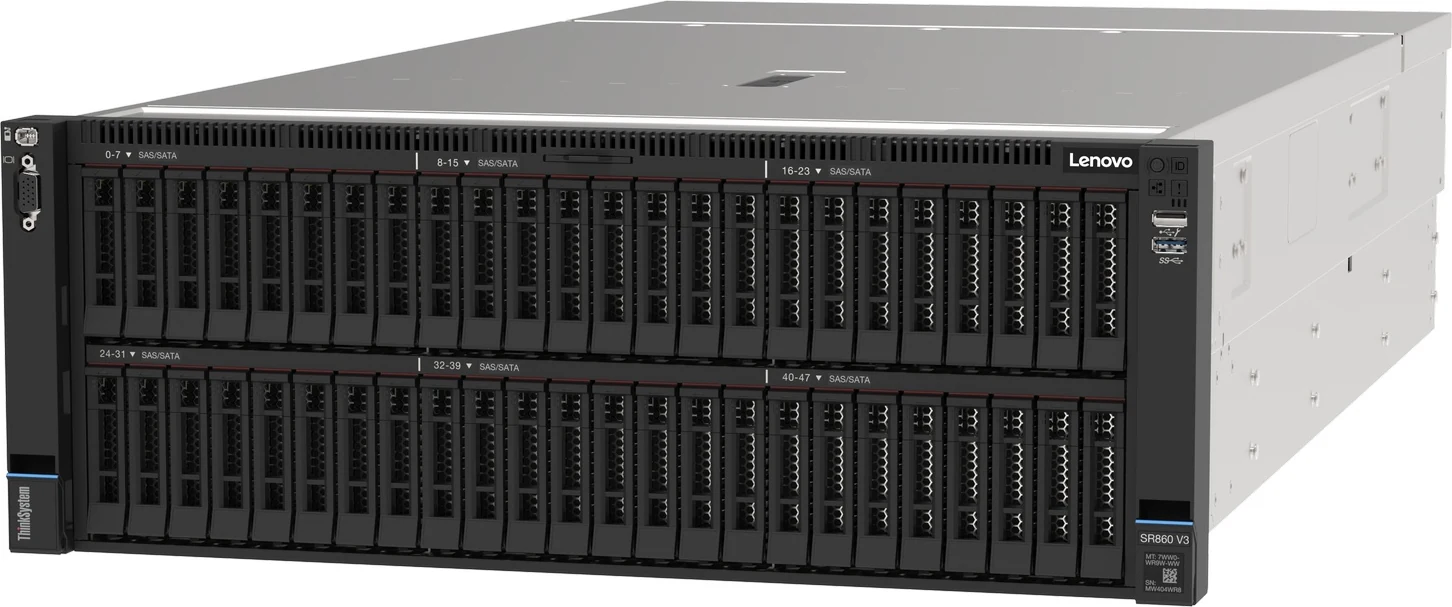
The ThinkSystem SR860 V3 takes four 4th Gen Intel Xeon Scalable processors and spends 4U of rack height on room: 48 front drive bays, up to 18 PCIe slots, four power supplies and space for four double-wide GPUs. It suits SAP HANA, large transactional databases, analytics and GPU-assisted work, and this page lays out the rules behind each of those limits.
4U Rack2 or 4 sockets4th Gen Xeon ScalableXClarity Controller 2
Our read of Lenovo’s documentation: where the SR860 V3 is strong, and the limits worth knowing before you spec one.
Strengths
+Forty-eight front bays in one chassis: all SAS/SATA, or 24 SAS/SATA plus 24 AnyBay with each AnyBay bay on its own Gen5 x4 NVMe link.
+Up to 18 PCIe slots (all Gen4), or 16 with twelve at Gen5, plus two OCP 3.0 slots — room for GPUs, storage HBAs and NICs at the same time.
+Four double-wide GPU positions (slots 4, 6, 16 and 18) or eight single-wide ones, and Lenovo lists an NVLink 2-slot bridge for adjacent pairs.
+Up to four hot-swap supplies in N+1 or N+N, and twelve fans in six hot-swap modules.
+The same ten processors, 64 DIMM slots and standard XCC2 Platinum as the 2U SR850 V3, with a DB-9 serial port fitted on every server.
Watch-outs
!GPU servers must be ordered on base BT2K; its winged rear heatsinks hold double-wide and full-length builds to processors of 270 W or less, and the standard base cannot be converted later.
!Lenovo’s GPU table lists only the single-wide NVIDIA L4 and an NVLink bridge — no double-wide card has a part number, despite the four double-wide positions.
!Two-processor servers drop to ten slots (counting both OCP), 32 DIMMs, eight NVMe drives and two double-wide or four single-wide GPUs.
!A full 48-drive front tightens thermals: 35 °C inlet with standard heatsinks and processors up to 350 W, 30 °C with performance heatsinks or any GPU.
!The 1100 W supplies are supported only as a set of four; a two-supply server needs 1800 W units or larger.
Processors10 SKUs
Cores / CPU8–60
DIMM slots64
Backplanes3
Max bays48
GPUsup to 8
PSU options11 · to 2,700 W
02 — Processors
10 supported processors, mapped
Processor choice is identical to the 2U SR850 V3 — ten H-series Gold and Platinum SKUs of the 4th Gen Xeon Scalable line, ranging from eight cores (Gold 6434H) to sixty (Platinum 8490H). Two or four are installed; a full set of four is meshed together by three 16 GT/s UPI links per chip.
Processor landscape — cores × TDP
10 SKUs · 1 family
4th Gen Xeon Scalable 10Bubble size = L3 cache · hover a bubble for the full SKU
Processor explorer
filter · sort · compare
Processor
Cores / threads
Base
L3 cache
TDP
W / core
Memory
Intel Xeon Platinum 8490H
60 / 120
1.9 GHz
112.5 MB
350 W
5.8
DDR5-4800
Intel Xeon Platinum 8468H
48 / 96
2.1 GHz
105 MB
330 W
6.9
DDR5-4800
Intel Xeon Platinum 8460H
40 / 80
2.2 GHz
105 MB
330 W
8.3
DDR5-4800
Intel Xeon Platinum 8454H
32 / 64
2.1 GHz
82.5 MB
270 W
8.4
DDR5-4800
Intel Xeon Gold 6448H
32 / 64
2.4 GHz
60 MB
250 W
7.8
DDR5-4800
Intel Xeon Platinum 8450H
28 / 56
2 GHz
75 MB
250 W
8.9
DDR5-4800
Intel Xeon Gold 6418H
24 / 48
2.1 GHz
60 MB
185 W
7.7
DDR5-4800
Intel Xeon Gold 6416H
18 / 36
2.2 GHz
45 MB
165 W
9.2
DDR5-4800
Intel Xeon Platinum 8444H
16 / 32
2.9 GHz
45 MB
270 W
16.9
DDR5-4800
Intel Xeon Gold 6434H
8 / 16
3.7 GHz
22.5 MB
195 W
24.4
DDR5-4800
Heatsinks follow the chassis base: the standard base (BT2J) fits four standard heatsinks, while the GPU base (BT2K) pairs two standard front heatsinks with two low-profile winged ones at the rear.
With double-wide GPUs or full-length adapters, the winged heatsinks restrict processors to 270 W or less, which rules out the 8460H, 8468H and 8490H.
A three-processor build is possible only by special bid.
Two SKUs carry conflicting TDPs in this guide too — the 6434H at 205 W (ordering) versus 195 W (features), the 6448H at 225 W versus 250 W; the explorer follows the features table.
03 — Memory
64 DIMM slots, 16 per processor
Sixty-four DDR5 slots — sixteen per processor across eight channels — take registered modules at 4800 MT/s with one per channel or 4400 MT/s with two. Fit only two processors and half the slots, 32, are usable, for an 8 TB ceiling.
Capacity with every slot filled
by DIMM size
Operating speed
per Lenovo memory tables
Processor
1 DIMM / channel
2 DIMMs / channel
4th Gen Xeon Scalable (H-series)
4800 MT/s
4400 MT/s
Sixteen terabytes is Lenovo’s figure for 64 × 256 GB 3DS RDIMMs, but the SR860 V3 memory table lists no 3DS part numbers; its largest listed module, the 128 GB RDIMM, fills 64 slots to 8 TB. We check 3DS availability when quoting.
The SR860 V3 memory rules carry no backplane limit for large DIMMs, unlike the SR850 V3’s; Lenovo instead sets inlet-temperature limits for fully populated 48-drive servers.
Supported DIMM counts per processor are 1, 2, 4, 6, 8, 12 and 16, and 96 GB modules go in only as eight or sixteen.
The 128 GB RDIMM (4X77A93887) is rated 5600 MHz but runs at up to 4800 MHz here; 128 GB and 256 GB 3DS modules can be mixed only eight-and-eight per processor.
ADDDC and SDDC require 10x4 modules, and 9x4 modules cannot be mirrored.
04 — Storage
3 backplane options, up to 48 bays
Six 8-bay backplanes fill the 4U front with 48 hot-swap 2.5-inch bays. Any of them can be SAS/SATA and up to three can be AnyBay, so the NVMe count tops out at 24 — each drive on a direct Gen5 x4 link with no retimer. The layouts below come from Lenovo’s supported-combinations table.
Headline layouts
front panel view
Front panel
Six SAS/SATA backplanes (BT3A): 48 SAS or SATA drives, supported with two or four processors.
SAS/SATANVMeSAS/SATA + NVMe
Controllers & boot
Intel VROC RAID1 Only — Software RAID. Onboard NVMe - Intel VROC NVMe RAID; RAID 1 only (no RAID 0/10/5); Intel and non-Intel NVMe SSDs (Table 20)
Intel VROC (VMD NVMe RAID) Standard — Software RAID. Onboard NVMe - Intel VROC NVMe RAID; RAID levels: see Intel VROC section of the guide
Intel VROC (VMD NVMe RAID) Premium — Software RAID. Onboard NVMe - Intel VROC NVMe RAID; RAID levels: see Intel VROC section of the guide
RAID 940-8i 4GB Flash PCIe Gen4 12Gb Adapter — RAID, 4GB cache. NVMe Adapters; Tri-Mode (U.3 NVMe x1) usage of the same adapter, separate feature code
RAID 940-8i 8GB Flash PCIe Gen4 12Gb Adapter — RAID, 8GB cache. NVMe Adapters; Tri-Mode (U.3 NVMe x1) usage of the same adapter, separate feature code
RAID 940-16i 4GB Flash PCIe Gen4 12Gb Adapter — RAID, 4GB cache. NVMe Adapters; Tri-Mode (U.3 NVMe x1) usage of the same adapter, separate feature code
RAID 940-16i 8GB Flash PCIe Gen4 12Gb Adapter — RAID, 8GB cache. NVMe Adapters; Tri-Mode (U.3 NVMe x1) usage of the same adapter, separate feature code
ThinkSystem 440-16e SAS/SATA PCIe Gen4 12Gb HBA — HBA. External SAS HBA (JBOD to external enclosures/tape), part 4Y37A09724 feature B8P7 - lp1606 L2199
A two-processor server supports at most eight NVMe drives.
RAID adapters with 8, 16 or 32 ports and up to 8 GB of flash are listed, so one controller can serve 32 drives.
Boot drives go on an internal M.2 module or on two rear 7mm hot-swap drives carried by a 7mm-capable Riser 3, in place of slot 20 in the 18- and 16-slot layouts. M.2 and 7mm share connectors and are never fitted together.
Intel VROC adds RAID on the onboard NVMe connections, including M.2 or 7mm boot drives, without an adapter.
No 3.5-inch bays are offered.
Every documented backplane
2 with drive bays
2.5-inch3.5-inchEDSFF (E1.S / E3.S)
05 — Accelerators & I/O
GPUs, PCIe and networking
GPUs need the BT2K base, built in the factory with full-length slots and winged rear heatsinks. The chassis then offers eight single-wide positions (slots 3–6 and 15–18) or four double-wide ones (slots 4, 6, 16 and 18). Lenovo’s table lists the NVIDIA L4 — up to eight, Controlled, at x8 in slots 3, 5, 15 and 17 — and a 2-slot NVLink bridge, three per GPU pair. Up to 8 × single-wide or 4 × double-wide GPUs (base BT2K); 2 double-wide or 4 single-wide with two processors.
NVIDIA L4 24GB PCIe Gen4 Passive GPU
single-wide
24GB · up to 8
I/O topology
80 lanes per CPU
All slots come from three risers. Riser 1 (slots 3–8) and Riser 3 (slots 15–20) are full-height and hold the double-wide GPU positions; Riser 2 (slots 9–14) is half-height. Each slot is wired to a specific processor, so a two-processor server keeps only part of the set. Two OCP 3.0 slots, one on CPU 1 and one on CPU 2, sit below the risers.
An entry layout with four Gen4 x8 slots (7, 8, 19 and 20) suits servers that need little expansion.
With two processors the usable slots are 3, 6, 8, 11, 14, 15, 18 and 20, plus both OCP slots.
Slots 3, 5, 15 and 17 are lost when the neighbouring slot holds a double-wide GPU.
Every x8 slot has a full-size x16 connector, but only eight lanes are wired.
Rear 7mm boot bays replace slot 20 in the 18- and 16-slot layouts.
06 — Power & cooling
11 power supplies, 1,100–2,700 W
Up to four hot-swap supplies can be fitted, all of the same wattage, for N+1 or N+N redundancy. The 1800, 2400 and 2600 W units run as two or four, but the 1100 W supplies — Titanium or Platinum — are supported only as four, and the 1100 W Platinum is the only one of these that accepts 115 V.
AC277 VAC / HVDC−48 V DC
PSU handles stand 871 mm behind the rack flange with 1100 W or smaller supplies, 899 mm with 1800 W units and 925 mm with 2400 W units.
1100 W and 1800 W supplies use C13 cords; 2400 W and 2600 W units use C19.
China-only CRPS options: 1300 W and 2700 W Platinum AC, and 1600 W for 336 V HVDC or −48 V DC.
Twelve 60 mm dual-rotor fans sit in six hot-swap two-fan modules with N+1 redundancy; Lenovo allows a module, and so two fans, to be out briefly while a fan is replaced.
Standby (zero-output) mode is not available.
07 — Management, security & OS
Run it, secure it, choose the OS
Management
XClarity Controller 2 (XCC2) on an ASPEED AST2600 BMC
XCC2 Platinum standard — it does not appear as a separate line in Lenovo’s DCSC configurator
Dedicated rear 1GbE XCC port · optional Redundant System Management Port Adapter
Rear DB-9 serial port, shareable with XCC for serial redirection
XClarity Provisioning Manager (UEFI, F1 at boot)
XClarity One, XClarity Integrator and XClarity Energy Manager
System Guard can be switched on in the factory (CTO orders)
Optional External Diagnostics Handset · XClarity Mobile over front USB 2.0
Security
Platform Firmware Resiliency hardware Root of Trust (NIST SP 800-193)
TPM 2.0 on the Root of Trust module
UEFI Secure Boot, set in the factory or by the customer
Enterprise Strict Security mode (CNSA 1.0) with XCC2 Platinum
Intel TDX, SGX and TME/MKTME
Self-encrypting drives with KMIP key management (IBM SKLM)
Chassis intrusion switch (standard on some models) · lockable top cover
NIST SP 800-147B compliant
Operating systems
Microsoft Windows Server 2019, 2022 and 2025
Red Hat Enterprise Linux 8.6 through 10.2
SUSE Linux Enterprise Server 15 SP4–SP7 and 16
Ubuntu 20.04, 22.04, 24.04 and 26.04 LTS
VMware ESXi 7.0 U3 to 9.1 · factory preload for CTO orders
08 — Compare
SR860 V2 → SR860 V3 → SR860 V4
The SR860 V3 guide compares it with the SR860 V2, and the SR860 V4 guide compares the V4 with it. Across the three, the 4U layout and the 48-bay 2.5-inch front stay put; what changes is the processor, memory type and speed, the slot mix, the NVMe count (up to 32 with the V4’s E3.S option) and the management controller.
Within Lenovo’s four-socket V3 range the SR860 V3 is the 4U option, with the most drive bays, slots and GPU room. The SR850 V3 packs the same four sockets and 64 DIMMs into 2U, the SR950 V3 goes to eight sockets, the SR650 V3 is the two-socket 2U alternative, and the SR860 V4 carries the design to Xeon 6.
This modelSiblings and successorEach value from that model’s own verified spec file · bars scale per column
Head-to-head comparisons
Every figure on this page, set against the machines buyers weigh it up with.
Four configurations that use what the 4U chassis adds — bays, slots and GPU room — each restricted to parts our configurator accepts for the SR860 V3. Every one opens in the configurator for editing; Lenovo’s base, heatsink and ambient conditions are verified for the final build at quotation.
AI inference & analytics
Eight-GPU inference server
Eight NVIDIA L4 cards — the single-wide maximum — alongside four 32-core Platinum 8454H processors, which stay within the 270 W limit set by the GPU base’s winged heatsinks. 2 TB of memory and eight NVMe drives complete a dense inference or analytics node.
4 × Xeon Platinum 8454H — 32 cores @ 2.1 GHz, 270 W each
8 × NVIDIA L4 24 GB, single-wide
32 × 64 GB TruDDR5 — 2 TB, one DIMM per channel
8 × 7.68 TB NVMe U.3 on one AnyBay backplane
2 × 480 GB M.2 boot
Broadcom 57508 2 × 100GbE OCP 3.0
2 × 2600 W Titanium
Ubuntu Server 24.04 LTS
Only a BT2K base, specified at the factory, accepts GPUs, and Lenovo restricts the Controlled L4 to its “for AI” CTO models. L4 cards in slots 3, 5, 15 and 17 run at x8, and more than four single-wide cards need all four processors.
Four 60-core Platinum 8490H processors bring 240 cores and 480 threads for consolidating large numbers of virtual machines, with all 64 slots holding 64 GB DIMMs for 4 TB at the two-per-channel rate of 4400 MT/s.
4 × Xeon Platinum 8490H — 60 cores @ 1.9 GHz, 350 W each
64 × 64 GB TruDDR5 — 4 TB, two DIMMs per channel at 4400 MT/s
8 × 3.84 TB NVMe U.3 on an AnyBay backplane
8 × 1.92 TB SATA SSD on a SAS/SATA backplane, RAID 940-8i with 4 GB flash
2 × 480 GB M.2 boot
Intel E810-DA4 4 × 25GbE OCP 3.0
2 × 2600 W Titanium
VMware ESXi 8.0
With no GPUs this build can use the standard BT2J base, which cannot be converted to take GPUs later. Even with every one of the 48 bays filled, Lenovo keeps standard-heatsink servers at a 35 °C inlet limit.
Four 16-core Platinum 8444H processors at 2.9 GHz keep the total at 64 cores, and 32 × 96 GB DIMMs give 3 TB at one per channel. Eight SAS SSDs sit on a 32-port RAID 940 with 8 GB of flash, with ports to spare for further SAS/SATA backplanes, and eight NVMe drives run direct to the processors.
4 × Xeon Platinum 8444H — 16 cores @ 2.9 GHz, 270 W each
32 × 96 GB TruDDR5 — 3 TB, one DIMM per channel
8 × 3.84 TB SAS SSD on a SAS/SATA backplane, RAID 940-32i with 8 GB flash cache
8 × 3.84 TB NVMe U.3 on an AnyBay backplane
2 × 480 GB M.2 boot
NVIDIA ConnectX-6 Lx 2 × 25GbE OCP 3.0
2 × 1800 W Titanium
Windows Server 2025 Datacenter
96 GB RDIMMs must be installed eight or sixteen per processor.
Four 48-core Platinum 8468H processors with every slot holding a 128 GB RDIMM — 8 TB, the most Lenovo’s listed modules reach — for in-memory analytics. Lenovo keeps a dedicated SAP HANA machine type (7D95) for this server.
4 × Xeon Platinum 8468H — 48 cores @ 2.1 GHz, 330 W each
64 × 128 GB TruDDR5 — 8 TB, two DIMMs per channel at 4400 MT/s
8 × 3.84 TB NVMe U.3 on one AnyBay backplane
2 × 480 GB M.2 boot
Intel E810-DA2 2 × 25GbE OCP 3.0
2 × 2600 W Titanium
SUSE Linux Enterprise Server 15 SP5
Reaching Lenovo’s 16 TB figure needs 256 GB 3DS RDIMMs, which the SR860 V3 memory table does not list; we confirm availability when quoting.
None of the servers in our refurbished configurator has four sockets or 48 bays, and Lenovo ThinkSystem is not offered there. When a two-processor SR860 V3 — 32 DIMMs, 8 TB, up to four single-wide GPUs — would be enough, a DDR4-generation Dell or HPE 2U is the practical re-certified substitute.
Gen10 Plus · re-certified
HPE ProLiant DL380 Gen10 Plus
2U · two sockets
32 DIMM slots · up to 8 TB DDR4
Up to 24 × SFF or 12 × LFF
DDR4-3200 · PCIe 4.0 · OCP 3.0 · iLO 5
The same 32-slot, 8 TB memory ceiling as a half-populated SR860 V3, with OCP 3.0 networking, for scale-up databases that fit in two sockets.
Up to 18 Gen4, or 12 Gen5 + 4 Gen4, or 4 Gen4 (entry)
OCP
2 × OCP 3.0 SFF, PCIe 5.0 x16 host interface
Serial
DB-9, standard
CXL
CXL 1.1 ready
Accelerators
GPU envelope
Up to 8 × single-wide or 4 × double-wide (base BT2K)
Listed parts
NVIDIA L4 24 GB (Controlled, up to 8) · NVIDIA Ampere NVLink 2-Slot Bridge
Double-wide rule
Processors of 270 W or less
Power
Supplies
Up to 4 hot-swap, N+1 or N+N, identical wattage
AC Titanium
1100 W (four only) · 1800 and 2600 W (two or four)
AC Platinum
1100 W 230 V / 115 V (four only) · 1800 and 2400 W (two or four)
China only
CRPS 1300 / 2700 W AC · 1600 W 336 V HVDC or −48 V DC
Ports & video
Front
VGA · 1 × USB 3.2 Gen 1 · 1 × USB 2.0 (XClarity Mobile) · external diagnostics port
Rear
3 × USB 3.2 Gen 1 · VGA · DB-9 serial · 1GbE XCC port
Video
16 MB, integrated in XCC2 · up to 1920 × 1200 at 60 Hz
Environment & warranty
ASHRAE
Class A2 in most configurations; A3, A4 or H1 depending on configuration
Operating temperature
10–35 °C (A2)
Maximum altitude
3,050 m
Warranty
1 or 3 years by machine type · CRU and onsite, 9 × 5 next business day
12 — FAQ
SR860 V3 questions, answered from the documentation
What is the maximum memory of the Lenovo ThinkSystem SR860 V3?
Sixteen terabytes, according to Lenovo: 64 slots of 256 GB 3DS RDIMMs across four processors. The guide’s memory table, though, stops at a 128 GB RDIMM, which gives 8 TB when all 64 slots are filled, so 3DS supply is confirmed at quotation. Two processors leave 32 slots and an 8 TB ceiling.
Which processors does the SR860 V3 support?
It uses the SR850 V3’s processor list unchanged: ten Gold and Platinum H-series chips of the 4th Gen Xeon Scalable family, with 8 to 60 cores and TDPs between 165 and 350 W. Servers ship with a pair or with all four sockets filled (three only on special bid), and four 8490H chips add up to 240 cores.
How many drives does the SR860 V3 hold?
Up to 48 × 2.5-inch hot-swap drives at the front on six 8-bay backplanes, of which up to three can be AnyBay — so at most 24 NVMe drives, each on a direct Gen5 x4 link. There are no 3.5-inch bays; boot drives go on internal M.2 or two rear 7mm bays.
How many GPUs does the SR860 V3 support?
Up to eight single-wide or four double-wide GPUs on the BT2K base, which has to be chosen at the factory. Double-wide builds are limited to processors of 270 W or less, and a two-processor server takes two double-wide or four single-wide cards. Lenovo’s current table lists the NVIDIA L4 and an NVLink bridge.
How many PCIe slots does the SR860 V3 have?
Up to 18 Gen4 slots, or 16 with twelve at Gen5, across three risers, plus two OCP 3.0 slots; an entry layout has four Gen4 slots. With two processors, eight riser slots and both OCP slots remain.
What power supplies does the SR860 V3 use?
As many as four hot-swap supplies, run as N+1 or N+N. Titanium ratings are 1100 W, 1800 W and 2600 W; Platinum ratings are 1100 W, 1800 W and 2400 W. The 1100 W supplies must be installed as a full set of four, while the larger ones work in twos or fours.
How big and heavy is the SR860 V3?
It is 4U — 447 mm wide (482 mm over the flanges), 175 mm high and 906 mm deep; measured from the rack flange, the supply handles reach 925 mm with 2400 W units. It weighs up to 59.4 kg.
How does the SR860 V3 differ from the SR850 V3?
The 2U SR850 V3 matches it on processor choice, DIMM count (64) and the 16 TB ceiling, but stops at 24 drive bays, up to 12 PCIe slots, two power supplies and four single-wide or two double-wide GPUs. The SR860 V3 spends two more rack units on 48 bays, 18 slots, four supplies and twice the GPU capacity.
What changed in the SR860 V4?
The SR860 V4 moves to Xeon 6700-series P-core processors of up to 86 cores, DDR5 up to 6400 MHz and CXL 2.0 memory. It adds an option of 32 E3.S 1T bays alongside 24 × 2.5-inch, makes 16 of its 18 slots Gen5, rates double-wide GPUs at 400 W instead of 350 W and uses XClarity Controller 3.
Is the Lenovo ThinkSystem SR860 V3 end of life?
The SR860 V3 product guide gives no end-of-life or end-of-service date and still presents its component tables as current options. Support beyond the base warranty is a matter of contract, and the end-of-life checker lists dates as Lenovo publishes them.
Sources & verification
Where these figures come from
Lenovo ThinkSystem SR860 V3 Server Product Guide (publication date is not printed in the text export) — Key features, SR860 V3 vs SR860 V2 (Table 2), standard specifications (Table 3), base models and heatsinks (Tables 4–6), processors (Tables 7–8) and two-processor and thermal rules, memory (Table 10) and rules, backplanes and drive combinations (Tables 11 and 13), 7mm drives (Table 16), slots and risers (Tables 33–34), GPUs (Table 40), cooling (Table 42), power supplies (Table 43), dimensions (Table 57), operating environment, security and OS support.
Specifications are extracted from Lenovo’s published documents and independently re-checked line by line. Configurations are quote-based; availability and exact options are confirmed at quotation. Last reviewed 2026-09-11.